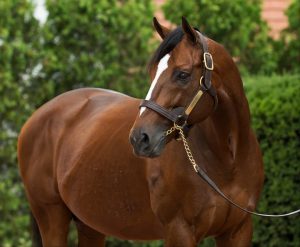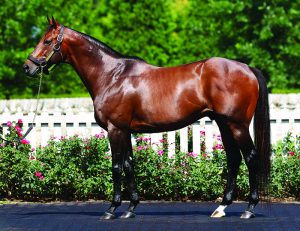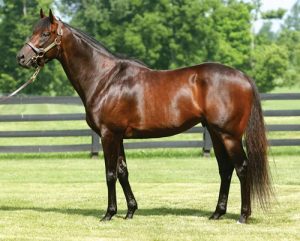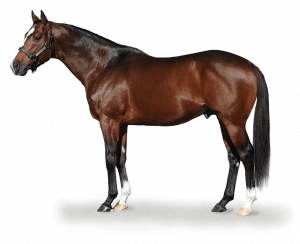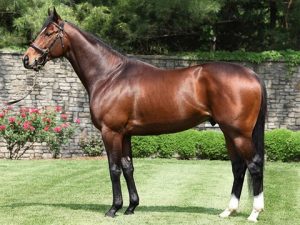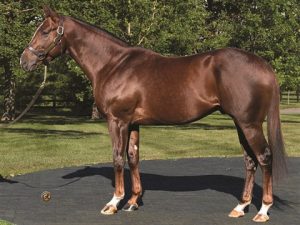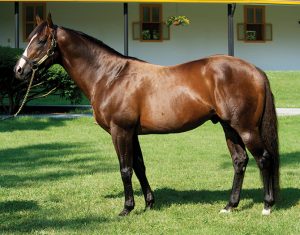
Breeders Cup Mile Winner Karakontie

When Gainesway debuted Karakontie in 2017, standing for $15,000, it was a fascinating and bold move. Bred in Japan, the young stud had an impeccable race record of Grade/Group 1 wins in France and North America, including the Breeders’ Cup Mile-G1, and earnings of just under two million dollars.

His pedigree, similarly, was stellar, by Bernstein, out of a granddaughter of the great Miesque, who herself won the Breeders’ Cup Mile-G1 twice, and had given birth to a wealth of talent including the great sire Kingmambo. Are you waiting for the huge “but” that’s coming? Here it is: but all Karakontie’s wins were on turf. A turf giant, standing in the land of the free and home of the dirt?

Gainesway has been rewarded for their courage, it would seem, as Karakontie had his first winner on Saturday, May 25, in a maiden special weight at Belmont, on the turf. Wesley Ward (who else?) put the two-year-old Karakontie filly Karak in against the boys, and she was victorious, taking the five furlong test easily, by three lengths, against her favored stablemate. Breeze Easy LLC bought Karak at the Ocala Breeders’ Sale in March for $365,000, after she breezed in 9.4 seconds, so the talent was clearly there. And getting her to Ward, who now has her aimed for Royal Ascot, was genius.

Karak’s pedigree also fascinates. Her broodmare sire, Mujadil, is by Storm Bird, out of a Secretariat mare, making him the mirror image of Bernstein’s renowned dad, Storm Cat. There is also a dose of Sir Gaylord, the sire of her third dam, making Karak triple-bred Somethingroyal, adding to the mare royalty provided by Miesque and her endlessly black-typed family. Karak sold for $22,000 as a weanling at Keeneland November 2017, giving J.C. Corp a huge pinhooking score.

But really, all the kudos go to Gainesway, the Beck family, and stallion manager Michael Hernon, for having the bravery and the foresight to stand this anomalous horse at their famed Lexington farm. With all of the injuries and fatalities to horses on dirt this year, Karakontie is a breath of fresh air.

— Roberta Smoodin

Honey Bunny and Monomoy Girl – Tapizar’s Girls

Rejoice, “Pulp Fiction” fans! Honey Bunny won the Winning Colors S.-G3 at Churchill Downs on May 25! The five-year-old mare by Tapizar, claimed in 2018 for $16,000, has now won her last five races in a row, and her first graded stakes, making her Tapizar’s fourth graded stakes winner.

The fourth crop sire, now ranked in eighth place on that list, stands at Gainesway Farm in Lexington, Kentucky, for $10,000, and is a stout, handsome son of Tapit who made waves last year when his brilliant Monomoy Girl was named Champion Three-Year-Old Filly, after winning a rash of Grade One stakes including the Breeders’ Cup Distaff, the CCA Oaks, the Acorn, the Kentucky Oaks and the Ashland, finishing second only once in G1 company in the Cotillion S. to Midnight Bisou (because of a DQ), and earning just under three million dollars.

But, wait a minute. When you look at Honey Bunny’s pedigree, doesn’t it ring a bell in your reptile brain? Because Honey Bunny and Monomoy Girl are bred so similarly it’s eerie, and provide insight into what works with Tapizar. Monomoy Girl is out or the Henny Hughes mare Drumette, whose great grandfather is Storm Cat, of course. Her second dam, Endless Parade, is by Williamstown, a son of Seattle Slew.

Honey Bunny is out of the Storm Cat mare Sennockian Storm, and her second dam is Winning Season, by Lemon Drop Kid. His dam is the Seattle Slew mare, Charming Lassie. So Honey Bunny has Storm Cat in the second position in her dams’ side, and Seattle Slew in the fifth position, while Monomoy Girl has Storm Cat in the fourth position on her dams’ side, and Seattle Slew in the fourth position.

This makes both Honey Bunny and Monomoy Girl inbred to Seattle Slew, on the zigzag, 5 x 4 in Monomoy Girl, 5 x 5 in Honey Bunny. With both having the Storm Cat in their dams’ side, the Nijinsky II and Unbridled in Tapizar reach out and adore the Storm Cat, not to mention the doubling of Secretariat, through A.P. Indy’s dam, Weekend Surprise, and Storm Cat’s dam, Terlingua, two of the greatest Secretariat mares ever. The similarities are downright eerie.

Monomoy Girl is still on hiatus from a bout with colic, but supposedly about to return to training, and Honey Bunny is going strong with her five-race win streak for trainer John Ortiz. The pattern discovered here is clear: mares from the Storm Cat sire line, with another dose of Seattle Slew through the second dam, seem to be a stone cold nick with young stud Tapizar, who, at $10,000, is a bargain if you’ve got the right mare.

— Roberta Smoodin

Stud Notes: Gio Ponti Climbs The Ranks

After looking at a list of leading fifth crop sires, the first three were a roundup of the usual suspects: Uncle Mo in the lead, of course, who stands at Ashford for $125,000; Twirling Candy in second, who stands at Lane’s End for $25,000; Trappe Shot third, standing at Claiborne for $7500. But I’d wager you’d never guess what stallion is firmly in fourth place: Gio Ponti, the only stallion standing at Castleton Lyons Farm in Lexington, Kentucky, for only $5000.

A 2005 foal by Tale of the Cat out of the Alydar mare Chipeta Springs, he was a stakes winner at two, three, four, five and six, making 29 starts, winning 12, placing in 10, and showing in one, earning over six million dollars in the course of this iron-legged career. More than this, though, was the grade one talent of this horse: at four, he won the grade one Arlington Million S., the grade one Man ‘o War S., the grade one Manhattan H., and the grade one Frank E. Kilroe Mile H., a remarkable achievement. But he was thought of as a turf horse, as all those wins were indeed on turf, and not given enough credit for his ability to win on a variety of tracks. He shipped all over the country, and he won.

Even more remarkable, his owner, the master of Castleton Lyons Farm, entered him in the Breeders’ Cup Classic-G1, against the formidable and thrilling Zenyatta…on dirt. And this game little horse, up against the amazon, finished an exciting second, proving he was not just a turf horse, and, one would think, improving his chances at stud. He went on to win, place or show in so many graded stakes races, and so many grade one races, including a repeat win in the Man ‘o War S.-G1, that he should have been a natural for a top class, much sought-after stud.

Instead, his sale prices didn’t set the world on fire, nor did his first couple of crops (as one would assume would happen to a horse who so excelled at four, five and six), and his appeal faded. Many stud farms would have sold him to Korea or Saudi Arabia, and washed their hands of him, but Castleton Lyons demonstrated a loyalty and belief in their horse that must be commended in this day and age of giving up way too quickly on stallions.

Then came Drefong, a son of Gio Ponti and a running machine. A grade one winner like his dad, he started nine times and won six, earning over one-and-a-half million dollars. This year, Gio Ponti’s leading earner is America’s Tale, a grade two winner who seems to have inherited his sire’s iron-leggedness, as he’s already started 18 times, and has been in the money ten of those. Other stakes winners include Sir Dudley Digges, Zanotti and Miss Technicality.

Plainly, it’s time for breeders to take a hard look at Gio Ponti, who is looking like the buy of the century in terms of value and ability. A handsome, well made horse like his father, Tale of the Cat, and an iron-legged race horse on both dirt and turf, he may be the most bang for your buck you can get for your mare. Castleton Lyons is quietly offering a first rate horse at stud, at a bargain price. A horse who would have won the Breeders’ Cup Classic valiantly, if not for the entry in the race of one of the greatest race mares of all time. If you are looking to breed yourself a race horse, look no further than Gio Ponti.

— Roberta Smoodin

Early Nomination for Broodmare of the Year

Though the pedigree of Country House has already been discussed in depth here, it’s worth noting that Country House’s half-sister (closer to three-quarters, actually), Mitchell Road, won the Gallorette S.-G3 on Preakness Day at Pimlico, putting their deceased dam, Quake Lake, by War Chant, on the radar in the space of two weeks’ time.

Mitchell Road is a four-year-old filly, a year older than Country House, so Quake Lake had two graded stakes winners from two years’ produce, a remarkable achievement. What’s particularly interesting is that the sires of both graded stakes winners are sons of the late, great Smart Strike, so clearly Mr. and Mrs. Shields had a vision about how to breed Quake Lake, and it has come to fruition in a big way. In both cases, inbreeding to Hail to Reason and Turn-to were sought out, as was inbreeding to Northern Dancer.

What’s interesting is that, in breeding to Looking at Lucky to get Country House, the Shields got a classic distance dirt horse. And in breeding to English Channel, they got a turf filly. This speaks more to Smart Strike’s versatility as a sire than anything else, and to the way his sons are carrying that on.

It’s also worth noting that Search and Destroy, the winner on the same day of the Soaring Softly S.-G3 at Belmont, gorgeous young stallion Verrazano’s first graded stakes winner, is also out of a War Chant mare. Though War Chant may have been a bit of a disappointment as a sire, it would seem that he’s turning into a first-rate broodmare sire, and seems to frank the more and more popular inbreeding to Danzig we are seeing in pedigrees, as was seen in Country House.

— Roberta Smoodin

Into Mischief Thrives On Black Eyed Susan Day at Pimlico

In 2009, a client requested I get his mare a season to a first-year stallion, Into Mischief, who was standing for $7500. I did so, and his mare got in foal, but I thought he was crazy. Who the heck was Into Mischief? Was the Harlan’s Holiday line going to produce a rightful heir? I didn’t think so.

I was wrong, in a big way. Today, Into Mischief, who stands for $150,000 at Spendthrift in Lexington, Kentucky, couldn’t get any hotter—or so it would have seemed, until his daughter, Covfefe, won the Miss Preakness S.-G3 on Black Eyed Susan day at Pimlico, breaking a 29 year-old track record by more than a second.

She won by 8 ½ lengths, and finished the six furlongs in a blazing 1:07.70, under Javier Castellano, who is as hot as Into Mischief. Out of an Unbridled’s Song mare, the automatic nicking services give her a yawning C nick, but the Storm Cat/Unbridled’s Song cross is a classic, and those automatic services fail to take into account such things as Covfefe’s third dam being the Blue Hen Courtly Dee, with her second dam Champion Althea. Covfefe was a $250,000 yearling at Keeneland September 2017, and she looks like the bargain of the century today.

From the same file, “Stallions Who Can Get No Hotter,” it must be noted that a Curlin colt and a Curlin filly took the Pimlico Special S.-G3 and the Black Eyed Susan S.-G2. Curlin, who stands at Spendthrift in Lexington for $175,000, can do no wrong these days. His colt, Tenfold, out of a Tapit mare, took the PImlico Special, and his filly, Point of Honor, out of a Bernardini mare, took the Black Eyed Susan. The pattern is clear—Curlin bred to an A.P. Indy line mare is golden, especially when that that A.P. Indy line includes a big dose of Fappiano or his son Unbridled.

To top off the day for Curlin, Mylady Curlin took the Distaff S.-G3 in a photo—an unbelievable three stakes sweep for the stallion. And, what a surprise, she is out of a Seattle Slew-line mare, her broodmare sire Slewdledo. So I’d take a Slew-line or A.P. Indy-line mare to Curlin any day, and an Unbridled-line mare to Into Mischief. If I could afford the stud fee!

— Roberta Smoodin

Pedigree Review: Country House

When a 65-1 shot wins the Kentucky Derby, it’s both history and news. But the way Country House won the Kentucky Derby transcended both of those with the disqualification of Maximum Security and what seems sure to be a court battle over that DQ. Maximum Security was clearly the best horse in the race, but Country House, the overlooked Mott trainee with star Tacitus the near-favorite, ran a hell of a race himself.

By Ashford stallion Lookin at Lucky, Country House joins Wow Cat and Accelerate as this sire’s Grade One winners, and now Lookin at Lucky has the rare accomplishment of having sired a Kentucky Derby winner, even though in the annals of the sport the win may, like novice jockeys, have a bug by his name because of the unusual nature of the win.

Because he is overshadowed by the Triple Crown winners standing at Ashford in Versailles, Kentucky, and stands for only $20,000 compared to American Pharoah’s and Justify’s hefty fees, Lookin at Lucky’s accomplishments may have been forgotten. But he was both Champion Two-Year-Old Colt and Champion Three-Year-Old Colt, a Grade One winner at both two and three, and counts among his victories the CashCall Futurity, the Del Mar Futurity, the Preakness S. and the Haskell Invitational S., a pretty good resume even when considered alongside Triple Crown winners.

By Smart Strike and out of the Belong to Me mare Private Feeling, we have the classic Mr. Prospector/Northern Dancer cross at work, though a similar cross creeps in via his third dam, Sharp Belle, who was by the Native Dancer son Native Charger, and out of a Northern Dancer mare, Sleek Dancer.

Country House’s dams’ side reinforces this classic cross, as his dam, Quake Lake, is by War Chant, himself a son of Danzig (note the doubling of Danzig, top and bottom—we see more and more of this lately), and War Chant’s second dam was a daughter of Mr. Prospector, Miss Wildcatter. Go back one more generation to Country House’s second dam, Shooting Party, though, and this cross will be repeated again, as she is by Sky Classic, a son of Nijinsky II, and out of a Jade Hunter mare.

The echoes continue, as Jade Hunter was by Mr. Prospector, out of the Pharly mare Jadana, so the pedigree boasts a dose of Lyphard as well. So Northern Dancer is represented by two doses of Danzig, strengthened by two of his greatest broodmare sire sons, Nijinsky and Lyphard. Mr. Prospector is represented through his sireline by Smart Strike, and through his daughter, Miss Wildcatter, and Jade Hunter’s daughter, Ayanka. Ayanka, by the way, was bred by Allen Paulson, of Cigar fame.

By far the most fascinating aspect of Country House’s pedigree, however, is the doubling, top and bottom, of the great mare No Class, by Nodouble out of Classy Quillo, on the zigzag. Smart Strike’s dam, Classy ‘n Smart, was a daughter of No Class, while Shooting Party, Country House’s second dam, was by Sky Classic, by Nijinsky II as previously mentioned, and out of No Class herself. No Class (1974) was a gorgeous collection of old blood, featuring numerous crosses to Canterbury Pilgrim, his son Chaucer, and Chaucer’s grandson, Hyperion, through the great mare Selene, along with numerous doses of Sir Gallahad II, not to mention the appearance of Swaps’ full sister, Track Medal.

The similarity of No Class’s pedigree to that of another great mare, Continue, must be noted, given both of these mares’ large doses of Double Jay and Nasrullah, and inbreeding to both Hyperion and Popinjay. As well, Classy ‘n Smart was by Smarten, giving Country House’s sire line a big dose of Turn-To, which is mirrored in War Chant’s dam, Hollywood Wildcat, by Kris S., who similarly traces back to Hail to Reason and Turn-To. Finally, No Class’s second dam, Quillopoly, was by Princequillo, perhaps the greatest broodmare sire of all time.

Another great mare makes a cameo appearance as Country House’s fourth dam—Al’s Charm, by Al Hattab, and out of Like a Charm. Al Hattab was by The Axe II, a son of Mahmoud and Blackball, a granddaughter of La Troienne, which harkens back to the La Troienne in the sire’s side, through Belong to Me. Add in more Nasrullah and Sir Gallahad II’s full brother, Bull dog, and the pedigree of the putative Derby winner makes even more sense.

This is a runner’s pedigree, certainly. Not as blue-blooded as Tacitus’ pedigree, but, then, no other horse may be as well bred as Tacitus. And Tacitus didn’t win the Derby. It’s not a beauty contest, nor is it a pedigree contest. An old trainer of mine used to say that there are ten thousand variables in any given race. This year’s Derby proved that there may be even more.

— Roberta Smoodin

Remembering Bayern & Shared Belief. Maximum Security’s Derby DQ Highlights Need For Rules Reform & A Double Standard.

In the 2014 Breeders Cup Classic, Bob Baffert’s colt Bayern took a left turn out of the gate directly into the lane of the favorite, Shared Belief. It was a clear and obvious foul. Shared Belief and Mike Smith were lucky not to go down. Despite being nearly wiped out at the start, Shared Belief finished fourth beaten 4 lengths.

Bayern won the race.

And kept the race.

In the Kentucky Derby at Churchill Downs on Saturday, Maximum Security, who showed himself to the world to be much the best horse in the field of twenty, was disqualified for causing interference to two horses that finished off the board. One that finished eighth, and one that finished sixteenth.

After reviewing the race, the Churchill Downs stewards followed and enforced the rules as they are currently written. But only in America could Maximum Security have been disqualified in this manner.

The question is – are the rules fair? Was a legitimate, courageous and gallant Kentucky Derby winner stripped unreasonably of a famous victory in America’s greatest race? In every other racing jurisdiction in the world, the stewards are allowed to use their intelligence and discretion to decide whether the placings of the first four horses would be any different, had interference not taken place.

In the case of Maximum Security, the second horse past the post, Country House, had every chance to get by him. But couldn’t. As his rider said on national TV, the interference to Country House was really nothing to him. He had a clean trip and every chance coming down the lane. The third horse past the post, Code of Honor, was not involved and would not have been any closer and the same can be said for the fourth past the post, Tacitus. And War of Will, who was impeded, might have been sixth or perhaps fifth at the very best.

The stewards in any other country would deem that the best horse on merit passed the post first in the Kentucky Derby. And that the second, third and fourth horse – and all the other horses – would still not have finished in front of Maximum Security if the interference had not taken place. Thus they would have ruled “no change”.

Which seems like a fair and reasonable result, and the right thing to do – given the winner’s clear superiority.

Now, there are some who are saying that Luis Saez could have caused an accident and that it was a dangerous situation. Of course it was a dangerous situation. Any horse race, especially one with 20 runners, is a dangerous situation. And interference took place. But was Saez careless or negligent on Maximum Security? Or reckless? Or was it Maximum Security himself who decided to change paths?

As the horses rounded the turn, on a horrible track that was a quagmire of miniature puddles and ponds and the roar of the crowd hit the field head on, Maximum Security drifted out and impeded War of Will. Was this due to reckless or dangerous riding by Saez? No. In the world of motor sport, it would have been called “a racing incident”, i.e. simply a situation that sometimes comes with the territory. Luis Saez was not guilty of reckless riding, and corrected Maximum Security as soon as he was able. And while there was interference, there was no interference that changed the positions of the first four horses home.

So why did the stewards DQ Maximum Security? Purely and simply because there was interference. And the rules currently say if a horse causes interference with another horse, he must be disqualified and placed behind the horse he interfered with.

America’s rules in this area need to come into line with the rest of the sensible world. Where stewards here in the USA could and would have the right to use their reasonable discretion, weigh up the cause, effect, degree of the interference, take into account whether it was intentional or accidental, and decide if it altered the finish position of the first four home.

Just like they did when they decided to let Bayern kept the Breeders Cup Classic..

The Wesley Ward Show Continues At Keeneland!

Like one of those Broadway shows that runs forever, “The Phantom of the Opera” or “Cats,” the Wesley Ward show keeps on truckin’ at Keeneland’s Spring Meet. Though he is currently second to Chad Brown in terms of winners, he’s hitting the board at an amazing 56%, and seems unable to miss with his two-year-old firsters.

Yesterday, April 25, the newest addition to his maiden special weight winning roster was Letsstaypositive, who became freshman sire Palace Malice’s first starter and first winner, taking the contest by four lengths. The Belmont S.-G1 and Metropolitan H.-G1 winner, arguably Curlin’s best son at stud, stands for $15,000 at Three Chimneys, and joins his roommate Fast Anna as a young stud to watch.

Out of the Mineshaft mare Jazzminegem, Letsstaypositive’s pedigree boasts inbreeding to Mr. Prospector and Northern Dancer, and was bred by Highclere, Inc., and others, and is raced by Highclere heir Jeff Morris in partnership with Constance Wickes. She earned $36,000 in her wire-to-wire victory, with Tyler Gaffalione up, just as he was on Fast Anna’s first winner a few days ago. This easy win by the filly marks her as another one to watch in Ward’s barn, which seems chock full of precocity. How does he do it?

Though early in the year for two-year-olds, thus far Ashford Stud and Three Chimneys seem to have the market cornered in exciting freshman stallions, leading the way with American Pharoah, Competitive Edge, Fast Anna and now Palace Malice. The other Kentucky farms have their work cut out for them in terms of catching these rapidly out-of-the-gate young studs.

Omaha Beach, and a Tale of Three Broodmare Sires

Omaha Beach’s stretch duel with Improbable made the Arkansas Derby-G1 an exciting race. The War Front colt demonstrated grit and tenacity by holding off one of Bob Baffert’s leading Kentucky Derby-headed contenders, and rocketed Omaha Beach to second place on the Kentucky Derby leaderboard, behind only Tacitus.

It warms a pedigree nerd’s heart to see these two at the top, because they have the best and most interesting pedigrees of all the possible contenders, with Tacitus being so classically blue-blooded, and Omaha Beach being from what may be the hottest family in the stud book for the past few years.

2013 Broodmare of the Year Take Charge Lady, a multiple grade one stakes winner and multi-millionaire, is the dam of hot young sire Will Take Charge, himself a multiple grade-one stakes winner and multi-millionaire (and one of the most eye-poppingly gorgeous stallions you will ever lay eyes upon) and Take Charge Indy, himself a grade-one winner and millionaire, who has turned into an impressive young stallion himself, though he has been sold to Korea after a slightly sluggish start at stud. She is also the grandmother of Champion Two-Year-Old Filly, grade-one winner and millionaire Take Charge Brandy, by Giant’s Causeway. If this is starting to sound like a broken record, it must be noted how unusual it is for such a young family to be so prolific.

Take Charge Brandy is out of the Seeking the Gold mare Charming, who never achieved black type herself, but Charming is the dam of Omaha Beach, making him a half-brother to Take Charge Brandy, and is now, himself, both a grade-one winner and a millionaire. The most fascinating aspect of his pedigree, however, aside from this family that can do no wrong, is that he is double-bred Rubiano, 3 x 4, with that stallion appearing in both his sire and his dam. This is a very rare and bold occurrence.
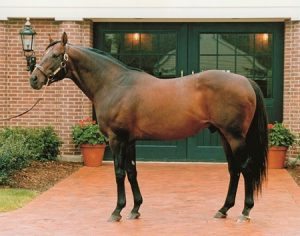
Rubiano (1987) was only a middling son of Fappiano, without the achievements in racing or at stud of luminaries like Kentucky Derby-G1 winning Unbridled. He also lacked Unbridled’s magnificent appearance, being smallish and fine-boned, though his beautiful gray coat faded to nearly white as he grew older, thanks to the influence of his granddam, Ruby Slippers, who was herself nearly pure white, and the cutest Nijinsky II mare ever, with her doll head and big deer eyes.

It is a truth universally acknowledged that Fappiano has now separated himself from his sire Mr. Prospector’s significant line, and has become a sire line unto himself. Pedigrees with both Fappiano and Mr. P in them are now commonplace and create racehorses, and there have even begun to appear pedigrees with double-doses of Fappiano in them, through different sons or grandsons, thanks to the proliferation of mares by the likes of Unbridled, Unbridled’s Song, Empire Maker, Pioneer of the Nile, etc.

Omaha Beach is different. His fabulous sire, War Front, by Danzig and single handedly responsible for bringing the Danzig sire line back to life, is out of the Rubiano mare Starry Dreamer, and she has carved herself a place in thoroughbred history through her wonderful son, whose offspring run on every surface, on every continent, and are much-coveted items at sales. Even she, though, is no match for Omaha Beach’s third dam, the Rubiano mare Felicita. Felicita was the dam of Take Charge Lady, making her the Queen Mother of this modern dynasty.

Both Rubiano mares have, in their pedigrees, a strong dose of Nasrullah through different sources (Forli and Blushing Groom), and while Ruby Slippers is by Nijinsky II, Felicita is by Nijinsky II’s close genetic relative, Blushing Groom (with her own dose of Nijinsky, of course, through Ruby Slippers), creating the kind of twinning on both sides of this pedigree that works miracles. Though Rubiano may not have been more than a useful sire, and his sons did not make any mark at stud, it could very well be that he has established his own niche, separate from that of his father Fappiano, as a broodmare sire. It should be noted that both the sires’ side of Omaha Beach and the dams’ side feature inbreeding to Northern Dancer, through Danzig and Nijinsky II on top, and through Deputy Minister and Nijinsky II on the bottom.

Charming’s sire, Seeking the Gold, by Mr. Prospector, has a license to be a top rate broodmare sire, and he currently sits at number eight on this year’s list. Out of the Buckpasser mare Con Game, he represents a classic cross, and the riches of Buckpasser, including the big dose of La Troienne (which reels in the La Troienne, through an entirely different source, found in Rubiano). He also represents the cross of the Fappiano line on the Mr. Prospector line, as detailed above, made even stronger by the big doses of La Troienne in both Seeking the Gold and Rubiano.

Omaha Beach’s second dam, the magnificent Take Charge Lady, is by Dehere, a stallion that has been much noted in this column for his up-and-coming success as a broodmare sire. In 2018, he was number 63 on that list, but this year he’s jumped all the way to number seven: you heard it here first. Much like Rubiano and Fappiano, he seems on his way to becoming a broodmare sire in his own right, apart from Deputy Minister’s acknowledged gifts in this arena. His broodmare sire strength comes from the same source as the two leading broodmare sires of the past twenty years, Storm Cat and A.P. Indy: all have dams by Secretariat. This is not coincidence. What’s interesting about this is that these three have different sires: Storm Bird, by Northern Dancer; Deputy Minister, a grandson of Northern Dancer; and Seattle Slew, a son of Bold Reason. No matter the sire line, the power of the 1973 Triple Crown winner, Secretariat, remains a huge influence today on the thoroughbred breed.

The Kentucky Derby is the most difficult race to predict an outcome for, and the most grueling, and one can’t help but be filled with both excitement and dread as those twenty horses come out of the starting gate. This year, to those interested in pedigree, there are two standouts, Tacitus and Omaha Beach, both of whom have tremendous residual value at stud in their futures. In the Derby, anything can happen, but in pedigrees, it’s possible to predict the future and recognize true stars.

— Roberta Smoodin
Carpe Diem’s First Starter Wins at Keeneland

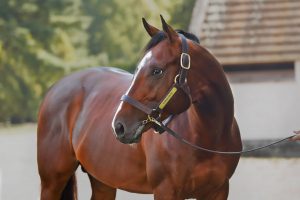
Winstar freshman stallion Carpe Diem’s first starter delivered a wire-to-wire win by over four lengths in a maiden special weight at Keeneland on April 17. Named Nayibeth, and trained by precocity-specialist Wesley Ward, she is a half-sister to Soldat, a multiple graded stakes winner who stands at Calumet Farm. Nayibeth’s connections are all stellar, as she was bred by Stonestreet Thoroughbred Holdings, ridden by Joel Rosario, and was a $230,000 yearling at Fasig-Tipton Kentucky October’s yearling sale last year, purchased by Ben McElroy for owner Ramon Tallaj.

Carpe Diem stands for $25,000 in 2019, and earned over a million and a half dollars, with grade one success at both two and three. By the late Giant’s Causeway, he is out of the Unbridled’s Song mare Rebridled Dreams. To prove that when it rains, it pours, Carpe Diem is also the sire of hip number 532 at the upcoming Ocala Breeders’ Sale of Two-Year-Olds in Training about to take place, and is certain to be a high seller given her fastest quarter mile work of the sale, clocking in at 20 3/5. Carpe Diem is clearly a young stallion to keep one’s eyes on.

— Roberta Smoodin