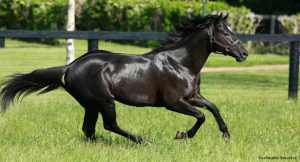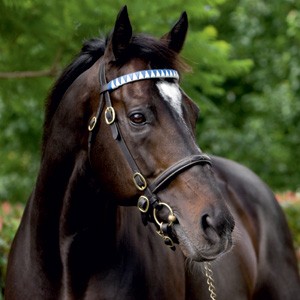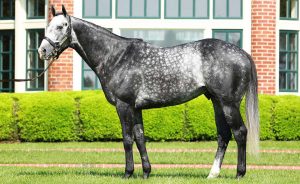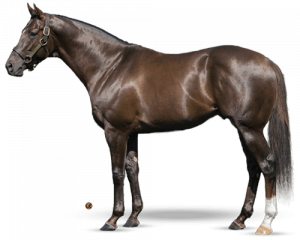
Stud Notes: Crestwood Farm’s Get Stormy Gets First Grade One Winner

On Arlington Million day, Crestwood third crop stallion Get Stormy, who stands for a bargain $6500, had his first grade one winner when Got Stormy beat the boys in the Grade One Fourstardave H. on turf at Saratoga. While the racing world had eyes on Chicago, Got Stormy set a new course record of 1:32 flat, decimating the previous record by nearly a second, and putting her sire on the map.

Get Stormy was a serious race horse, who raced from two to six, earning over a million and a half dollars, starting 31 times, but he didn’t reach his peak until age five (though he did win the Fourstar- dave H. himself, at four, like his brilliant daughter, though it was only designated a Grade Two at the time). That’s when his Grade One status was affirmed, through wins in the Turf Classic S. and the Maker’s Mark Mile S., while finishing second in the Shadwell Turf Mile to Champion Turf Horse Gio Ponti and third in the Gulfstream Park Turf H. At six, he won the latter Grade One race, and finished second in the Fourstardave H.-G2 to the great Wise Dan.

A son of Stormy Atlantic, Get Stormy’s pedigree doesn’t attract immediate attention, as he was the only black type offspring of his dam, Foolish Gal, by Foolish Pleasure, and his next two dams are nearly devoid of black type. His fourth dam though, the Apalachee mare Amerigo’s Fancy, was a stakes winner and producer of much black type herself, and through her daughters, and one can assume that Get Stormy’s ability is inherited from her.

One look at Got Stormy’s pedigree reveals that she got her turf ability from dad, but her relentless speed from her dam, Super Phoebe, by Malabar Gold, an unheralded son of Unbridled who is closely related to Unbridled’s Song (and Storm Cat and his sons make race horses when bred to daughters of Unbridled’s Song). So she gets her brilliance through Fappiano/In Reality and Known Fact/In Reality, and the Tsunami Slew in her broodmare sire harkens to the Seattle Slew in Stormy Atlantic’s pedigree, through his great dam, Hail Atlantis (making this inbreeding on the zigzag). Though she is tail-female Tiy, through her best daughter Ahpo Hel, by Mr. Leader, this is mostly a case of lesser individuals combining perfectly to create this wonderful race mare. Inbreeding to Northern Dancer should also be noted, through Storm Bird, Far North and Vice Regent.

The Fourstardave H.-G1T was a “win and you’re in” race, so we will get to see Got Stormy racing against the boys yet again in the Breeders’ Cup Turf Mile. If she can pull off another performance like this one, expect Get Stormy, who stands at Crestwood Farm in the Bluegrass, to have a deserved raise in stud fee for 2020.

— Roberta Smoodin

A Star Is Born At Saratoga In Shanghai Bobby’s 2-Y-O Colt Shancelot

When veteran trainer Jorge Navarro says he’s currently training the best horse he’s ever had, people should listen. Anyone who bet the farm on Shanghai Bobby’s son, Shancelot, in the Amsterdam S.-G2 July 28 at Saratoga is very happy. Anyone who just watched the race is happy—Shancelot, is the most thrilling sprinter to hit the racing scene in recent memory. Now three wins in three starts, Shancelot left the gate from the outside post and never looked back, setting ridiculously fast fractions and ending up 12 ½ lengths ahead at the wire, just missing the stakes record set by Quality Road. The horse is a freak.

Shanghai Bobby entered stud in 2014, having demonstrated stunning precocity. He won the Breeders’ Cup Juvenile S.-G1, the Champagne S.-G1 and the Hopeful S.-G2, and was named Champion Two-Year-Old Colt in 2012. Though his three-year-old campaign was a disappointment, his brilliance at two could not be doubted, and he went to stud at Ashford, in Versailles, Kentucky, for an initial fee of $25,000. He was a top five freshman sire and sophomore sire, and is currently in second place for third crop sires, behind only Take Charge Indy.

Unfortunately, he shares another trait with Take Charge Indy: both have been exported abroad, Take Charge Indy to Korea, and Shanghai Bobby to Japan, as of November of 2018.

Now, Shanghai Bobby has sired the freakishly fast Shancelot. Shanghai Bobby’s pedigree is fascinating. He is by Harlan’s Holiday (turning out to be a sire of sires, given the huge success of Into Mischief), and out of the Orientate mare Steelin’, making him inbred to close genetic relatives Blushing Groom (through Mount Livermore and Carson City) and Turn-to (through Halo and Cox’s Ridge).

An examination of Shanghai Bobby’s 2019 stakes winners reveals a surprising pattern. Shancelot’s pedigree underscores his sire’s strengths with another dose of Turn-to, through Roberto, and Turn-to’s close genetic relative, My Babu, through his daughter, Missy Baba. The same pattern exists in the pedigree of stakes winner Toss of Fate, and Shang as well features Missy Baba. The only 2019 stakeswinner by Shanghai Bobby that is different is Shanghai Tariff, whose dams’ side is strong in double doses of Mr. Prospector.

Shanghai Bobby’s last North American crop will be hitting the yearling sales this summer, and my guess is that Shancelot just brought up their auction average. If he stays healthy, his sire’s worth will soar, making Japanese breeders very happy indeed.

— Roberta Smoodin

El Prado’s Influence Continues Over Haskell Weekend

The continuing influence of the glorious stallion El Prado surfaced over Haskell weekend, as two of his sons, Artie Schiller and Medaglia D’Oro, sired stakes winners, Bowie’s Hero in the Eddie Read S.-G2 at Del Mar and Golden Award in the Shuvee S.-G3 at Saratoga. El Prado, a foal of 1989, died in 2009, but his sons are carrying on his legacy in a grand fashion, especially the spectacular Medaglia D’Oro, whose sales figures reflect the value of his sons and daughters on the track.

El Prado stood his entire career at the old Adena Springs, in Midway, Kentucky. A Champion Two-Year-Old in Ireland, he was raced by Robert Sangster and trained by Vincent O’Brien, but it was his stellar pedigree that set him apart and turned him into a sire of race horses and a sire of sires. By Sadler’s Wells out of the Sir Ivor mare Lady Capulet, the dams in his bloodlines are like a who’s who of great mares of the twentieth century: Almahmoud, Lalun, Rough Shod II, Somethingroyal, Gaga. As well, we see where his spectacular coloration came from: he is 5 x 5 x 4 Mahmoud, the gray horse responsible for most of the gray coloration in thoroughbred horses today, and this is on the zigzag, through two daughters, Almahmoud and Ghazni, and a son, Mr. Trouble.

Of course, he was by Sadler’s Wells, responsible for so much greatness in Irish breeding, including Galileo himself, whose own sons are now making such a splash.

Artie Schiller has disappeared from the world of thoroughbred studs, after standing at Winstar Farm and then in Australia, but he has a terrific pedigree, being out of the Majestic Light mare Hidden Light, a daughter of Tallahto. He was a useful sire, but no match for Medaglia D’Oro.

Medaglia D’Oro, standing at Darley, is a superstar. The sire of such as Rachel Alexandra, Songbird, Vancouver, Mshawish, Plum Pretty, Violence…the list goes on forever. His offspring tend to have good size and conformation, and are uniformly beautiful yearlings in the sales ring, frequently fetching million dollar bids.

So the stallion that had the best Haskell weekend? Has to be the unforgettable El Prado, who was matched only by Cozzene for sparkling white beauty and success at stud.

— Roberta Smoodin

Liam’s Map Gets First Winner With Basin At Saratoga

I’ve been waiting to write about Liam’s Map’s first winner, because I love the horse. When I visited Lane’s End to view him when he first went to stud, he knocked my eyes out. He is the most unusual of gray horses, with a silver coat that appears to be star-spangled. But I was already pre-disposed to love him, because I’d put a big (for me) bet on his nose to win the Breeders’ Cup Dirt Mile-G1, and he did so in convincing fashion, by 2 ½ lengths, in a new track record. This was a race horse. He did not race at all at two, however, so I feared his first crop might not be precocious.

Yesterday, 7/21, at Saratoga, his son Basin won a maiden special weight over a prohibitive favorite. Owned by Jackpot Ranch, trained by Steve Asmussen, and bred by Cottonwood Stables, Basin demonstrated in his second start that he has potential. He’d already had a second at Churchill Downs, to the colt who would go on to win the Sanford S.-G2—not too shabby.

Basin is out of the Johannesburg mare Appenzell, whose pedigree complements that of Liam’s Map by adding a second dose of Damascus, and two more of Mr. Prospector to reach out to the Fappiano in the sire’s side. The important relative in the dams’ side, however, is Seeking the Gold, who adds another dose of Buckpasser to Liam’s Map’s already La Troienne-rich pedigree. As well, Appenzell’s pedigree includes two doses of Northern Dancer, through Storm Cat and Dixieland Band.

Liam’s Map entered stud for a fee of $25,000, which was reduced in 2019 to $20,000. Not a bad fee for a millionaire and multiple-grade-one winner, with his looks. I personally am looking forward to what his three-year-olds and four-year-olds will do, as that was when Liam’s Map turned into a winning machine. I’m hoping he will be the heir apparent of the magic that Unbridled’s Song had at stud.

— Roberta Smoodin

Stud Notes: Competitive Edge and Daredevil at Saratoga

The Stillwater S. on July 18 at Saratoga turned into a showcase for one freshman sire, and an exclamation point for another. Ashford’s freshman Competitive Edge emerged from the shadow of American Pharoah when his fillies, My Italian Rabbi and Fierce Lady, finished first and second in that race, dueling one another like real pros. My Italian Rabbi is the first stakes winner for Competitive Edge. Finishing third was a first-time starter, Jewel of Arabia, from another frequently overlooked freshman sire, Winstar’s Daredevil.

My Italian Rabbi, a $160,000 purchase at Fasig-Tipton’s Saratoga Preferred New York Yearling Sale in 2018, has a fascinating pedigree, with A.P Indy appearing in his sire’s and dam’s side, while adding yet another dose of Seattle Slew in the sire’s side. Fierce Lady’s pedigree doesn’t have the Seattle Slew/A.P. Indy inbreeding, but does feature both In Reality and Damascus, both of which were present as well in the pedigree of My Italian Rabbi.

Jewel of Arabia is out of a Mineshaft mare, and was a $140,000 weanling at Keeneland November, 2017. Her pedigree features inbreeding to both Mr. Prospector and Northern Dancer, and it makes good sense that the double dose of Halo in Daredevil holds hands with the Hail to Reason in Seattle Slew on the dam’s side.

With Khozan, with his $4,000 stud fee, atop the freshman sire list, and these two relatively bargain priced stallions, the expected emergence of American Pharoah as a force of nature among freshman stallions has been at very least delayed. That is not to say that he won’t end up as leading freshman sire of 2019. However, Competitive Edge and Daredevil are also making their mark for breeders with smaller checkbooks but just as high hopes.

— Roberta Smoodin

Fasig-Tipton’s July Sale: Crunching Numbers and Young Guns

The big news from the Fasig-Tipton July Sale, the premier yearling sale of 2019, was Darley at Jonabell’s and Winstar’s freshmen sires, a newly monetized Ken McPeek, and a very high RNA rate, withdrawal rate, and private sale rate. The latter three indicate that consignors and owners didn’t understand the market, and had false optimism for growth from 2018 that did not materialize.

As well, because this is a select sale, meaning that Fasig-Tipton operatives comb the country, seeing every yearling that passes the initial pedigree screening, one must question whether the 364 yearlings catalogued were up to snuff in terms of what buyers were looking for. It would seem, therefore, that owners, consignors and the sales company itself had false belief in the growth of the yearling market, probably due to successful two-year-old in training sales indicating strength in pinhooking which did not lend itself to a more successful yearling market. There are, of course, the majority of yearlings remaining to be sold, at Saratoga in August and at Keeneland in September, but one looks for trends in the marketplace from the July sale, and these trends usually continue.

Numbers tell part of the story. There was a 32.6% RNA (reserve not achieved) rate at the sale, while a 20-25% rate is considered the norm, though even 25% seems high, indicating a full fourth of owners and consignors miscalculated the worth of their offerings. There were 64 withdrawals from the sale, though this statistic is harder to analyze, as yearlings, the teenagers of the horse market, are undoubtedly the most apt to hurt themselves playing and running. You can’t wrap them in bubble wrap once Fasig selects them, and keep them in a stall thus wrapped until July. Plus, yearlings spending long periods of time in stalls, together in barns, being sales prepped, also tend to get illnesses which quickly spread throughout a yearling barn, necessitating withdrawal.

The other intangible is that Fasig examines the yearlings early in the year for the July catalogue, and some that look spectacular in February or even March enter an awkward stage by July, or simply don’t grow as predicted, and owners and consignors make a wise choice to give such a baby more time, entering it instead into Keeneland September or Fasig October. Whatever the reason, a near 18% withdrawal rate must be considered significant, especially when added to the near 33% RNA rate. The other statistic that must be considered is that, at this sale, only 14 yearlings sold for over $200,000, down from 24 in 2018.

If you study the results, as well, you will be surprised by the number of yearlings noted as PS, that is, private sale. This means that the owners/consignors set an unrealistic reserve that was not met, brought their babies back to the barn, and a buyer went back to the barn as well and made an offer, under that reserve, that the owners/consignors then accepted—a true reality check. There were 34 such private sales, and though statistics aren’t kept or offered for this, as it is considered, in sales results, as simply another sale, this brings the number of significant incorrect appraisals of a yearling’s worth up to 132, which in a sale that only ended up offering 300 yearlings, is significant, at a whopping 44%.
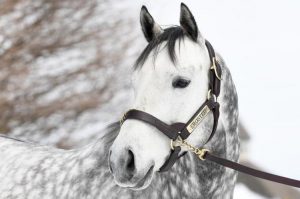
Now for the good news. The Fasig-Tipton July Sale is the first indicator of another trend: which freshmen sires look the most promising to buyers. Though a buzz about the first crops of certain freshman sires begins when the babies hit the ground, the July Sale is the true, initial barometer of that buzz that can be quantified, and Darley at Jonabell and Winstar Farm were the big winners.

Frosted, who stands at Darley, was always a drop-dead gorgeous horse, my Kentucky Derby pick that year because of his speed and handsomeness, and he did earn nearly four million dollars, as well as winning the Grade One Wood Memorial, Whitney and Metropolitan, and had the misfortune to enter the Triple Crown races in American Pharoah’s year, justifying his $50,000 stud fee when he went to stud in 2017. Mare owners who were willing to pay that fee were rewarded at the July Sale, as Frosted was the leading freshman sire with an average of $229,000.

Following close behind was Darley’s other star freshman, Kentucky Derby-G1 winner Nyquist, who stood for $40,000 in 2017, after a career that earned him more than five million dollars, with his other Grade One wins coming in the Breeders’ Cup Juvenile, the Del Mar Futurity, the Frontrunner, and the Florida Derby—this was a serious race horse. Plus, he was a chip off the old Mo—he inherited his sire’s good looks, musculature and size. Uncle Mo may be the most impressive-looking stallion standing in the Bluegrass, and clearly many breeders who could no longer afford good old dad went to Nyquist, and were rewarded. Nyquist’s average yearling price was $153,000.

The other standout freshman sires were Runhappy, who stands at Claiborne, and was helped by two hefty purchases by his owner, James McIngvale, making Runhappy the second leading freshman sire behind Frosted, averaging $157,000; Speightster, standing at Winstar, who averaged $141,000; Brody’s Cause, a resident of Spendthrift, averaging $111,000; and Outwork, another son of Uncle Mo who stands at Winstar, averaging $107,000. All of these, plus Taylor Made’s son of Medaglia D’Oro Not This Time, had one or more yearlings hammered down for $200,000. Clearly the market for the offspring of this year’s freshman sires is strong.

The other news that stands out when reading the sale’s results is the emergence of trainer Kenny McPeek as a leading buyer. McPeek bought 11 head, for a total of $1.4million, for various clients, in various price ranges. McPeek is known for finding hidden gems at bargain prices at the big yearling sales, so this year’s purchases reflect clients giving him carte blanche, a vote of confidence in his ability to find a race horse among yearlings that seems completely justified. It will be worth watching how these select purchases do once they hit the track.

Now, we wait. For Fasig’s Saratoga Yearling Sale, which is known to feature both great pedigrees and great physicals, and for the giant supermarket of yearlings, the Keeneland September Sale, to determine if these trends hold true, or if new trends emerge. The first few days of the Keeneland Sale, featuring stellar yearlings, including the majority of Lane’s End’s and Claiborne’s babies, will either reinforce the predilection for the selection of certain freshman sires, or introduce new ones to the most prestigious offerings. The parade of gorgeous 2018 foals has officially begun.

— Roberta Smoodin
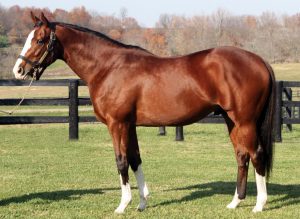
Why American Pharoah might be as good as Secretariat.

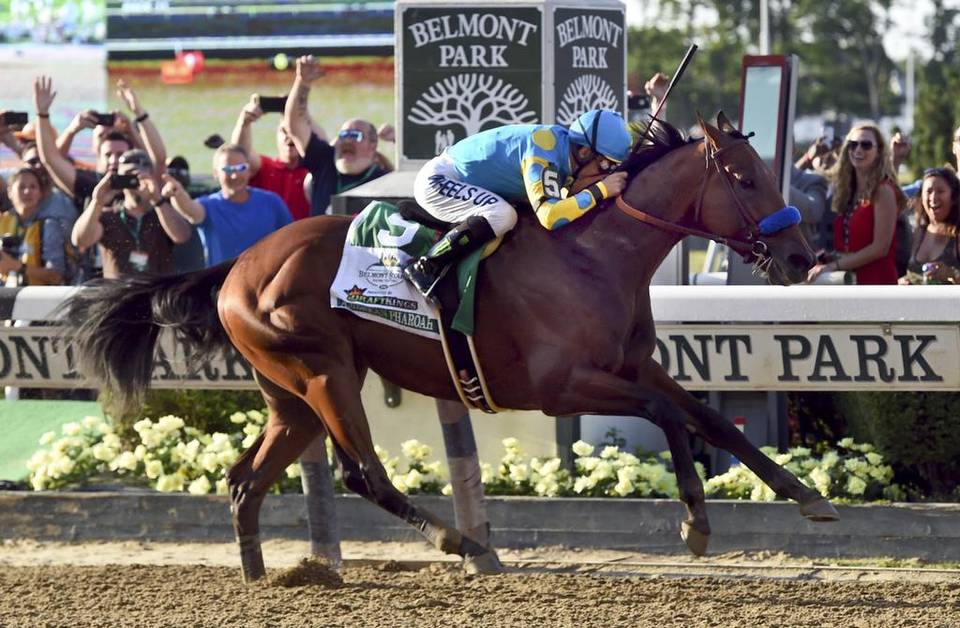
AmericanPhaorahBelmontWithin moments of his facile victory in the Belmont Stakes making him the first Triple Crown winner in 37 years, the inevitable and tricky comparisons between American Pharoah and the three great Triple Crown winners of the 1970s began…  The general consensus seems to be that while some believe that American Pharoah may perhaps be on a par with Seattle Slew and Affirmed, he is just not in the same league as Secretariat.

While I am as impressed by that amazing and legendary big red colt from 1973 as anyone else, I am not at all sure that Pharoah is inferior. Here’s why.

1) Much is made of Secretariat’s 31 length margin of victory and the winning track record time of 2.24 flat. And so it should be, it was a phenomenal time. American Pharoah ran the second fastest Belmont ever in 2.26.6. That is approximately ten lengths slower than Secretariat’s 1973 time of 2.24.

Or is it? In an article in The Bloodhorse June 20th edition, EQB president Jeff Seder revealed that he believes that the main track at Belmont Park in 2015 is a significantly slower racetrack than the one over which Secretariat ran 2.24 in 1973, saying that the current Belmont track now has four more inches of sand in the cushion than the Belmont track had in it back then.

What is that worth in terms of time? It could be worth more, but let’s be conservative and suggest it takes off one second. So we are at 2.25.6.

Pharoahstill2) Victor Espinoza has said he has been asked by Bob Baffert to never win by too far on American Pharoah. Victor is adamant that he could have won the Belmont by significantly further. How much further? Pharoah was absolutely cantering coming round the final turn under a firm hold. Let’s suggest instead of holding on to him that Victor had asked him for full run at that point and opened up on American Pharoah then, rather than when he just gently asked him for minimum effort at the furlong pole, 300 yards later. Could we see Pharoah taking six or eight more lengths out of the field as a result? Certainly. There is another second to a second and a half off the 2.26.6.

Now we are getting real close to Secretariat’s 2.24.

3) The competition. Frosted. Materiality. Mubtaahij. In a field of eight, three proven Grade 1 Stakes Winners were taken on by American Pharoah in the Belmont. Time may reveal that Frosted is one of the best horses that Kieren McGlaughlin has ever trained. Mike De Kock’s Mubtaahij is highly rated by his trainer. Trying to roll with American Pharoah early saw Materiality run below his best, but the other two ran well.

AmericanPhaorahBelmontYet they were made to look like claimers by Pharoah.

Secretariat took on a field of five in his Belmont. Only one was of significant quality, Sham. Sham was a great horse at his best, but he clearly wanted no part of a mile and a half and ran so far below form that day that he couldn’t even beat the three hopeless longshots and finished dead last. So if the real Sham did not show up in the Belmont, what exactly did Secretariat beat by 31 lengths? And how far would American Pharoah have thrashed those very mediocre horses? Is it conceivable that they could have received an equally impressive drubbing from him?

4) The early fractions. For most horses, the faster the early pace, the slower they come home. The early Belmont fractions were sensible for the distance, 1.13 and change for the six furlongs and 1.38 (1.37.99) for the mile. From a 1.38 mile it would be almost impossible to finish in 2.24 for the mile and a half. That would mean running the last half mile in 46 flat…. (I am actually not entirely sure that American Pharoah could not have done that.) As it is, American Pharoah cruised it in a nonchalant 48. Like it was a stroll in the park. He could have come up into the grandstand to sign a few autographs as he came into the stretch and still won…  So effortless was his victory and so obviously did he get the mile and a half trip, I would bet that even if he had gone the mile in 1.36, if asked, he could still have run the last half in the 48 flat required.

And Voila. There is your Secretariat time of 2.24. On a track slowed down by four inches more cushion than it had in 1973, no less.

Secretariat was an awesome, incredible racehorse. But many talk of him as if he was an unbeatable individual and conveniently forget that he was beaten on five separate occasions. He won his Derby and Preakness in a not unusual two and a half lengths. Scratch him from the Belmont and he would not be revered the way he is. Nonetheless, he still deserves to be spoken of in the same breath as War Admiral, Sea Biscuit, Citation, Native Dancer, Whirlaway et al. Time will tell that American Pharoah deserves the same.

Am I wrong about this? Am I overrating this American Pharoah? I could be, but I don’t think I am. He won’t be around much longer and I would rather appreciate and understand what I am seeing now, as it happens before my own two eyes, rather than in years to come. When folks finally realize how good this horse was.

Watch American Pharoah win the Belmont again here

Who do you think is the best of the last four Triple Crown winners?

Take the poll here

Nathaniel’s Daughter Enable Wins Grade 1 Eclipse in England

Though it hardly seems possible, Khalid Abdullah and his Juddmonte Farms have outdone themselves in terms of audacious breeding in the creation of super-mare Enable, who on July 6, 2019, won the Coral Eclipse S.-G1 with ease, and with her trainer, John Gosden, saying she was only 85% fit. She is en route to her third Prix de le Arc de Triomph S.-G1, which she has won two years in a row, beating the boys with astonishing ease.
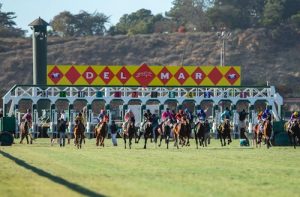
Her pedigree is a masterpiece of bravado inbreeding, creating a new nick that must raise eyebrows of pedigree nerds everywhere. It must be noted that the irrepressible Frankie Dettori rode Enable, after telling the press that she was “coming along nicely.” And understatement is not usually his forte. Enable’s sire, Nathaniel, stands at Newsells Park Stud in Newmarket, England, for 25,000 Euros, and won the Coral Eclipse S.-G1 just as his daughter has, as well as being Champion Three-Year-Old Colt in England and Champion Older Horse at four in Europe.

Nathaniel entered stud in 2013, making Enable a product of his first crop. What led Juddmonte to breed their lovely Sadler’s Wells mare, Concentric, to this untested commodity? Allow me to attempt to read the minds of the Abdullah/Juddmonte brain trust. Enable is inbred to Sadler’s Wells three by two, very close. Prevailing wisdom, which is frequently incorrect in terms of breeding theorems, states that inbreeding any closer than a number that adds up to seven is too close; Enable’s number is five.

Young Nathaniel, however, is a son of the ubiquitous Galileo, who has dominated European racing for years, and whose sons and grandsons continue to dominate the biggest races on that continent and in England and Ireland. Though Galileo is a son of Sadler’s Wells, my guess is that Juddmonte believes Galileo has begun his own sireline, separate and split off from that of Sadler’s Wells, much as Fappiano has done with his own sire, Mr. Prospector, making the Fappiano/Mr. P. cross commonplace and successful in North American breeding.

Want to guess how many Sadler’s Wells mares have been bred to Nathaniel? One. Concentric, with the sole offspring from that cross being Enable. Has Juddmonte begun a trend? I believe the answer has got to be yes. Expect to see many more Sadler’s Wells mares mated to the many great sons and grandsons of reigning king and first of his line, Galileo.

— Roberta Smoodin

Del Mar Unveils New Safety Measures; 5 Person Panel To Review All Entries

Press Release: Building on industry-leading safety and welfare measures, Del Mar Thoroughbred Club (DMTC), operators of San Diego County’s iconic horse racing venue at Del Mar, today announced a series of initiatives to enhance safety protocols and procedures as the track prepares to celebrate its 80th season of racing.
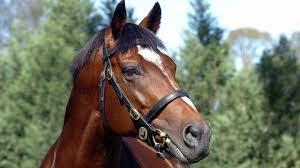
These initiatives build on effective safety and welfare measures that Del Mar introduced over the last several seasons of racing and which led to Del Mar being recognized as one the safest racetracks in the US in 2018, according to The Jockey Club’s Equine Injury Database.

“Del Mar continues to strive to provide the safest environment possible for our equine and human athletes for both racing and training,” said Chief Executive Officer Joe Harper.  “We have a responsibility to implement the best practices for safety and welfare and the further responsibility to educate the public about these practices and about the extraordinary levels of care provided to our equine athletes.”

Among the additional steps Del Mar is enacting for the 2019 season: 

  • Entry Review Panel: All horses entered to race at Del Mar will be reviewed by a five-person panel consisting of: CHRB Equine Medical Director, Dr. Rick Arthur; two CHRB veterinarians – Dr. William Farmer and Dr. Timothy Grande; CHRB Chief Steward, Darrel McHargue and CHRB Safety Steward, Luis Jauregui. The panel will provide additional review of horses’ medical, training and racing history. The panel will recommend to the Stewards that any horse that it deems unfit for competition be declared from racing.
  • Medication Reform: Del Mar is adopting additional reforms modeled after the International Federation Horseracing Association (IFHA) requirements. NSAIDs (non-steroidal anti-inflammatories), that were allowed previously up to 24 hours in advance of a race, will be restricted to 48 hours before either a race or workout. The time period that allowed therapeutic usage of corticosteroids in joint treatment has been extended from the previous length of three days before a race to 14 days and horses will not be allowed to start until after the 14-day window. 
  • Increases in out-of-competition testing: Random testing will be instituted for any horses stabled at Del Mar, including horses readying for – or having just completed – morning workouts. 
  • Enhanced stable security: Working in conjunction with the investigative staff of the CHRB, an enhanced stable security team will monitor all aspects of the stable area to ensure that rules are properly followed.
  • Additional veterinary protocols for morning training: Veterinarians will be stationed at elevated observation points at the facility to oversee morning workouts and will have the ability – through communication with outriders – to remove horses from the racetrack and have them undergo a follow-up examination for soundness.
  • Prohibit the use of the riding crop during morning workouts: Exercise riders and jockeys will be prohibited from using a riding crop to encourage their horses during morning workouts. Del Mar will continue to work with the CHRB and the Jockey’s Guild on additional guidelines for riding crop use.
  • Stakeholder Advisory Committee: DMTC has created a stakeholder advisory committee represented by trainers, veterinarians, jockeys, racing surfaces maintenance personnel and management that will meet regularly to discuss safety practices, operations and track surfaces.
In addition, the conditions of all horses stabled at Del Mar (approximately 1,850) will be thoroughly analyzed and reviewed by Del Mar’s racing department regularly with specific conditions (e.g., gaps in racing or workout activity) flagged for additional scrutiny. 

“Significant thought, due diligence and stakeholder input went into the crafting of the reforms we are implementing this summer,” said DMTC’s Tom Robbins. “All of us recognize our responsibility to ensure the safety and welfare of the horses that race and train here. We are very appreciative of the cooperation from industry stakeholders including our owners and trainers.”

In 2018 and 2017, Del Mar made a series of changes and adjustments focused on the safety of horses and riders, all of which will be continued in 2019. They include:

  • Reduction in Race Dates: DMTC reduced its summer racing season from eight weeks to seven, providing additional time to prepare the racing surfaces (after the San Diego County Fair) and to allow horses to acclimate to new surroundings. The reduction in days resulted in approximately $1 million less in net revenue.
  • New director of racing surfaces maintenance: In 2017, DMTC hired Dennis Moore, widely considered the top track maintenance overseer in the industry. Moore immediately changed Del Mar’s banking and grading to conform with the other racing surfaces in Southern California, allowing an easy transition for horses competing in the Los Angeles-area. The cost of implementing these changes was approximately $1.5 million.
  • Fewer horses on the grounds: DMTC reduced the number of horses allowed on the grounds by roughly 15%; from approximately 2,100 to 1,850. Fewer horses alleviated demand for access to the main track during busy morning training hours, creating a safer training environment.
  • Adjusted morning workouts: DMTC allowed only “workers” (those going at race speed, not joggers or gallopers) on the track for the first 10 minutes following the first two morning breaks.
  • Enhanced veterinary inspections: DMTC employed additional veterinarians to conduct pre-race inspections and monitor pre-race activities for starters, creating four distinct veterinary observation points for horses on race day.
  • Racing Surfaces expert Dr. Mick Peterson: DMTC enlisted the services of Dr. Mick Peterson, director of University of Kentucky’s Equine Ag Programs and Professor of Biosystems and Agricultural Engineering, widely recognized as the nation’s foremost track surfaces analyst. 

The most recent Jockey Club Equine Injury Database ranked Del Mar as among the safest major racetracks in the country with a rate of 0.79 fatal injuries per 1,000 starts in 2018. The national average of tracks reporting was 1.68.

In addition, DMTC remains fully accredited by the National Thoroughbred Racing Association’s Safety and Integrity Alliance for its upcoming season, having passed a complete review of equine and track safety protocols, injury reporting and prevention, medication testing, jockey health and safety best practices, wagering integrity and equine aftercare policies in October of 2017. 

Del Mar will begin its 80th summer season on Wednesday, July 17 and race for 36 days through Labor Day Monday, September 2. Racing will be conducted five days a week from Wednesday through Sunday with a sixth day added on the closing week. First post daily is at 2 p.m. with the exceptions of Fridays when racing begins at 4 p.m. 

Irish Derby 2019 – The Galileo, O’Brien, Magnier, Smith,Tabor Monopoly

The Group One Irish Derby at the Curragh on June 29 represented a hat trick not often seen. The first three finishers, Sovereign, Anthony Van Dyck and Norway, were all sons of the magnificent Galileo, Coolmore’s king. All trained by Aidan O’Brien. All owned by the triumvirate of Magnier/Smith/Tabor. The only differences in the three, apart from very minor differences in pedigree, is that O’Brien couldn’t clone a single jockey to ride all three, and so was dependent on various riders to claim the Irish Derby as his own, as he has done six times before.

The pedigree of Sovereign is a beauty, as he is out of the Danehill Dancer mare Devoted to you, and both Danehill Dancer and his sire, Danehill himself, present fabulous nicks with Galileo. Galileo’s AEI with all mares is a remarkable 3.14, well above the standard of excellence of one, which is considered superior. Anthony Van Dyck, the second-place finisher, is out of the Exceed and Excel mare Believe ‘n’ Succeed. Exceed and Excel is by Danehill as well, and Galileo’s Average Earning Index with Exceed and Excel mares is a whopping 18.21, almost stratospherically unheard of. It should also be noted that Anthony Van Dyck’s second dam, Arctic Drift, is by Gone West out of the Storm Cat mare November Snow, which adds two doses of Secretariat (and his dam, Somethingroyal), and a mirroring of the Northern Dancer/Mr. Prospector cross offered as well in Galileo himself. Third place finisher Norway is out of the Kingmambo mare Love me True, providing that Northern Dancer/Mr. Prospector twinning as well, plus the tail female family of A.P. Indy, and a 7.22 AEI. These are remarkable statistics, even for the great Galileo.

An examination of the fourth, fifth and sixth place finishers, however, cements this monopoly that Galileo seems to have on Irish racing, more like an iron fist of a hold. Madhmoon finished fourth, and he is a great-grandson of Galileo. Guaranteed was fifth, and is also a grandson of Galileo. Broome, sixth, another O’Brien trainee, is a grandson of Galileo, while Il Paradiso, seventh, trained by O’Brien, is a son of Galileo himself, out of a Danehill Dancer dam, with a second dam by Black Tie Affair, a son of Miswaki. Galileo is, of course, out of the great Miswaki mare Urban Sea.

I’m not a math person—far from it—but sometimes numbers don’t lie. And certainly pedigrees don’t lie. Galileo’s achievements as a sire cannot be underestimated. He is the greatest sire of our time, without doubt, and no North American-based stallion can come close to his achievements, nor to those of the entire Coolmore group.

— Roberta Smoodin