Streak of Luck Commands $6.2 Million at Fasig-Tipton November Sale

Record-Breaking Sale Follows Son’s Breeders’ Cup Victory

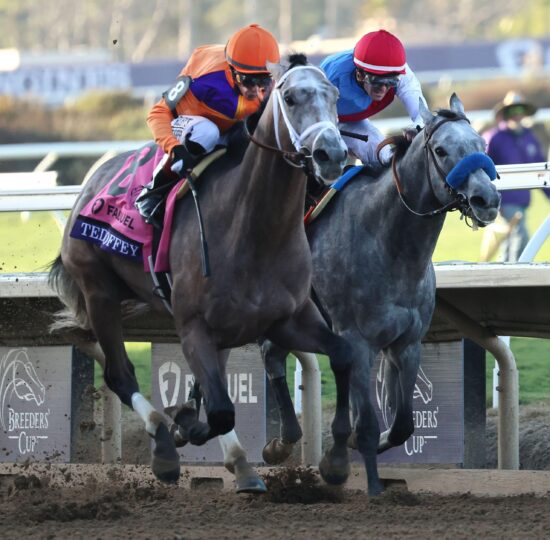
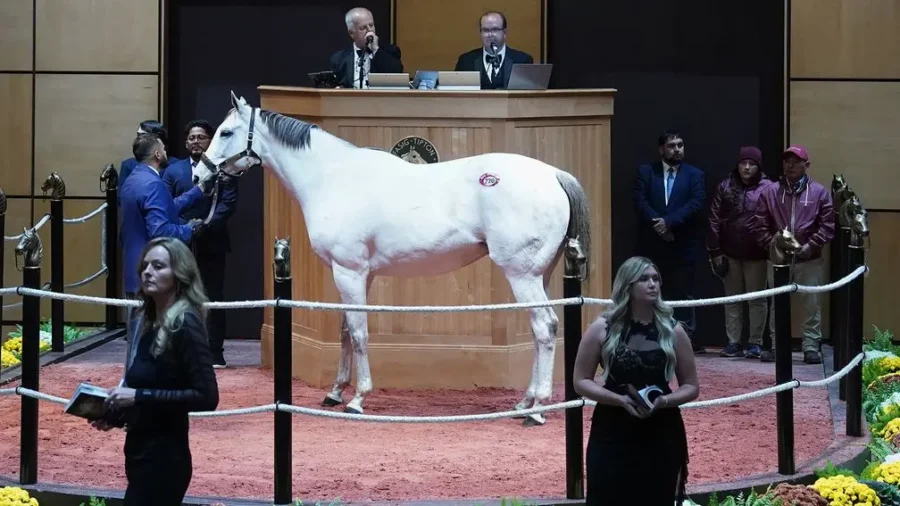
The broodmare Streak of Luck topped the Fasig-Tipton November Sale on Monday, selling for $6.2 million to AMO Racing in Lexington, Kentucky. The sale came just days after her undefeated 2-year-old son Ted Noffey captured the Grade I Breeders’ Cup Juvenile at Del Mar on November 1.

The 10-year-old daughter of Old Fashioned was consigned by Taylor Made Sales Agency on behalf of Aaron and Marie Jones, who had purchased her for $620,000 in foal to Authentic at the 2021 Keeneland November Sale. She was offered in foal to Not This Time, one of the country’s leading young sires.

Perfect Timing

Streak of Luck was supplemented to the November sale in mid-October, and the timing couldn’t have been better. Ted Noffey is a three-time Grade 1 winner who completed an unbeaten season and is widely expected to be named the Eclipse Champion 2-Year-Old Colt of 2025.

Ben McElroy, who signed the ticket on behalf of AMO Racing, acknowledged that Ted Noffey had been on their radar as a yearling, saying the Into Mischief colt made their list but they weren’t smart enough to buy him. McElroy described the purchase as a long-term investment, noting that Taylor Made’s Frank Taylor told him the mare’s Into Mischief foal is a super star.

Strong Market Overall

The Fasig-Tipton November Sale produced strong results with increases in average and median over its 2024 renewal, with 138 horses selling for $102,027,000. The average rose 35.4% to $739,326 and the median was up 20.0% to $300,000.

A total of 27 horses sold for seven figures Monday, up from 25 a year ago. Fasig-Tipton President Boyd Browning praised the market, saying it was very good but still rational, with buyers demanding the proper combination of pedigree and conformation.

Taylor Made Connection

The sale held special significance for Taylor Made Sales Agency. Frank Taylor credited the Jones family with putting the farm “on the map,” recalling that Aaron Jones sent him 40 mares when Taylor was just 17 years old and the farm had only five boarded mares at the time.

Taylor noted that Streak of Luck has a yearling Munnings filly that sold to Repole Stable for $425,000 at Keeneland September, and her Into Mischief foal at the farm could potentially top next year’s September Sale.

Other Notable Sales

The sale featured several other high-profile broodmares. Puca, the reigning Broodmare of the Year and dam of Kentucky Derby winner Mage and Belmont Stakes winner Dornoch, sold for $5 million to the Raging Torrent Syndicate. Champion 2-year-old filly Just F Y I sold for $4.5 million to Katsumi Yoshida.

The Fasig-Tipton November Sale has become one of the industry’s premier bloodstock auctions, and this year’s results reinforced its status as the “Night of the Stars” where elite breeding stock changes hands for premium prices.

Pedigree Review: Kentucky Derby and Belmont Stakes Winner Sovereignty

When Sovereignty powered home under Junior Alvarado at Churchill Downs, the breeding shed theorists had their “I told you so” moment. The Into Mischief-over-Bernardini mare cross had produced a legitimate classic horse, and the dam side of this pedigree deserves far more attention than it’s received.

The Into Mischief Factor: More Than Just a Hot Sire

Yes, Into Mischief is the most obvious part of this equation—standing at $250,000 and churning out stakes winners like a factory. With Authentic, Mandaloun, and now Sovereignty, Into Mischief has proven he can sire genuine 10-furlong horses when mated correctly. 

The Harlan’s Holiday line brings tactical speed and precocity, but Into Mischief’s real genius is in his versatility. Through his dam Leslie’s Lady—herself the 2016 Kentucky Broodmare of the Year who produced Beholder and Mendelssohn—he carries a female family that consistently produces high-class performers across distances. The cross with stamina-laden mares has been the secret sauce.

Crowned: The Bernardini Mare Who Never Raced

Here’s where it gets interesting. Crowned, a $1.2 million Keeneland September yearling, never made it to the races. Godolphin bought her with breeding in mind, banking on Bernardini’s reputation as a broodmare sire. That bet has paid off spectacularly.

Bernardini himself was the complete package: 2006 American champion three-year-old, Preakness winner, Travers winner, Jockey Club Gold Cup winner. His progeny averaged winning at 7.5 furlongs, and his daughters have been gold for breeders. The Into Mischief-over-Bernardini mare cross had shown promise with Owendale (G3 winner, third in the Preakness), but Sovereignty is the one who elevated it to elite status.

The question breeding experts were asking: Could Into Mischief’s speed merge with Bernardini’s stamina without losing either? Sovereignty answered emphatically. He had the turn of foot to close from the clouds, but the gas tank to do it at 10 furlongs and beyond.

The Mushka Connection: Grade I Class Through the Dam Line

Sovereignty’s second dam, Mushka, is where this pedigree really starts to cook. Like Sovereignty, a Bill Mott trainee, Mushka was a tough, versatile mare who won the G1 Spinster Stakes and placed in twelve of nineteen starts over four seasons. She won on dirt, turf, and synthetic—the G2 Demoiselle Stakes at 1 1/8 miles on dirt, the G3 Glens Falls Handicap at 1 3/8 miles on turf, and the Spinster at 1 1/8 miles on synthetic. That kind of durability and versatility doesn’t show up by accident.

Mushka was by Empire Maker out of Sluice (by Seeking the Gold). Empire Maker—Belmont winner, Derby runner-up, sire of Pioneerof the Nile and grandsire of American Pharoah—is arguably the single most important source of classic stamina in modern American pedigrees. Having him as the broodmare sire of your dam is like having an insurance policy for the Derby.

The Seeking the Gold line through Sluice adds another layer of class, and when you get to the fourth dam, Lakeway—a four-time Grade I winner by Seattle Slew—you realize this is an exceptional family.

Triple Crown Blood: The Genetic Foundation

Seattle Slew appears multiple times through the pedigree, and there’s a Fappiano duplication that adds Northern Dancer influence through both the male and female lines.

This isn’t just name-dropping legendary horses. These duplications matter. Seattle Slew brought an aggressive, competitive style and tremendous soundness. The Fappiano duplication reinforces Mr. Prospector influence while also bringing in Northern Dancer bloodlines. It’s a classic pattern of speed reinforced, balanced by all that Empire Maker and Bernardini stamina on the bottom.

Nick Analysis: Why This Cross Worked

For pedigree geeks keeping score at home, this is a textbook example of complementary breeding:

– **Speed source**: Into Mischief (Storm Cat/Mr. Prospector lines through Harlan’s Holiday)
– **Stamina source**: Bernardini (A.P. Indy over Quiet American)
– **Reinforcement**: Empire Maker (Unbridled over Toussaud)
– **Class through the tail female**: The Sluice/Lakeway family with multiple G1 winners

The A.P. Indy connection (Bernardini is a direct son; Seattle Slew’s son A.P. Indy appears in the broader pedigree) is the X-factor that ties it all together. A.P. Indy was one of the few horses who could genuinely do it all—speed, stamina, class, soundness. When you can work with that influence in a pedigree, magic can happen.

Performance Validates the Paper

Sovereignty’s running style reflected his pedigree perfectly. He was never going to be an early  speed horse, that’s not the Bernardini/Empire Maker way. But he had enough tactical speed from Into Mischief to position himself within striking range, and then the tank to make one sustained run in the stretch.

The wide trip in the Derby (five and six wide on the turn) would have cooked a speed-bred horse. Sovereignty ate it up. The slop? Empire Maker horses handle off tracks. The 10 furlongs? This horse was bred to get 12.

Sovereignty’s success has already impacted the commercial market. Into Mischief mares bred to stamina influences are hot commodities. Bernardini mares, already valuable as broodmare sire prospects, have become even more pricey. And anyone with an Empire Maker mare is looking to mate her with Into Mischief or similar speed influences.

Sovereignty is the result of a carefully crafted genetic recipe that took decades to develop. From Into Mischief’s brilliance to Crowned’s untapped Bernardini stamina, to Mushka’s Grade I class and Empire Maker foundation, to the layers of champion blood woven throughout—every piece mattered.

The Bloodlines of Breeders’ Cup Juvenile Winner Ted Noffey

In racing, where bloodlines are traced with the precision of royal genealogies and names often reflect noble heritage, there’s something delightfully irreverent about a champion racehorse named after a social media typo. Yet Ted Noffey—whose name came from an innocent transposition of Spendthrift Farm general manager Ned Toffey’s name—has proven that what’s in a name matters far less than what’s in the blood.

On October 31, 2025, at Del Mar, the gray colt with the imperfect name delivered a perfect performance, capturing the $2 million Breeders’ Cup Juvenile with a professional one-length victory over Mr. A.P. It was his fourth consecutive win, completing an unblemished 2-year-old campaign that included three Grade 1 victories and virtually guaranteed him the Eclipse Award as champion 2-year-old male.

But to understand Ted Noffey’s excellence, one must look beyond the winner’s circle and into the intricate tapestry of bloodlines that produced him—a pedigree that blends contemporary dominance with classic stamina, speed with staying power, and American dirt prowess with touches of European class.

The Sire: Into Mischief’s Historic Legacy

Ted Noffey is sired by Into Mischief, and if that sounds familiar, it should. Into Mischief stands as perhaps the most dominant stallion of the 21st century, having been North America’s leading sire by progeny earnings for seven consecutive years from 2019 through 2025. His reign of supremacy matches Bold Ruler’s historic seven consecutive championships from 1963 through 1969, making them the only two stallions in modern racing history to achieve such sustained dominance.

The son of Harlan’s Holiday out of the remarkable mare Leslie’s Lady, Into Mischief himself was a Grade 1 winner at two who showed promise but whose racing career was abbreviated by injury, limiting him to just six starts. Retired to Spendthrift Farm in 2009 for a modest initial stud fee of $12,500 (which later dipped to $7,500), few could have predicted the revolution he would spark in Thoroughbred breeding.

Today, Into Mischief commands a stud fee of $250,000 and has become the first stallion in history to surpass $225 million in progeny earnings. His impact on the breed has been nothing short of transformational.

Kentucky Derby Royalty

When Sovereignty splashed home first in the 2025 Kentucky Derby, Into Mischief achieved a milestone that places him among racing’s immortals: he became only the fifth stallion in history to sire three Kentucky Derby winners, tying the record set by legendary sires Virgil, Falsetto, Sir Gallahad III, and Bull Lea. His Derby winners—Authentic (2020), Mandaloun (2021), and Sovereignty (2025)—made him the first stallion to produce back-to-back Derby winners since the race’s inception.

But Into Mischief’s influence extends far beyond the Run for the Roses. He has sired 27 Grade 1 winners, six Eclipse Award champions (earning eight total Eclipse Awards), eight Breeders’ Cup winners, and 84 graded stakes winners. His progeny excel at all distances and surfaces, though he’s perhaps best known for producing brilliant sprinters and milers.

Among his champions are Covfefe (2019 champion 3-year-old filly and female sprinter), Authentic (2020 Horse of the Year and champion 3-year-old male), Gamine (2020 champion female sprinter), Wonder Wheel (2022 champion 2-year-old filly), Pretty Mischievous (2023 champion 3-year-old filly), and Citizen Bull (2024 champion 2-year-old male).

The Into Mischief Formula

What makes Into Mischief such a potent sire? Breeders and handicappers point to several key attributes:

Precocity: His offspring are famously fast and mature early, making them formidable 2-year-olds. Ted Noffey exemplifies this trait.

Versatility: While known for sprinters, Into Mischief has proven he can sire classic distance horses. His three Kentucky Derby winners demolish the myth that he can’t “get” 1¼ miles.

Soundness: His progeny tend to be durable and able to handle rigorous racing schedules.

Commercial appeal: In the sales ring, Into Mischief yearlings have averaged over $800,000 in 2025, making him the only North American stallion to maintain a yearling average exceeding $500,000 for four consecutive years regardless of economic conditions.

The Dam: Streak of Luck’s Blue-Collar Brilliance

If Into Mischief represents contemporary elite, Ted Noffey’s dam, Streak of Luck, brings a different kind of excellence to the equation—the durability and determination of a true racehorse.

Bred by Aaron and Marie Jones in Kentucky, Streak of Luck is by Old Fashioned, a son of the influential Unbridled’s Song. A gray like her famous son, Streak of Luck was a stakes winner and graded-placed performer who earned $352,109 during her racing career. What makes her particularly noteworthy is her durability: she made 30 starts over four racing seasons, demonstrating the kind of soundness and consistency that breeders covet.

Her finest moment came in the 2019 Grade 2 Buena Vista Stakes at Santa Anita Park, where she finished a gutsy second to Vasilika at odds of 53-1. She also won a stakes race at one mile on turf and earned two additional graded placings, also on grass. Her ability to perform at the graded level despite being lightly regarded shows the kind of class hidden in her pedigree.

The Jones family retained Streak of Luck for breeding, and Ted Noffey became her second foal. Her first foal, Fully Authorized (by Authentic, who is also by Into Mischief), is a three-quarter brother to Ted Noffey who has campaigned primarily on turf as a miler. Following Ted Noffey’s Breeders’ Cup triumph, Streak of Luck’s value skyrocketed. Just two days after the race, she sold for $6.2 million at Fasig-Tipton’s “Night of the Stars” November Sale to Amo Racing. The 10-year-old mare was carrying a foal by Not This Time and also left behind a weanling full brother to Ted Noffey and a yearling filly by Munnings.

The Broodmare Sire: Old Fashioned’s Untapped Potential

Old Fashioned, Ted Noffey’s maternal grandsire, represents one of racing’s most tantalizing “what ifs.” By Unbridled’s Song out of the Meadowlake mare Collect Call, Old Fashioned was a large gray who showed immense promise during a brief but brilliant racing career.

Undefeated in his first four starts, Old Fashioned captured both the Grade 2 Remsen Stakes and the Grade 3 Southwest Stakes, establishing himself as a serious Kentucky Derby contender. He finished second in both the Grade 2 Rebel Stakes and the Grade 1 Arkansas Derby before sustaining an injury in the latter race that ended his career at just six starts.

Despite his abbreviated racing record, Old Fashioned possessed the kind of talent and pedigree that warranted a chance at stud. He’s a son of Unbridled’s Song, one of the most influential sons of the great Unbridled and a sire whose male line has produced numerous champions and classic winners.

Ted Noffey represents the first runner from the Into Mischief–Old Fashioned cross, but his sire has enjoyed considerable success with mares from the Unbridled male line. Into Mischief has sired eight black-type winners from mares by Unbridled’s Song and its descendants, including the brilliant champion Covfefe (out of an Unbridled mare) and Grade 1-winning turf router Gina Romantica.

The Female Family: Depth and Class

While the male side of Ted Noffey’s pedigree brings power and contemporary relevance, his female family provides depth, class, and that intangible quality horsemen call “heart.”

Second Dam: Valeria

Streak of Luck is out of Valeria, by Elusive Quality, one of the most important sons of Gone West. Elusive Quality was a brilliant racehorse who finished second in the 2001 Kentucky Derby and went on to become an influential sire, most notably producing 2004 Kentucky Derby winner Smarty Jones.

Third Dam: Lindsay Jean

Digging deeper, we find Lindsay Jean (by Saint Ballado), Ted Noffey’s third dam, who was a multiple stakes winner from a mile to 1 1/16 miles. Her victories included the Grade 3 Brown Bess Handicap, and she finished third in the Yerba Buena Breeders’ Cup Handicap at 1⅛ miles. This demonstrated staying ability that passed through the generations to her great-great-grandson.

Lindsay Jean established herself as a quality producer, with several of her daughters earning black type. She is also the second dam of stakes-winning miler Moment’s Pleasure, further establishing the female family’s consistent quality.

The Storm Bird Connection

Looking further back in the pedigree reveals even more blue-blood connections. Ted Noffey’s sixth dam is South Ocean, a full sister to the legendary Storm Bird. Storm Bird was not just a champion—he became one of the most influential sires of the late 20th century. His legacy includes Storm Cat, whose descendants dominate modern pedigrees. Remarkably, Storm Cat appears as the fourth tail sire (paternal line ancestor) of Into Mischief, creating an elegant pedigree knot that brings Storm Bird’s influence through both sides of Ted Noffey’s family.

Ted Noffey’s fifth dam, Oceana, was an unraced full sister to Northernette, who was a Canadian champion at both 2 and 3. This concentration of Northern Dancer blood (Storm Bird’s sire) through multiple lines adds class and athleticism to the pedigree.

The Cross: Theory Meets Reality

On paper, the mating that produced Ted Noffey represented an intriguing hypothesis. Would Into Mischief’s precocious speed combine successfully with the two-turn stamina suggested by Old Fashioned’s pedigree and racing record? Would the Unbridled’s Song influence through Old Fashioned complement Into Mischief’s strengths?

Pedigree analysts note that Into Mischief has been particularly successful with mares from the Unbridled sire line, producing champions and classic winners from this combination. The presence of Old Fashioned—himself by Unbridled’s Song—positioned this mating within a proven successful pattern.

The result speaks for itself. Ted Noffey combines his sire’s tactical speed and brilliance with enough stamina to excel at two turns. His four victories have come at distances ranging from 6½ furlongs to 1 1/16 miles, and he’s shown the cruising speed and tactical versatility that should serve him well as he attempts the classic 1¼-mile distance of the Kentucky Derby.

The Purchase: $650,000 Well Spent

Aaron and Marie Jones bred Ted Noffey in Kentucky, and when he was offered as a yearling at the 2024 Keeneland September Sale, Spendthrift Farm’s buying team, led by Ned Toffey (yes, that Ned Toffey), recognized something special. They purchased the gray colt for $650,000 from the Taylor Made Sales Agency consignment.

“I actually remember saying this to Ned: Do we really want a gray Into Mischief?” recalled Spendthrift owner Eric Gustavson. “And thankfully they said yes.”

That decision has already paid enormous dividends. Ted Noffey’s career earnings stand at $1,657,963 after just four starts, and his value as a future stallion—given his pedigree, performance, and perfect record—is incalculable. As an undefeated Grade 1-winning 2-year-old by Into Mischief, he has virtually guaranteed himself a spot in the Spendthrift stallion barn upon retirement.

The Team: Hall of Fame Excellence

Ted Noffey’s success isn’t just about breeding—it’s also about the master horsemen who have developed and campaigned him. Trainer Todd Pletcher, a Hall of Famer and the sport’s all-time leader in earnings, now has 16 Breeders’ Cup victories and five Breeders’ Cup Juvenile wins. The Juvenile victory with Ted Noffey tied him with his late mentor, D. Wayne Lukas, for the most wins in that race.

Jockey John Velazquez, also a Hall of Famer, notched his 22nd Breeders’ Cup victory aboard Ted Noffey. The partnership between Pletcher and Velazquez has now produced 496 stakes victories over 29 years, making them one of the most successful trainer-jockey combinations in racing history.

“He’s as good as any 2-year-old we’ve had,” Pletcher said after the Breeders’ Cup Juvenile. “Look at his résumé. To go from the Hopeful to the Breeders’ Futurity back to Saratoga and then to the Breeders’ Cup on the West Coast, that’s pretty hard to beat.”

The Future: Derby Dreams and Stallion Potential

With 40 points on the Road to the Kentucky Derby leaderboard, Ted Noffey sits atop the rankings for the 2026 Kentucky Derby. Only two horses have swept the Breeders’ Cup Juvenile and Kentucky Derby: Street Sense (2006-07) and Nyquist (2015-16). The double is notoriously difficult, requiring a horse to maintain peak form through the winter, navigate the grueling prep race schedule, and perform at 1¼ miles on the first Saturday in May.

Can Ted Noffey become the third to accomplish the feat? His pedigree suggests he has the stamina. His running style—tactical speed that allows him to track or press the pace—should help him avoid the traffic troubles that doom so many Derby hopefuls. His connections know exactly what they’re doing, having won multiple Derbies before.

Yet history counsels caution. The majority of Breeders’ Cup Juvenile winners fail to reach the Derby winner’s circle. Six months is an eternity in horse racing, and maintaining soundness and form is monumentally challenging.

The Legacy: Already Secured

Regardless of what happens in 2026, Ted Noffey has already secured his place in racing history. He’s given Into Mischief another champion, adding to the stallion’s unprecedented modern dominance. He’s proven that the Into Mischief–Unbridled’s Song cross can produce top-level classic distance horses. He’s brought joy to the sport with his quirky name and brilliant performances.Ted Noffey carries the blood of champions through multiple generations, from Storm Bird and Northern Dancer through Into Mischief and Old Fashioned to Streak of Luck and himself.

In the end, it doesn’t matter whether you call him Ted or Ned—this gray colt has written his own story, and it’s already one for the ages. His bloodlines gave him the tools. Now he’s showing the world what championship material really looks like.

The typo became a champion. The pedigree became poetry in motion. And the 2025 Breeders’ Cup Juvenile has a winner whose name we’ll be discussing for years to come.
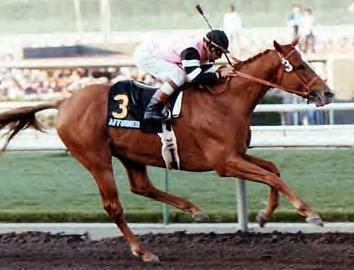
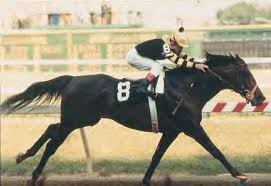
Forty Seven Years Ago In New York – Affirmed v Seattle Slew

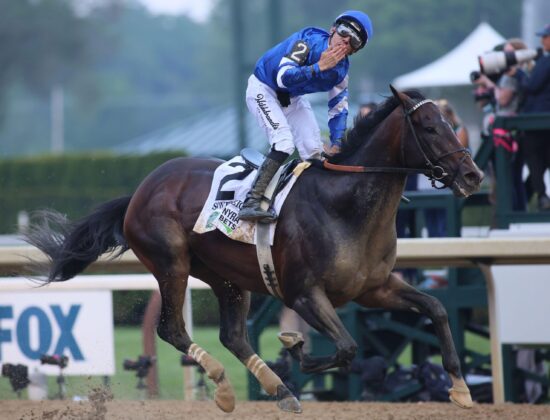
Affirmed-race-horses-4078945-354-270seattleslewIt was 47 years ago that the great Affirmed met the great Seattle Slew at Belmont Park, New York in September 1978. On that fall day in New York the two Triple Crown champions met, an event that obviously has not occurred since. The great Forego led them out on to the racetrack for this epic event. It was a shame that either had to lose – but one did. Watch these two greats fight it out…..

Affirmed v Seattle Slew, Marlboro Cup 1978

Belmont Winter Racing to be Exclusively on Tapeta Track

Edited Press Release, NYRA: Although race dates for 2026-27 are still to be determined, NYRA anticipates this change will amount to approximately three months of racing exclusively on an all-weather surface. This reflects NYRA’s commitment to improving all aspects of winter racing at the new Belmont Park. Shifting from dirt to the all-weather in the winter months will enhance equine safety and provide additional opportunities for NYRA’s year-round horse population for the benefit of the state’s thoroughbred racing ecosystem.
“At its core, our vision for the new Belmont Park is centered around modernizing racing and training facilities in ways that will ensure the sport’s continued success and future growth,” said Dave O’Rourke, NYRA President & CEO. “NYRA has closely tracked the evolution and application of synthetic surfaces, and the relevant data unequivocally supports a shift to the all-weather surface during the winter months.

“Together with the renovated main track and two new turf courses, Belmont Park will provide a multitude of quality options for both training and racing throughout the year,” added O’Rourke. “We will continue to work closely with New York’s horsemen and breeders to ensure a smooth transition as the new facility takes shape.”

In preparation for the consolidation of downstate racing operations at Belmont Park in 2026, NYRA is undertaking a complete evaluation of its overnight and stakes programs to ensure high quality racing throughout the year.

This February, at the request of the Horseracing Integrity and Safety Authority (HISA), NYRA convened a group of leaders to form an All-Weather Surfaces Committee. The committee is chaired by O’Rourke and is tasked with evaluating the impact of various racing surfaces on equine injury rates while studying the feasibility of broader adoption of all-weather surfaces nationally.

“HISA commends NYRA for prioritizing horse safety in its decision to utilize an all-weather racing surface at Belmont Park for winter racing,” said Lisa Lazarus, HISA CEO. “NYRA has shown tremendous leadership through the research and analysis it has undertaken in making these important decisions for the future of the sport.”

In recent years, NYRA has invested in upgrades to a variety of racing and training facilities at Belmont Park, Aqueduct Racetrack and Saratoga Race Course. This includes the installation of an all-weather Tapeta surface over the Belmont Park pony track and the complete renovation of the main track and Oklahoma Training Track at Saratoga. At Aqueduct, NYRA has renovated the main track; replaced the inner dirt with a second turf course and added a new surface to the inner turf course all since 2017.

Following the installation of a limestone base topped by a clay pad, the dirt surfaces at Saratoga now respond exceedingly well to extreme weather while the clay pad offers a more forgiving surface. According to The Jockey Club Equine Injury Database, the dirt surfaces at Saratoga have been the statistically safest among NYRA tracks each year since 2021.

To achieve consistency with the dirt racing and training surfaces at Saratoga, the main track at the new Belmont Park will feature a limestone base topped with a clay pad below the racing surface itself. This structure has proven to be effective in the wide variety of weather conditions found at Saratoga from April through November and will be similarly beneficial for the main track surface at the new Belmont Park.

While the composition of the main track will not allow for its use during the winter months, the addition of the all-weather Tapeta track will allow NYRA to conduct winter racing over a surface optimized for the climate.

“The harmonization of NYRA’s dirt surfaces is yet another important equine safety measure in New York,” said Andrew Offerman, NYRA Senior Vice President of Racing and Operations. “Aligning the composition of the Belmont main track with both dirt surfaces at Saratoga will further NYRA’s ability to conduct world-class dirt racing in the spring, summer and fall.”

In addition to the construction of a new main track and all-weather Tapeta track, NYRA is currently renovating and expanding Belmont’s Widener and Inner turf courses. As a result, both courses will feature additional running lanes, modern drainage and a state-of-the-art irrigation system serviced by a new infield irrigation pond and on-site pump station.

The construction of four entirely new racing surfaces at Belmont is being overseen by Glen Kozak, NYRA Exec. Vice President for Operations & Capital Projects, who has managed the extensive track renovations at Aqueduct and Saratoga. In addition to Kozak and his internal team, NYRA relies on outside soil engineers and architects with surface analysis and testing provided by the University of Kentucky.

“This is a hugely significant project in NYRA’s history, and it’s an honor to be a part of something that will push the sport into the future,” said Kozak. “Our goal is to provide the highest quality and most consistent surfaces in racing, and we have assembled a team that will make that goal a reality.”

Despite the prominent role that New York-based trainers, owners and jockeys have played in the Breeders’ Cup World Championships, the event has not been held at Belmont Park since 2005 due to the antiquated infrastructure and lack of a fully winterized building. Upon completion of the new facility, the Breeders’ Cup has committed to adding Belmont Park to the rotation of host sites.

“We are very supportive of the Belmont Park renovation, particularly plans to put in place a world-class facility with fantastic racing surfaces that offer versatility and the ability to address various seasons and weather conditions,” said Drew Fleming, President & CEO of Breeders’ Cup Limited. “As we said before, if you build it, we will come. We look forward to working with the New York Racing Association to bring the Breeders’ Cup World Championships back to the Empire State when the time is right.”

Pedigree Review – Bay Bridge

When the Group One Champion Stakes was about to be run on October 15, there was hardly a punter who would bet against Baaeed. It was considered Baaeed’s race to lose, and lose he did. In fact, he came in fourth. The surprising winner was the long shot Bay Bridge, who became an instant millionaire. Many blamed the heavy going for Baaeed’s loss, but Bay Bridge won the thrilling contest.”

Bay Bridge’s sire is one of the leading third crop sires in Europe, New Bay, who, with the addition of Bay Bridge, now has three Group One winners from his first crop. A Juddmonte-bred standing at Ballylinch Stud in Kilkenny, Ireland for 37,500 euros in 2022, that stud fee is certain to rise in 2023. New Bay was no slouch at the track himself, having won the Prix du Jockey Club-G1 and earned over a million and a half euros. He went to stud in 2017.

New Bay’s Group One winners from his first crop are Bay Bridge, of course, Saffron Beach, and Bayside Boy, and G3 winner Claymore. Even at this early stage, the pedigrees of all of these top racehorses indicate what New Bay needs in his broodmares to achieve success. Bay Bridge is out of a Multiplex mare; that sire may be little known, but he does bring a dose of Danzig through Danehill and matches the Sadler’s Wells in New Bay with a dose of his own.

Hayyona, the Multiplex mare, adds another cross to Somethingroyal through Habitat, a son of Sir Gaylord, to match what we get through New Bay via Gone West, but of more importance, we get matching appearances by Slightly Dangerous, 5 x 4, herself the Kentucky Broodmare of the Year in 1997, and by the marvelous turf influence Roberto.

New Bay has three sons of Northern Dancer in his pedigree: Colorado Dancer. The Minstrel, and Sadler’s Wells, and Bay Bridge’s dams’ side complements this with Danzig, and that second dose of Sadler’s Wells via his son, King of Kings, making the Sadler’s Wells connection on the zig zag, through a daughter in New Bay and a son in Hayyona, which of course doubles the Fairy Bridge, Blue Hen descendant of Rough Shod II.

So we have in Bay Bridge doubles of Secretariat’s dam, Somethingroyal, Slightly Dangerous, and Fairy Bridge, not to mention the excellent Pretense mare Fall Aspen in New Bay; she was the dam of such as Timber Country, Bianconi, Hamas, Elle Seul and many others. So the mare power is great in this pedigree, as it is in the pedigrees of most top class runners.

New Bay’s grandfather, the ill-fated Dubai Millennium (he died, at five, after only one year at stud, of grass sickness), did not live long enough to create a broodmare sire legacy, sadly, but his son and New Bay’s father, Dubawi, is now twenty years old and has created his own legacy.

It is interesting to note that Dubai Millennium’s sire, Seeking the Gold, has left virtually no legacy, and his sire line, except for Dubai Millennium, is currently non-existent, despite Seeking the Gold’s top class pedigree, as he is by Mr. Prospector out of a Buckpasser mare.

The best broodmare sires for Dubawi are Singspiel (a grandson of Sadler’s Wells), Dansili and his sire Danehill, Green Desert and Galileo. So it should come as no surprise that New Bay is already demonstrating a liking for more Northern Dancer, especially when coming from a second dose of Sadler’s Wells and Danzig, and Bay Bridge exemplifies this, as Multiplex is a son of Danehill (by Danzig) and boasts that extra cross in his dams’ side of Sadler’s Wells, as mentioned.

In fact, all of his best early winners demonstrate this fact. Saffron Beach (G1) offers more Northern Dancer, Bayside Boy offers Danzig, and Claymore (G3) offers the extra Sadler’s Wells, just as Bay Bridge does. Though Hoyyana is the only Multiplex mare to be bred thus far to New Bay, what Hayyona brings to the pedigree marks New Bay as a promising sire, much like his great father Dubawi, who will create first class runners with a similar group of mares that Dubawi has demonstrated such success with.

New Bay joins other promising sons of Dubawi, such as Makfi, Night of Thunder, and Poet’s Voice, and ensures the continuation of Dubai Millennium’s sire line, which provides the powerful dose of Mr. Prospector to inspire all of the Northern Dancer blood that dominates European breeding.

Maryland Jockey Club Announces Intent To Write No-Lasix 2-Year-Old Races

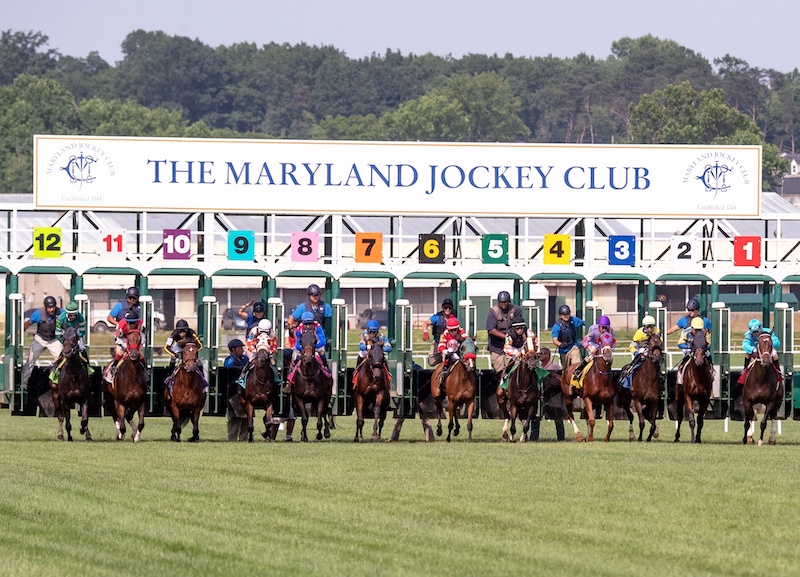
In accordance with the national movement that was initiated by the Thoroughbred horse industries in California, Florida, Kentucky and New York, the Maryland Jockey Club has taken the important and necessary action to inform the Maryland Racing Commission of its plans to restrict races for 2-year-old horses to those whose connections elect not to administer the drug Lasix on race day.

“The time has come to phase out Lasix beginning with 2-year-old horses,” said Belinda Stronach, Chairman and President, The Stronach Group and 1/ST.  “We are following through on 1/ST Racing’s commitment to put horse and rider safety and welfare at the forefront. We believe in the principle that horses should only be racing free of medication. By taking this important step together, the Maryland racing community will become stronger and provide the right foundation for our sport to progress into the future.”

Permitted use of Lasix was first allowed by the Maryland Racing Commission more than 40 years ago on a limited basis and only upon a veterinarian’s examination and confirmation that the horse was a “bleeder” and had a medical need that required the administration of Lasix. Over the years, however, Lasix became a commonly used drug, administered to a large percentage of the horse population to enhance performance rather than as a medical therapeutic.

“The clear weight of evidence shows that what began decades ago as a limited therapeutic to assist the few horses that were problem bleeders has become a crutch for those looking for a competitive edge,” said Craig Fravel, Chief Executive Officer, 1/ST Racing. “The time is now to address this matter and to do so without delay.”

In April 2019, the phasing out of Lasix in 2-year-old horses was announced by a coalition of the country’s major Thoroughbred racing associations and organizations, which include:

  • The Stronach Group’s Santa Anita Park and Golden Gate Fields (California) and Gulfstream Park (Florida)
  • Del Mar and Los Alamitos (California)
  • Churchill Downs Inc. and Keeneland (Kentucky)
  • New York Racing Association (New York)
  • Lone Star Park (Texas)
  • Oaklawn Park (Arkansas)
  • Breeders’ Cup Limited
  • Thoroughbred Owners and Breeders’ Association (TOBA)
  • American Graded Stakes Committee of TOBA
  • Kentucky Thoroughbred Association

Under this program, which began on January 1 of this year, 2-year-old horses are not permitted to be treated with Lasix within 24 hours of a race. Beginning in 2021, the same prohibition will extend to all horses participating in any stakes race at coalition tracks listed above.

In addition, The State of Maryland, in the context of the “Racing and Community Redevelopment Act of 2020,” recognized the important issue of horse safety and established an Equine Health, Safety and Welfare Advisory Committee to ensure that equine safety becomes paramount to the industry.

Street Sense’s Son Maxfield Impresses Upon His Return

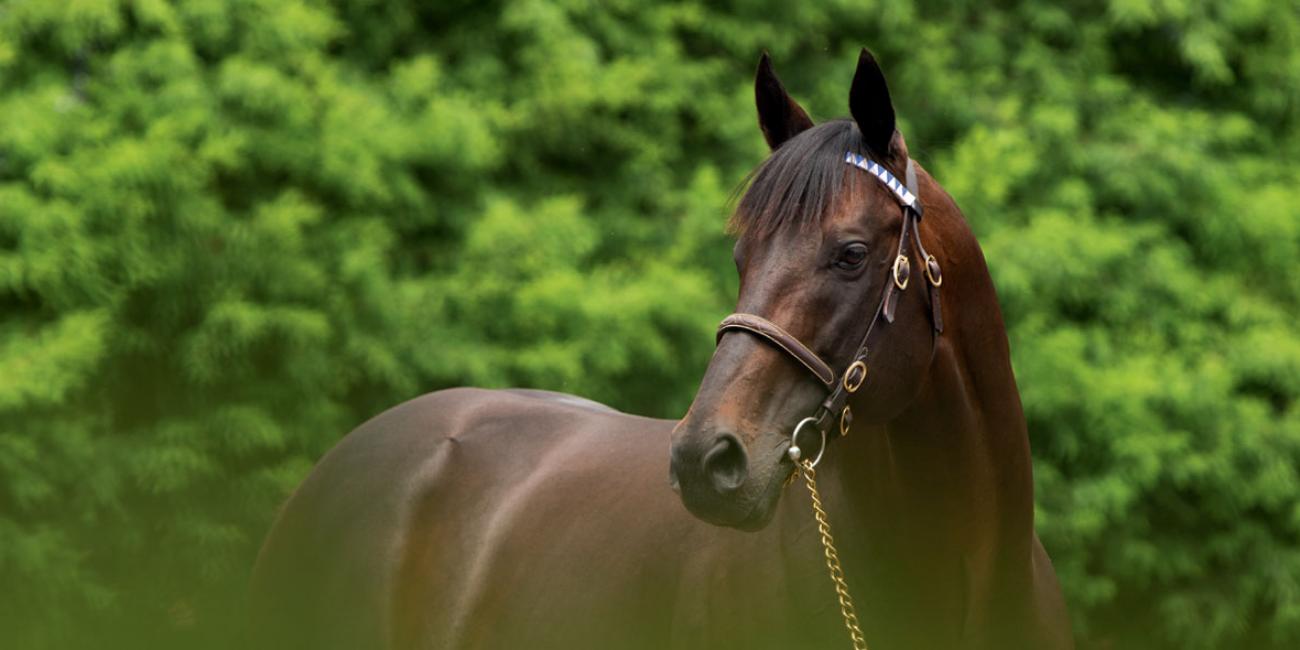
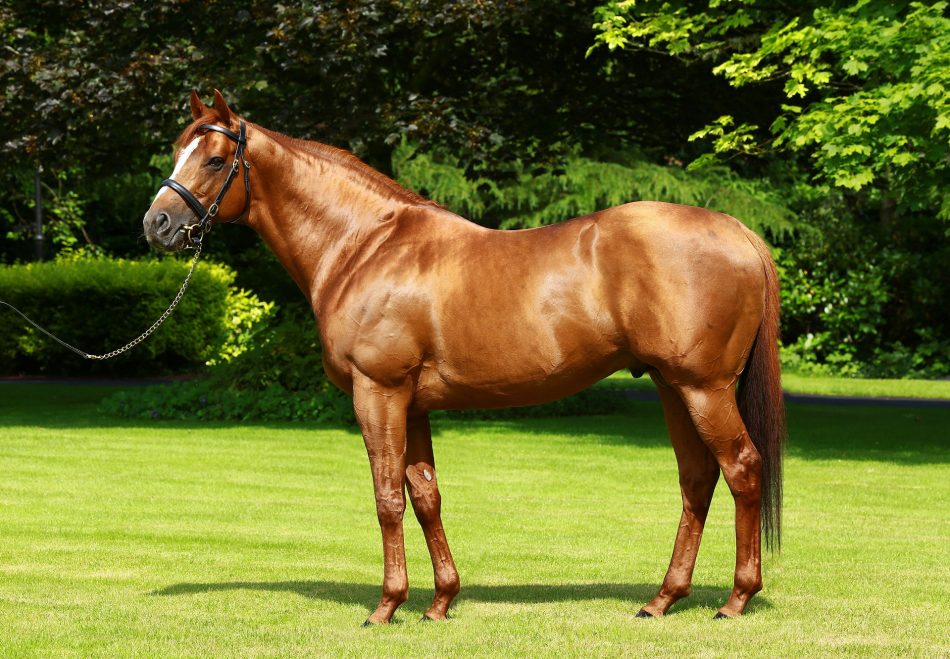
Is there a more exciting horse in training in North America than Maxfield? I think not. The son of Street Sense (pictured) is unbeaten, was brilliant at two before ankle chips sidelined him just before the Breeders’ Cup Juvenile S.-G1, and is one of the handsomest horses you’ll ever see, big and both masculine and elegant.

But doubt always lingers when a precocious two-year-old becomes injured, requires surgery, and has what seems to be an over-lengthy lay-up. Will he come back? Will his form remain the same? Is it possible that he might be even better?

On September 23, Maxfield came back in the Matt Winn S.-G3 at Churchill, creating sweaty palms and dread among his fans. And the G1 winner looked badly beaten as he was shuffled back into the no man’s land between mid-pack and underachievers, and seemed to be laboring. Then Jose Ortiz shook up the reins, steered the gorgeous colt outside, and Maxfield put on a clinic, passing rivals with an ease that made them look like they were standing still, to win convincingly.

This is a race horse. He became my Kentucky Derby-G1 pick last year, and despite the chaos surrounding the Triple Crown Races in 2020, he remains so, despite the front-running thrills of Charlatan and Nadal. Maxfield needs no specific track, distance, nor placing during the race: he simply wins.

Maxfield is by Kentucky Derby winner Street Sense, who stands at Darley in Lexington, Kentucky, for $75,000, and is by Street Cry, who stood at the same stud until his untimely demise. A quick look at Street Sense’s best offspring makes it clear that there is an absolute blueprint for making a stakes winner with him, and makes it equally clear that Maxfield is built upon these same plans, only more so. Inbreeding to Mr. Prospector and to Northern Dancer are essential in the best mates for Street Sense, and a good, close dose of A.P. Indy or Seattle Slew seals the deal. The fact that Mr. Prospector and Seattle Slew share the same, important tail female, Frizette, stamps this combination as significant in contemporary breeding.

Storm Cat is one of the preferred ways back to Northern Dancer, because his Secretariat dam, Terlingua, complements A.P. Indy’s Secretariat dam, Weekend Surprise. Street Sense may be one of the most straightforward stallions to breed to in the whole stud book, because of the similarity of mares that work well with him.

Maxfield’s dam is Velvety, by the upcoming, important broodmare sire Bernardini, out of the multiple graded stakes winner and dam of sire Sky Mesa, Caress. It’s worth noting here that this is a pedigree, top and bottom, that produces sires, as Street Sense’s third dam is Long Legend, the dam of the great Mr. Greeley. More than this, though, Maxfield is 4 x 6 Mr. Prospector, and 4 x 6 x 5 Northern Dancer, fitting the parameters for Street Sense perfectly.

Add in Bernardini’s sire, A.P. Indy, and the one dose of Mr. Prospector through the Fappiano line in Cara Rafaela, Bernardini’s dam, plus Velvety’s second dam, La Affirmed, by Affirmed, adding that rebel dose of Native Dancer, and this pedigree takes shape. Velvety’s third dam is La Mesa, by Round Table, who was by Princequillo, giving Maxfield Princequillo on the zig zag through the two great Secretariat mares, out of the Princequillo mare who was his dam, Somethingroyal, and through Princequillo’s most important son.

On the same day that Maxfield won the Matt Winn S.-G3, two other offspring of Bernardini mares won stakes races: Owendale, who won the Blame S., out of the Bernardini mare Aspen Light, and Dunbar Road, winner of the Shawnee S., out of the Bernardini mare Gift List. Anyone looking to collect a good young broodmare for his or her band should pay attention to this trend.

The pedigree of Maxfield plays one more fine magic trick. Busanda, the dam of Buckpasser, appears, of, course, through A.P. Indy in Bernardini. But Maxfield’s sixth dam is also Busanda, through her daughter Finance, adding Busanda on the zigzag to the pedigree, and making Maxfield tail female La Troienne, as she is his eighth dam. Did I mention this is a sire’s pedigree? The female family of Maxfield could not be stronger. Kudos to Godolphin (Kentucky) for creating this magnificent colt, who will one day stand with his sire, Street Sense, at the beautiful Darley stud farm.

— Roberta Smoodin


Charlatan and Nadal Make it Bob Baffert day in Hot Springs, Arkansas

It was Bob Baffert day in Hot Springs, Arkansas, on the first Saturday in May, and he won everything but the key to the city. His brilliant colts, Charlatan and Nadal, both unbeaten, took both divisions of the Grade One Arkansas Derby, and his precocious filly Gamine remained unbeaten as well in allowance company.
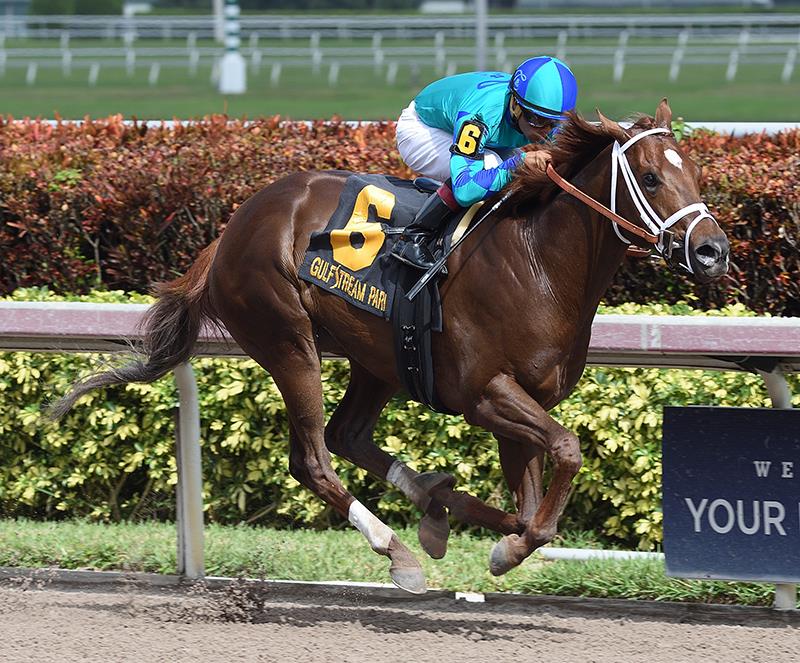
Gamine is by Into Mischief: enough said. Nadal is bred on the proven Blame on A.P. Indy/Seattle Slew line cross, being out of a Pulpit mare. But Charlatan’s pedigree is a bit more of a puzzle. Clearly he looked the part even as a yearling, when he sold for $700,000 at Keeneland September 2018, and his ownership reads like a who’s who of big players.

By the grand old man, Speightstown (1998), who stands at Winstar in Versailles, Kentucky, for $70,000, his race record, pedigree and progeny speak for themselves. Being by Gone West, out of the Storm Cat mare Silken Cat, he is 3 x 4 Secretariat, via arguably the best daughters of Secretariat, Terlingua and Tamerett, with a second dam by Chieftain, echoing Secretariat’s breeding, and a clever 5 x 5 dose of Tom Fool, via Buckpasser on the dams’ side and Tim Tam on the sires’, against representing the best progeny Tom Fool produced.

Speightstown loves mares that offer a Northern Dancer-line broodmare sire, such as El Prado, Sadler’s Wells and Medaglia d’Oro, and also likes an extra dose of Mr. Prospector. But a list of his best produce doesn’t feature any out of Quiet American mares, or any Fappiano-line mares, as Charlatan is. Charlatan’s second dam, Court of Appeal, is by Deputy Minister, just as millionaire and Grade One winner by Speightstown, Golden Ticket’s first dam, was by Deputy Minister, and the latter’s credentials as a broodmare sire can’t be questioned.
Charlatan’s dam, Authenticity, sold in 2013 for $1,200,000 at Fasig-Tipton November, and Charlatan proves her value. She was a winner of $883,362, and finished third to Beholder and Songbird in the Breeders’ Cup Distaff-G1, pretty distinguished company. Though the nick of Speightstown on Quiet American mares only offers us eight foals to examine, seven of those were winners, though none achieved at the level of Charlatan, so this cross has remained unpopular, until now. Quiet American is by Fappiano, of course, a son of Mr. Prospector, but note this with caution: Fappiano is considered his own sire line now, so although we have 3 x 4 inbreeding to Mr. P, the crosses Speightstown seems to prefer are from the non-Fappiano Mr. P sons and grandsons.

So where do we look, to understand the success of this cross in Charlatan? No further than Graded Stakes Winner and leading sire Munnings, easily Speightstown’s best son at stud, who’s having a stellar year with progeny winning, it seems, everything. The key here is Munning’s dam, La Comete, by Holy Bull, who is related to Quiet American through the In Reality/Dr. Fager family.

Charlatan is inbred to Dr. Fager 4 x 5 through Quiet American. Dr. Fager was by Rough ‘n Tumble, out of the Better Self mare Aspidistra, and is closely related to In Reality (by Intentionally, out of My Dear Girl by Rough ‘n Tumble), and to the grandsire of Holy Bull, Minnesota Mac, who was by Rough ‘n Tumble out of Ta Wee, by Intentionally and out of Aspidistra. This is one tough, winning, gritty family that excels on dirt, and was famous, back in the day when this mattered, for carrying weight and winning in handicaps. Holy Bull also adds Mahmoud and more La Troienne, through The Axe II and Grey Dawn, which the two doses of Northern Dancer in Authenticity, the aforementioned Deputy Minister and Lyphard, offer through Natalma/Almahmoud. Charlatan even resembles Munnings, being a smallish, bright chestnut horse, and may mature into the muscleman that his sire is.
One more important element of Authenticity’s pedigree must be pointed out. She has two great Princequillo mares, 5 x 6, via Cequillo and Quack’s dam Quillon. This is an exact twin of Speightstown’s two doses of a single Princequillo mare, 5 x 6, Secretariat’s dam, Somethingroyal, plus the addition, via Chieftain’s second dam, How, of another dose, making Charlatin 6 x 6 x 8 x 6 x 7 Princequillo mares. Princequillo may have been one of the greatest broodmare sires of all time, and this collection of his prized blood through so many mares, relatively close up in Charlatan’s pedigree, must account for some of his dazzling speed.

If you looked Charlatan up yesterday, before the first division of the Arkansas Derby-G1 was run, his pedigree was given a D grade on a major five-generation pedigree site. Today, after winning that race, his pedigree has risen to B level. This only serves to indicate how bogus the analyses are in these computer-generated services. Charlatan had the same pedigree yesterday as he does today. One needs to look further than the sire and broodmare sire to determine potential, and the group that paid $700,000 for this stunning colt certainly did their due diligence.

— Roberta Smoodin


Keeneland, Fasig-Tipton Announce Changes In Medication Policies For All Sales

Officials from Keeneland Association and Fasig-Tipton Company Inc. today announced restrictions on the use of non-steroidal anti-inflammatory drugs (NSAIDs), corticosteroids and bronchodilators, including Clenbuterol, for all horses sold at sales conducted by these two major Thoroughbred auction houses effective immediately.

These latest reforms are in addition to restrictions put in place earlier this year for 2-year-sales held at Keeneland and Fasig-Tipton, and follow action in 2009 to ban the use of anabolic steroids in sales horses and last year’s ban on the off-label use of bisphosphonates in horses younger than four years old.

Keeneland President and CEO Bill Thomason and Fasig-Tipton President Boyd T. Browning Jr. said in a joint statement: “We remain united in our advocacy to serve the best interest of the horse. The use of medication is the most critical issue facing the Thoroughbred industry, and one that threatens the confidence of both the marketplace and the public. These reforms continue to promote transparency and integrity, and in doing so, strengthen the entire auction process.”

Medication Reforms

The following changes in the medication rules will govern all future sales at Keeneland and Fasig-Tipton:

NSAIDs

– All horses except 2-year-olds and horses in training – No more than one NSAID administered within 24 hours prior to sale.

– 2-year-olds and horses in training – No NSAIDs administered within 24 hours prior to sale.

Corticosteroids

– All horses except 2-year-olds and horses in training – No more than one corticosteroid administered within 14 days prior to sale.

– 2-year-olds and horses in training – No corticosteroid administered within 14 days prior to sale.

Bronchodilators (including Clenbuterol)

All horses with exception of broodmares, broodmare prospects, stallions and stallion prospects – Bronchodilators (including Clenbuterol) prohibited within 90 days of sale. The administration of a bronchodilator for valid, on-label purposes prior to July 1 of a horse’s yearling year is permitted, but must be disclosed in the Repository with a note of explanation from the treating veterinarian.

Buyers may now elect to have post-sale testing for anabolic steroids, bisphosphonates, bronchodilators and the use of NSAIDs and corticosteroids in violation of the Conditions of Sale.