By Kimberly French
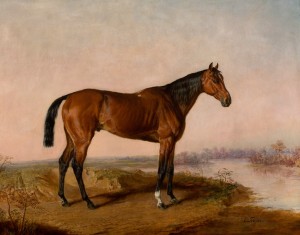 His biography for the National Museum of Racing and Hall of Fame calls him the horse that “time forgot”, as Kentucky was not inducted into this beloved shrine until 1983. It also claims he is “arguably the greatest son of Lexington ever inducted into the Hall.” Although that is certainly a matter up for debate, especially with Lexington’s prowess in the breeding shed, it cannot be denied Kentucky is a well-deserving member of this select circle of Thoroughbred icons.
Bred at the famed Ashland stud by John M. Clay, one of the top such individuals in the world at that time, Kentucky was born in 1861. Out of the mare Magnolia, who was a daughter of the influential English import Glencoe, this colt was a beauty right from birth. A striking bay with a narrow white snip and splash of white on his right front pastern, Kentucky competed only once for the person responsible for his presence on earth. That was as a 2-year-old, when the colt won easily at a new facility in New Jersey.
Clay sold the horse on to John Hunter, an original founder of Saratoga Race Course and the first chairman of the Jockey Club. After the ownership transfer, Hunter appealed to William R. Travers and George Osgood to take pieces of his new prized possession. Both men acquiesced and the trio began to prepare Kentucky for his sophomore campaign.
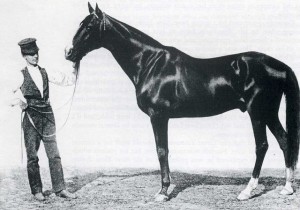 The colt resumed his racing career on June 7, 1864, in Paterson, New Jersey for the first edition of the 1½ mile Jersey Derby. The evidence is unclear as to whether Kentucky’s training had been interrupted or whether he was simply not at his best, but the result was certain: a loss. The colt struggled home a distant fourth behind Norfolk. Norfolk was also sired by Lexington and produced by a Glencoe mare.
According to an edition of the Harper’s New Monthly Magazine (volume 41), “This defeat led to a long and bitter controversy.” Norfolk was taken out West by his connections and never ventured forth to take on Kentucky again to prove which was horse was “superior.”
That contest was the only one Kentucky ever lost in his entire career. Only 48 hours after his trouncing by Norfolk, the colt visited the winners’ circle for the second time in the two mile Sequel Stakes and was then transported to Saratoga. The race track opened its gates for the first time on August 2, 1864. This was only a few weeks after more than 7,000 Union soldiers had met their deaths in a horrific Civil War battle at Cold Harbor, Va. At the “Spa” however, the attendees were far removed from the gruesome spectacle of war and their attention was firmly affixed to the wonders of Thoroughbred competition.
The very first Travers Stakes was the first racing event on the agenda at the new racing facility. The contest was named in honor of William R. Travers, one of Kentucky’s three owners and the president of the Saratoga Association. Kentucky annexed the race by a widening three lengths with fellow future Hall of Famer Gilbert W. Patrick holding the reins. After cruising home in the Travers, Kentucky captured another two mile race at Saratoga and then traveled on to New Jersey, where he won three more races in five days, one of which was the Jersey St. Leger at 2 ¼ miles.
His Hall of Fame biography called him “the undisputed best horse in America” during his four and five year seasons. He raced seven times from June to October of 1865 with one triumph coming in the first ever Saratoga Cup, which was quite prestigious in its day, and two other victories being walkovers, because no one wanted to run against him.
In 1866 at age five, Kentucky would once again remain undefeated. On June 6 in New Jersey he held Norwich at bay in two mile heats. Twenty four hours later he won a three mile race in 6:04¼. The very next day he repeated the same exact feat, except his time in the first and second heats was swifter. After the stallion galloped 13 miles in 72 hours, his connections afforded him the opportunity to rest until Saratoga reopened.
Upon his return Kentucky collected his second Saratoga Cup and then went four miles in a walkover performance, as his prep for Jerome Park’s Inaugural Stakes. Contested as four consecutive four mile heats, this race also proved quite facile for the stallion as he came home virtually unchallenged.
After his appearance in New Jersey, Kentucky was sold to Leonard Jerome. The man whom the Jerome Handicap was named for and the grandfather of Sir Winston Churchill, was smitten by the son of the Lexington, as were most followers of the turf. In fact, he offered his connections $40,000, the highest price ever paid for a horse, to obtain him. Understandably, Kentucky’s owners decided to part with him and he proved the price paid was worth its weight in gold with another easy win in the Grand National Handicap. It would be the only start Kentucky ever made for Jerome, as he gave anywhere from 19 to 24 pounds to the rest of the field. With his win streak now at 20, Jerome decided there was nothing left for Kentucky to accomplish.
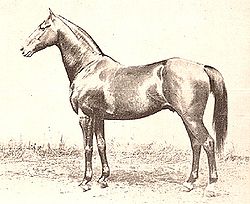 Harpers contends that was not exactly the case. As Kentucky’s half-brother Norfolk was gaining esteem out West, another half-brother, Asteroid, was building his own following in the Midwest.
“Distance separated the three half-brothers: each won renown on fields highly apart,” the magazine said. “Each was claimed the superior of the other and it was the fond dream of enthusiastic turfmen to bring them together in a race for the honours of supremacy. But the dream was never realized. The controversy between the friends of Kentucky and Asteroid, especially, was marked with much feeling and the names of the two horses were daily in the mouths of thousands.”
The Hall of Fame biography does not mention it and the book The Thoroughbred by E.S. Montgomery states the owners of Kentucky and Asteroid had arranged two match races between them. One would be held in New York and one would be contested in Louisville, which was Asteroid’s home track. The winner of those two contests would take all of a $20,000 pot. Harpers, however, says nothing of a match race and merely that the two horses were slated to meet in the Inauguration Stakes.
“When it was known that Asteroid had left his paddock at Woodburn to journey East, the excitement was intense in turf circles and the trains brought to New York crowds from all over the Union, including far-off Texas,” the magazine said. “The coming race was an all absorbing topic of conversation. Every morning hundreds of visitors went out to Jerome Park to see the horses at work. Asteroid was one of the grandest looking horses to ever tread the turf and one had only to see him to admire him. Kentucky was also a magnificent appearing animal and his friends maintained confidence in his prowess.”
Then as often transpires in horse racing, the revered meeting between these two titans of the turf vanished into thin air.
“But one Sunday morning a gloom fell upon all hearts,” Harpers said. “Lip spoke to lip and the intelligence rapidly spread that Asteroid had broken down in a trial gallop in the mud. He had sprung a tendon and his career as a racer was abruptly brought to a close. The disappointment was great. Sad faces were seen on all the drives to the Park; and as the story was told, a tear dimmed more than one eye unused to weeping.”
Two years after his retirement they brought Kentucky back to the track to eclipse his sire’s world record mark for four miles (7:19¾). Jerome even wagered $5,000 that the stallion would establish a new speed standard for the distance.
The contest against the clock took place on Thursday, October 17, 1866 at Jerome Park before 20,000 witnesses. Kentucky carried 120 pounds and jockey Charles Littlefield. Three miles into the event he was two full seconds ahead of Lexington’s time, although his sire had only carried 103 pounds in his time trial. In the stretch, Kentucky clearly illustrated he had enough and attempted to bolt. When he hit the wire his time was 12 seconds slower than Lexington’s.
“Kentucky was badly ridden, was outpaced in the first two miles and lost the race by the equivalent of 11 and three quarter lengths,” Harpers said. “The only time that the people ever saw him show signs of distress was when he was coming down the homestretch in the last mile; he was weak, he was tottering and his courage failed him. Even had he been properly managed on that lovely October day, we do not think he could have been successful. The task was too great for him – he was overmatched. He carried too much weight; and every ounce tells upon the speed and endurance of a horse, especially in a struggle over four miles. By weight you can reduce the fleetest and gamest racer in the world to the level of the most common hack. Kentucky is not a stronger horse than Lexington was and Lexington carried but 103 pounds.”
A year after his last appearance on the track, Kentucky was sold through auction for $15,000 to August Belmont. He took up residence in Belmont’s Nursery Stud until he passed away in 1875 at age 14. Coincidentally, that was the same year his great sire perished, but Kentucky never replicated the success in the breeding shed Lexington enjoyed. He did sire the champion filly Woodbine (1869) and the stakes winners Bertram, and the filly Elastic (1871).
 Say you had squirreled away four and a half million dollars somehow, and decided to buy the best mare your money could get you. The 2018 Fasig-Tipton November Sale and day one of Keeneland’s November Sale offered opportunity galore, in the glorious presences of Stopchargingmaria, Lady Eli, and My Miss Sophia. I’m not ignoring the staggering price paid for Lady Aurelia by Barbara Banke at Fasig, $7,500,000, but the fact that she was buying out a partner indicates that she was paying only fifty to seventy-five cents on the dollar, in all probability. As we will never know the real price paid by Banke of Stonestreet Thoroughbred Holdings, and because Lady Aurelia is such a collector’s item with deep personal meaning for Ms. Banke, leaving her out of the four-million-dollar question seems to make sense.
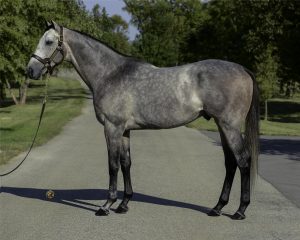 Once the Breeders’ Cup Juvenile races have been run, an assessment of the leading freshman sires can finally be made, and this year, as usual, those results have skewed the leading freshman sires ranks, as Cross Traffic, with his filly Jaywalk (who also won the Frizette S.-G1) winning the Breeders’ Cup Juvenile Fillies-G1, making her a millionaire in the process, and bringing his first crop earnings to $1,942,157.
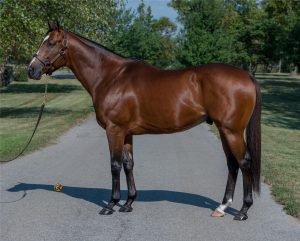 Second place is held by Goldencents, a son of Into Mischief, whose progeny have earned over a million dollars without any single dominating earner—there is no Jaywalk to catapult his earnings into first place, but he instead has had 22 winners and five black type stakes horses. More than this, though, Cross Traffic and Goldencents represent a Spendthrift exacta, a rare occurrence in freshman sire standings. Spendthrift is known for its creative approach to breeding, offering breeders many options to share in its young stallions without having to spend a fortune (sometimes, payment is even deferred until the weanling or yearling sells at public auction). B. Wayne Hughes has implemented and spearheaded alternative approaches for breeders, and this year’s freshman sire list reflects how well that creativity and flexibility work. Goldencents’ average yearling sold for $46,979, indicating that, like Cross Traffic, those first yearlings sold pretty well, though not into the rarefied air of the sires who inspired buyers as American Pharoah and others have.
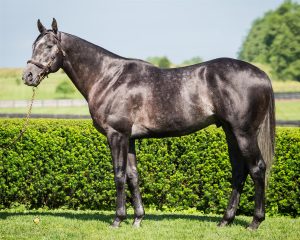 Cairo Prince is in third place, with a yearling average of $151,657—Airdrie Stud, where he stands, supported his first foals brilliantly and tirelessly, and this handsome son of Pioneer of the Nile, standing for $25,000 initially, seemed poised to hit. His first crop earnings, thus far, are short of the million dollar mark reached by both Cross Traffic and Goldencents—at $866,198, and with his biggest earner, Cairo Cat, with only $133,750 to his credit, it would seem that buyers spent too much to guarantee a good return on investment from Cairo Prince. Though Cairo Prince himself was precocious, he did excel as a three-year-old as well, winning the Holy Bull S.-G2 by nearly six lengths, so it would seem too early to pass any sort of judgment on the offspring of this young stallion.
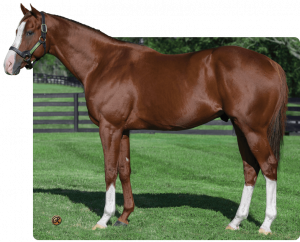 Breeders’ Cup Classic-G1. His first crop inherited his good looks, and averaged $151,931 for yearlings, making him the star sire of this freshman crop by selling price. His dams’ side is one of the hottest, featuring 2013 Broodmare of the Year, Take Charge Lady, by Dehere, and a Rubiano second dam, making him double-bred Fappiano, another trend to be recognized.
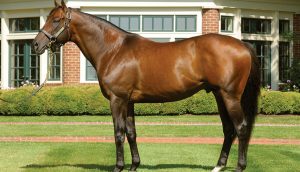 When Leofric, by Candy Ride, won the Grade Two Hagyard Fayette S. at Keeneland on October 27, many things were at work to guide him to victory, among them weather and mud, because the favorite, Hofburg, clearly labored. Owned by Landers Racing, LLC, bred by Peter E. Blum, trained by Brad Cox, and ridden smartly by Florent Geroux, Leofric inherited his sire’s proclivity for getting mudders, as well as having a pedigree that in so many ways mimics that of Candy Ride’s very best runner, the magnificent Horse of the Year Gun Runner, who is out of a Giant’s Causeway mare, and whose second dam is by Quiet American, making him 4 x 4 Fappiano.
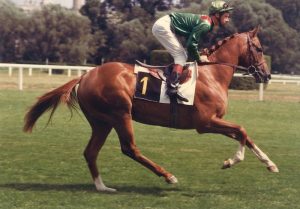 What also seems clear is that, though Cryptoclearance hasn’t become a sire or grandsire of sires across the board, if you add another, stronger dose of the Fappiano line to Candy Ride, you get something special. As well, adding to the American speed on top, is European staying power through Blushing Groom in Candy Ride’s pedigree. Blushing Groom’s affinity for Nijinsky II is well known, but Storm Bird is bred so similarly to Nijinsky that his presence in a mare’s pedigree enhances Candy Ride’s strengths; it’s worth noting how well Storm Cat has worked with Blushing Groom-line mares, because of this great nick—think Giant’s Causeway and Freud, for example.
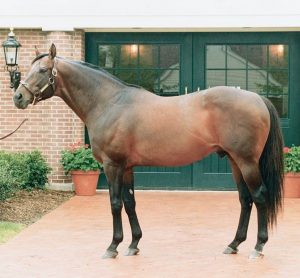 The Fayette S. first three finishers demonstrate such a similarity that an alien being seeking to learn about thoroughbred breeding from this race would assume that the entire thoroughbred genepool consisted of no more than four horses—Fappiano, Nijinsky II and his close relative Storm Bird, Blushing Groom, and Secretariat. Young Twirling Candy’s best progeny reflect the same proclivities as his sire’s, littered with runners out of Storm Cat line mares, Fappiano line mares, Blushing Groom line mares, etc. In fact, his best runner to date, Finley’sluckycharm, was out of a Victory Gallop mare, and Victory Gallop, of course, was by Cryptoclearance—a twinning of that son of Fappiano, top and bottom, making Nice Not Nice 4 x 3 Cryptoclearance, and 5 x 4 Fappiano. Twirling Candy’s other top winner, Danzing Candy, is 5 x 5 Fappiano (through Unbridled on his dams’ side), and his second dam is by a son of Nijinsky II. The evidence doesn’t lie; these patterns aren’t mere coincidence.
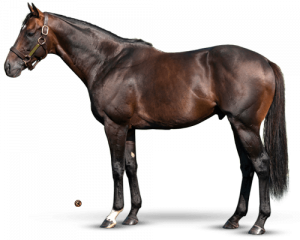 A 70/1 long shot winning the Grade 1 Breeders’ Futurity S. at Keeneland on October 6 created a frisson of excitement for the crowd, trainer Ben Colebrook winning his first graded stakes, jockey Albin Jiminez ditto, and especially second crop sire Paynter, whose first two crops had not been setting the world on fire—until now. The colt, Knicks Go, took the Futurity with ease, full of run, eventually winning by 5 ½ in a win that was never in question. On a race day full of thrilling upsets, Knicks Go was the star, and he will now undoubtedly go to the Breeders’ Cup Juvenile-G1 as the Futurity provided him with the coveted “win and you’re in” opportunity.
 Press Release:
 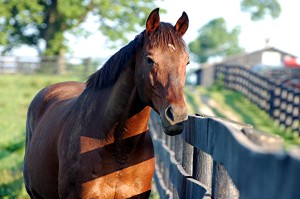 Intelligence. That is the quality that separates good horses from champions, Michael Blowen, founder and president of Old Friends, is fond of saying. Horses with a lot of intelligence are the ones to watch because they will become great champions.
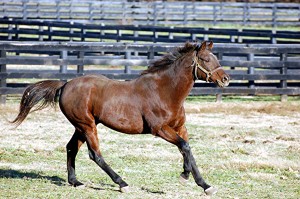 Gulch was loved by many people, which was evident by those who came to see him from all over the world. It is said he was Queen Elizabeth’s favorite horse and she would visit him while staying at Lane’s End farm whenever she came to Kentucky. Gulch was also a favorite of Laura Hillenbrand, author of Seabiscuit. She had the opportunity to finally get to see him last Fall while on a road trip. The day she arrived, Gulch was getting an acupuncture treatment and she got to hold his lead while they were doing the procedure. It was a moment she says she will never forget. Gulch had a presence about him and almost everyone that got to see him while taking a tour of Old Friends would come away knowing they had seen greatness.
 After that win, Gulch was retired and stood at stud at Lane’s End farm in Versailles from 1989 to 2009. There he sired a number of great champions, which included 1995 Kentucky Derby and Belmont Stakes winner Thunder Gulch, as well as other Grade 1 winners such as Court Vision, Great Navigator, The Cliff’s Edge and Wallenda, who is also a retiree at Old Friends.
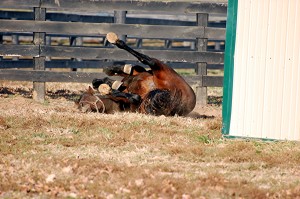 Blowen did not hear anything for a couple of weeks, and then got a call from Bill Sellers, assistant stallion manager at Lanes End. Sellers said he heard Blowen had made a request for Gulch and asked if he could come over and look at the farm. Blowen said yes, and later that afternoon Sellers arrived at Old Friends to look around.
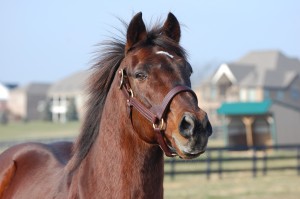 Sure enough, just a few days later, a Lane’s End horse van drove up the long driveway to the barn and Gulch was led off the trailer and into the paddock where he would begin his retirement at Old Friends. It was something to see, as Gulch stood tall and proud, surveying his new surroundings. Then he slowly began to trot around his paddock with his held head high, making sure everyone knew the champion had arrived.
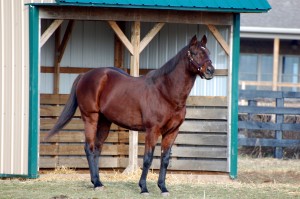 After topping off his bucket, I’d just stand there in the quiet of the late afternoon; the only sounds to be heard were the two horses chewing, and birds chirping in the trees. There, as the setting sun’s soft light fell all around, I’d lean against the fence and just watch Gulch enjoy his meal. As he ate, he would sometimes lift his head and look at me, with eyes that were so soft and welcoming. Those are special moments of Gulch I will always remember.
 When Parx has its biggest race day, with two million-dollar grade one races on the card, the Cotillion S. and the Pennsylvania Derby, the biggest guns come out. No surprise, then, that the jockey known by the nickname Big Money won both, on September 22, 2018, within the space of a single hour. Smith is certainly one of the greats of all time, and his brilliant ride on Midnight Bisou, which resulted in the disqualification of the previously unbeaten Monomoy Girl, and his confident, chilly hand ride on McKinzie, proved you can have no one better at the controls. Smith is simply the Master. Whether he’s riding for Baffert or Asmussen, betting on Big Money Mike is the ultimate no brainer in racing.
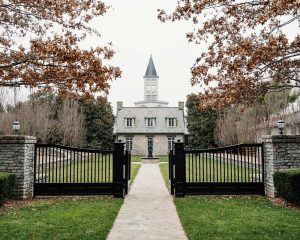 The history of the Triple Crown can be traced to 1919, when horse racing writers took note of the first winner of the Kentucky Derby, Preakness Stakes, and Belmont Stakes, the great Sir Barton. However, 1930 was the year when the phrase became common parlance, when Gallant Fox won the Triple Crown for his breeder, Belair Stud, and then, five years later, his son Omaha also won the Triple Crown, the only father/son duo to complete such a feat, and for the same breeder. Both were trained by Sunny Jim Fitzsimmons, the only trainer in history to train two Triple Crown winners, until this year. Both were retired to stand at stud at Claiborne Farm, Gallant Fox in 1931 and Omaha in 1936, though Gallant Fox was a highly esteemed sire there for many years, while Omaha, lacking in fertility, was sent in 1943 to New York and later to Nebraska.
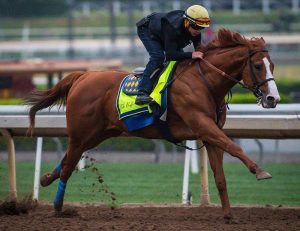 Now, this year, a spectacular horse and his magical trainer enter this rarified atmosphere. Justify, a man among boys from the first time race fans laid eyes upon him, is our Triple Crown hero, trained by the silver haired wonder Bob Baffert, who won the same prestigious prize in 2015 with American Pharoah. Justify, owned by a conglomerate of owners that includes the China Horse Club, Head of Plains Partners, Starlight Racing and Winstar Farm, among others, announced Friday, September 14, that the long-rumored agreement to stand Justify at Ashford Stud (Coolmore America), in Versailles, Kentucky, had become reality, and Ashford too joins this elite company, with Claiborne and Calumet, as only the third farm to ever stand two Triple Crown winners at the same time.
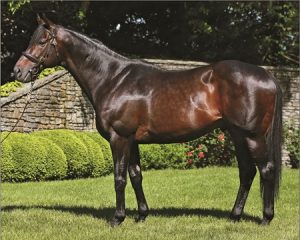 Justify is a magnificent chestnut colt by Scat Daddy, out of the Ghostzapper mare Stage Magic, and Baffert further tempted the racing gods by leaving the colt unraced at two. His career began at three, and no other unraced two-year-old has ever won the Triple Crown. Justify was considered to be completely untested, and disbelievers and naysayers abounded before the Kentucky Derby, only to be silenced by Justify’s magnificent win. Even the Preakness win couldn’t silence the cynics, who predicted a son of Scat Daddy would never win the mile and a half Belmont Stakes. Once again, wrong. The great sadness is that this big, gorgeous, muscular hunk of horseflesh will not be running in the Breeders’ Cup Classic; he was retired with filling in an ankle that prohibited training.