Thoroughbred People’s Equine Legends Series: Fashion

Fashion and PeytonaBy Kimberly French

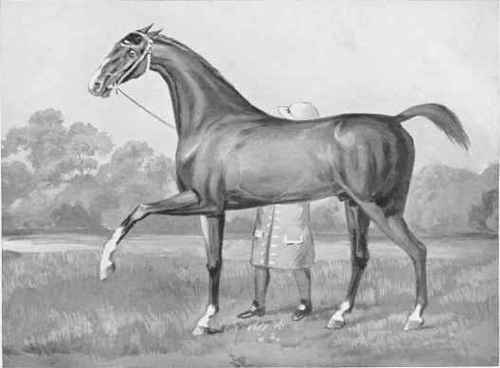
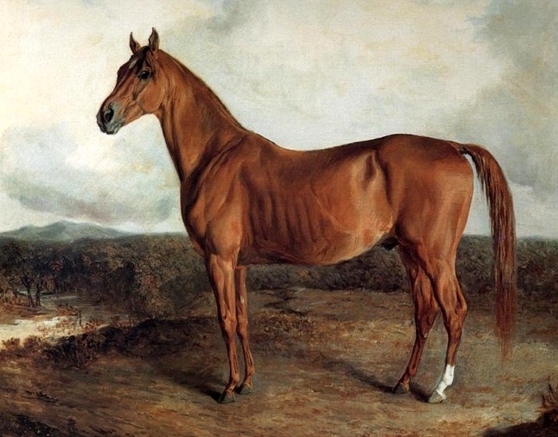
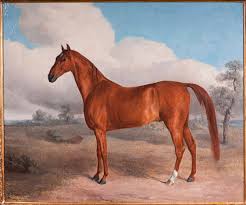
On the authority of Spirit of Times, Fashion, one of America’s first great race mares and a member of the National Museum of Racing and Hall of Fame “is a rich, satin-coated chestnut, with a star, and a ring of white above the coronet of her left hind foot: on her right quarter she is marked with three dark spots, like Plenipo, and other “terribly high-bred cattle.” While the beginning of the unknown author’s description sounds less than flattering he or she states, “her great excellence consists in the muscular developments of her quarters, thighs and gaskins. As in the greyhound and the hare, the seat of the propelling power in the horse, which enables him to move with a great degree of velocity, is centered in his hindquarters: necessarily in proportion to their strengths there, will be the impulse which impels the whole mass forward.”

Whether the disposition towards or opinion of Fashion in regards to this particular writer is positive or negative, it cannot be disputed the daughter of Trustless and Bonnets O’ Blue was a superb performer. In fact, she defeated the mighty Boston twice, her career spanned eight years and there were only four occasions she did not finish first. In addition, her four mile standard of 7:32 ½ existed for thirteen years. Unsightly spots on a horse’s quarters do not detract from their capability to perform.

Born on April 26th 1837, at William Gibbons’ establishment in Madison, New Jersey, Fashion was descended from some of the most elite horseflesh in the country. Her sire was imported from England, where he finished third in the 1832 Derby, by steamboat and railway magnate Robert Stockton. Until he passed at the age of 27, Trustree never was assigned a high stud fee or attracted a bevy of mares but he sired Revenue and Levy. Revenue went on to become a top racehorse and leading sire himself in 1860, while Levity’s line was responsible for such horses as Luke Blackburn, Salvator, The Bard and Tammany.

When it comes to female tail lines Bonnets O’ Blue was one of the finest broodmare prospects in the United States during her time. Sired by Sir Archy’s excellent son Sir Charles and foaled by Reality, who defeated her mate as well as Timoleon during her career, she was referred to as “one of the greatest racehorses ever seen.” Therefore, Bonnets O’Blue possessed all the right genetic material to dominate as a racehorse and she did not disappoint. She won five of seven starts at age six and hit the wire before Goliah, Black Maria and St. George.

Gibbons purchased her in the fall of 1836 for $2,500 with Mariner, a colt by Shark, at her side and Fashion in utero. Mariner also was a very talented racehorse, but none of Bonnet O’ Blues remaining seven foals ever achieved the stature of her first two. Indeed three of her progeny had the misfortune of perishing before reaching adulthood.


Fashion and Peytona

Fashion’s Early Career

As Gibbons, who refused to wager on any of his racehorses, a rarity at that time, was concerned about the complications encountered when breaking Mariner, Fashion was not placed into training until she was three. She was placed under the care of Samuel Laird, a former jockey and new employee for Gibbons. He was told to never rush her or push her along. Gibbons must have been pleased with how Laird reacted to his instructions as he remained her trainer every time she competed and his son Joe was her regular pilot.

Fashion debuted in the fall of her three-year-old season with triumphs in two-mile events at Camden and Trenton in the Garden State. She commenced her four-year-old campaign at Union Course on Long Island in a three mile heat by defeating four contestants. Her second start was a four mile heat race, but the mare was not at her best due to a cough and finished third. Given ample time to recover her health, Fashion returned to the track that fall at Union Course in a two-mile heat in the mud where she won with ease. Her next performance was in a three mile heat race in Baltimore that was also over a rain soaked course, where she bested John Blount.

In October, she took on the venerable Boston and John Blount at Camden, New Jersey, in her first four mile set of heats. She reigned victorious as John Blount broke down and she was much the best over a tired Boston. He had stood stud that winter and spring, was now eight and laid it all out when winning his last race, which was against Fashion’s older half sibling Mariner.


The Great North South Match Race

With the nation literally in stunned disbelief that Boston had lost and his owners, James Long and Colonel William Johnson, not classy in defeat, a gauntlet was laid down to “the Friends of the distinguished Race Nag, Fashion) to meet Boston yet again in a $20,000 match race. The race was to be held at Union Course during the spring and would consist of four mile heats. Ironically, Long and Johnson were the individuals who sold Gibbons Bonnets O’ Blue, so how could they ever refer to her as a nag?

Gibbons was not at all inclined to run any of his horses in match races. It simply was not how he conducted his stable, but he grudgingly gave way on November 20, 1841, 24 hours before the challenge expired. His proxy for acceptance of the meeting was issued through his friend Henry Toler, the New York Jockey Club Secretary. The date for the event would be May 10 and the nation worked itself up into a fervor prior to the time the horses took to the course.

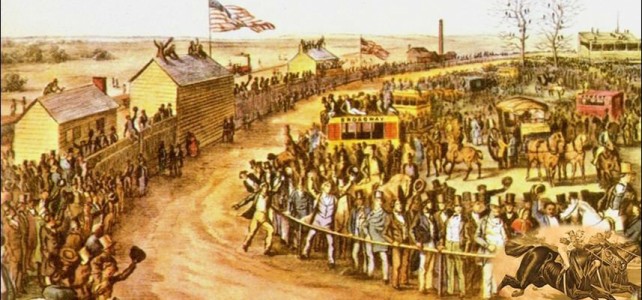
Billed as a contest between North and South, people were making such outrageous wagers on which horse would win based on their regional biases, many men bet their whole farms. It was claimed no other contest had the magnitude of this match race since that of Eclipse and Henry in 1823. That race was also considered to be a battle not between horses, but of the regional areas of the nation.

With estimates of more than 40,000 spectators on hand to witness the event, the crowd was privy to the performances of two great champions. Boston cut himself quite severely on his sheath when hitting the rail and both horses were bothered by the throngs of people that were so close to the racing oval. Ultimately, Fashion, who was competing with an injured hock sustained by a kick from another horse prior to the match race, defeated Boston. This is when she set her world record time.

At the dinner after the Great Match race, Long issued another challenge to Gibbons for the two horses to meet yet again that year, but Gibbons refused. Fashion was turned out for three months and returned to work in October. She closed out her season with three more triumphs and she had galloped under the 7:40 American record for four mile heats on three occasions.


Fashion and PeytonaAfter the Defeat of Boston

In 1843 and 1844 Fashion won 13 consecutive races and became an American icon. She was worshipped as a Queen of the Turf and even had steamboats as well as hotels named after her. The mare even became a brand name for products such as molasses, brandy and ladies gloves. Fashion was the equivalent of a modern day superstar.

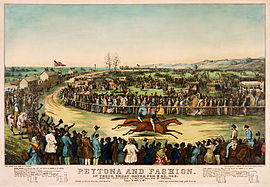
In 1845, however, the country was clamoring for yet another regional match race after the mare Peytona had captured five straight the previous year and won more purse money during her racing days than Fashion. The date for their $10,000 meeting was set for May 15, 1845 at the newly remodeled Union Course.

It was an absolute zoo as over 70,000 fans were on hand and the crowds were so problematic to herd, the race started an hour late. The number of people clearly bothered Fashion and the mare lost by a length to Peytona in the first two heats. It was the last time the regional match races ever took place and was a mere 15 years before the outbreak of war.

Fashion atoned for her lose to Peytona just 13 days later when she bested that rival in the Jockey Club Purse and finished out her season with one more victory. The following year, at age nine, she captured all three of her starts and at age 10 competed on two occasions with one win over Passenger as well as one loss to that opponent.

The amazing mare returned to the racetrack in 1848 at 11 years of age amidst the public’s contention she had accomplished enough and deserved her time in the field. She started three times that year, beating Bostona in May, losing to her in the fall and then closing out her career with a facile victory after Bostona was withdrawn.

In nearly all her races as an older campaigner, she gave away considerable amounts of weight to younger rivals and continuously competed in four mile heats. It is astonishing how she managed to maintain that type of form and longevity over that many seasons. It is obvious why American citizens adored her.


Fashion and PeytonaFashion’s Second Career

While Fashion produced seven foals in nine years, none of her offspring replicated her form on the turf. Her first three matings where to her half -brother Mariner and her first foal, which was a colt, died while he was quite young. Her two fillies who followed were modest horse races and decent broodmares but not exceptional.

In 1956, Fashion was sold to John Reber of Lancaster, Ohio, in foal to Monarch with her yearling and weanling fillies. She was sent to the stallion Lexington that year, but failed to catch, but produced the colts Revenge (Monarch) and Dangerous (Bonnie Scotland) in 1858 and 1859. Fashion perished in 1860 while giving birth to a Bonnie Scotland filly. The filly failed to make it as well.

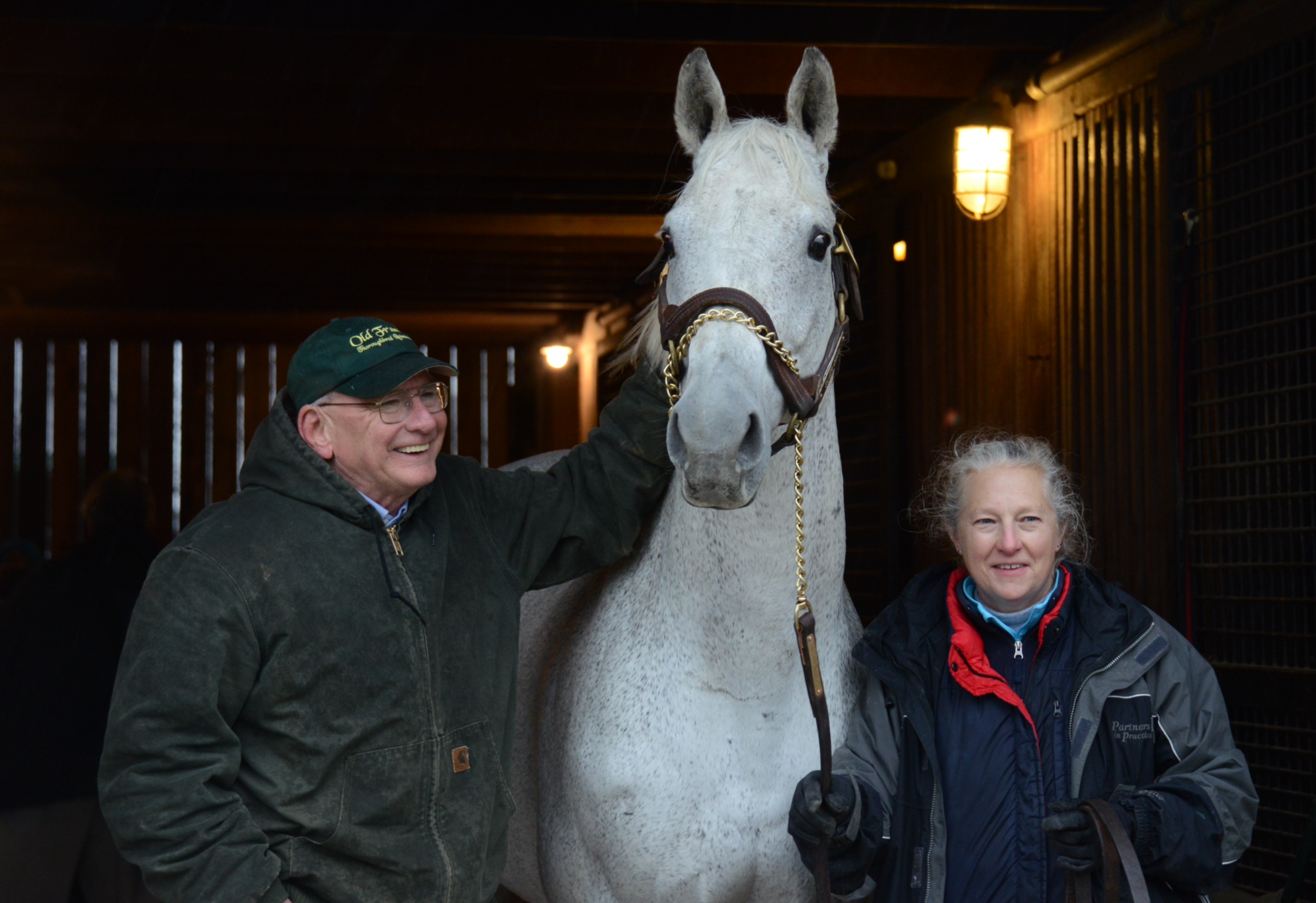
The Interviews: Michael Blowen, Proprietor of Old Friends

WEB_Pops_Ring_Capone

Originally founded in 2003 by former Boston Globe film critic Michael Blowen, Old Friends today cares for more than 100 horses across three states whose racing and breeding careers came to an end. A “living history museum of horse racing”, the farm attracts nearly 20,000 tourists annually. Thoroughbred People talked to Michael about the operation

TBP: How did you get involved with horses and how did Old Friends begin?

MB: An editor at the Boston Globe where I used to work invited me to Suffolk Downs one day. I went a few more times and just fell in love with the sport.

I thought if I learned more about horses themselves I could become a better handicapper and so I apprenticed myself out for a couple of years to a claiming trainer at Suffolk Downs. He was known as the King of the Fairs. He would get old horses with some back class ready for a couple or races, but then they would disappear off the scene. It was the disappearing part that I wondered about, they used to tell me that they had found homes for these horses at riding academies in Maine.

The truth of the matter was that they were just going to the meat buyer. A lot of owners are kept in the dark by trainers about what really happens to their horses when they finish racing.

I did some stories on some of these horses, one of them was a horse called Saratoga Character who ended up in a wonderful program that the Thoroughbred Retirement Foundation ran. I got connected to them, one thing led to another and when I retired from the Boston Globe the TRF asked me to become their Operations Director.

It was a wonderful experience with Amazombie_Caponewonderful people. I discovered however that nobody in the horse retirement business was interested in taking pensioned stallions because they were considered too much trouble, too temperamental and too tough to handle. I thought maybe if we started rehoming some stallions we might be able to get a public following and people might pay to visit them and help support the operation.

TBP: How did you go about getting land and a facility?

MB: We started out leasing some land and then leased a little more, then we picked up the 52 acres in Georgetown which we now own. We always need more land as we usually have a waiting list. I just signed a lease on a property next door to us which is 47 acres, and there is another opportunity to get another 100 acres, which would be great. 

TBP: Do you sometimes get horses that you retrain to go on to become riding horses or to compete in other spheres?

MB: If we have a horse sent here that can be retrained we will send them over to New Vocations in Lexington who do a great job in that area. Likewise, if they get a horse over there that is proving to be a problem and can’t be retrained they will come here.

bobbyfrankelTBP: Tell us about the New York operation of Old Friends, and how it came to be named after Bobby Frankel.

MB: Cabin Creek in New York is very successful, it’s run by Joanne Pepper and her husband Mark with a lot of wonderful volunteers.

I didn’t personally know Bobby Frankel, but the first great stallion we got here was a horse called Ruhlman, who Charlie Whittingham trained after Bobby had him. Ruhlman came to us with a real reputation, Peggy Whittingham told me that he was the only horse Charlie was ever afraid of. When he got here he was very tough, but after a few months he mellowed. He would roll over on his back and let you scratch his stomach and all kinds of things.

Bobby won the Woodward Stakes with Ruhlman and I ran into him at Saratoga just after Ruhlman had come to us. I said “Mr. Frankel, my name’s Michael Blowen. I have your great horse Ruhlman at my farm.” He said “That’s nice” and just walked away.

ruhlmann_oldfriends298About two days later he taps me on the shoulder and says “Aren’t you the guy with Ruhlman? I loved that horse, he was the toughest horse ever. I was really sorry I had to send him to California but I am glad he was successful out there.”

That was the longest conversation I ever had with him. Then when Bobby died, Dottie Ingordo, who worked for him, called me and said that Bobby had left Old Friends a lot of money and most of his trophies.

He donated well into six figures to us. He was a New York guy and that’s how Old Friends at Cabin Creek, The Bobby Frankel Division came to be named in his memory.

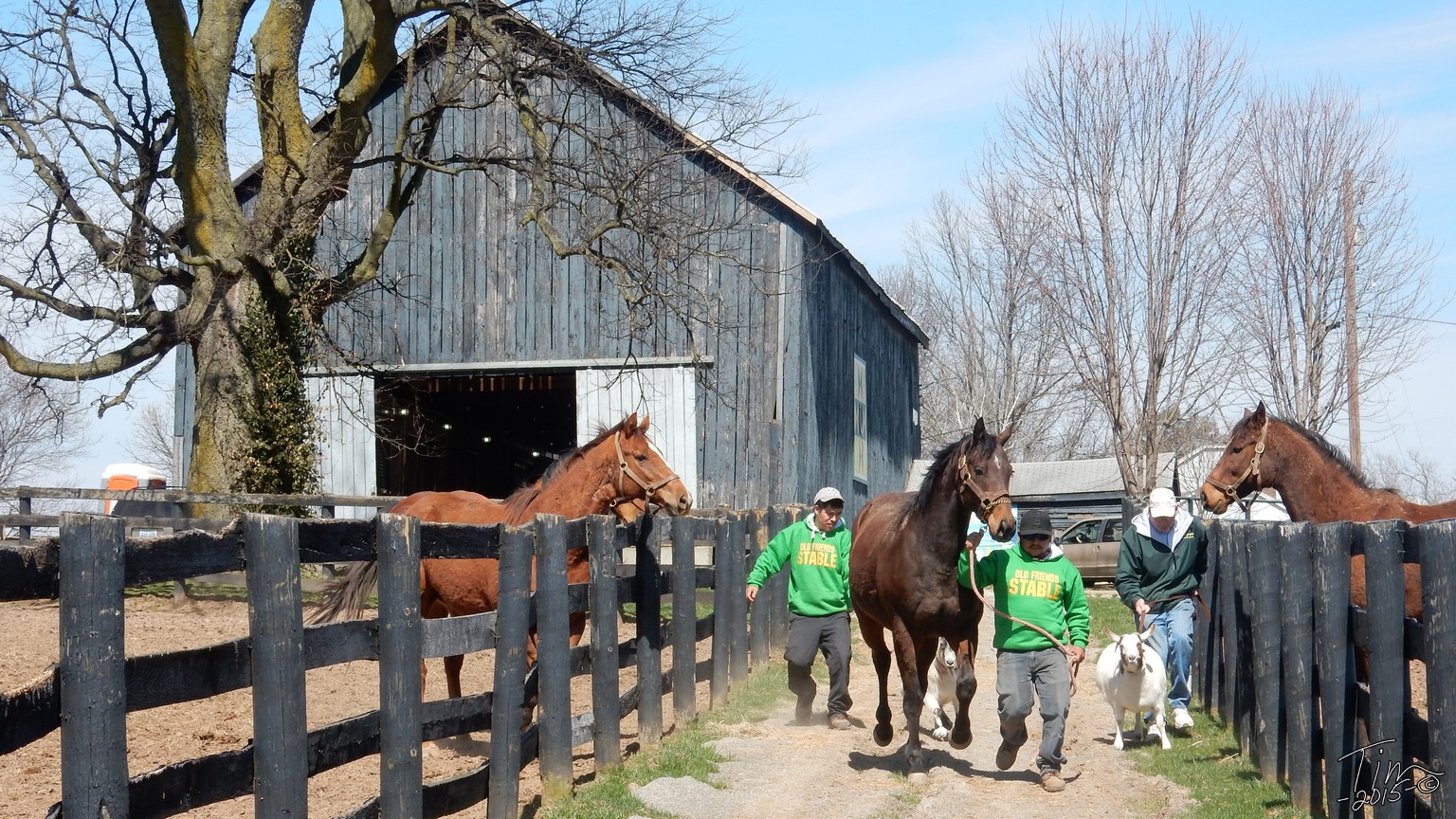
Eldaafer and goats2TBP: How many horses and staff do you currently have?

At the farm here in Georgetown we have 104 horses and over in New York there are 13. We have five paid employees. The rest are all volunteers. Our Georgetown farm manager Tim Wilson does a phenomenal job. 

TBP: Was it a long process to become registered as a 501c charity?

MB: Yes, it was really a big hassle, I think it might be worse than getting audited by the IRS! We jumped through a lot of hoops to get it done and it took about two years.

TBP: How has the funding flow been since you started?

MB: Well there have been some very tough times when we have come close to becoming financially obliterated, but people came through with money for us at the right time fortunately. We are on a reasonable financial footing now, but it’s a constant challenge.

Battles_Silver CharmTBP: Tell us about some of the best known horses you have had at Old Friends.

MB: When Silver Charm came here after his breeding career in Japan, thanks to Beverley and Jeff Lewis and the JBBA who have been tremendously helpful to us, it was one of the greatest days of my life. I’ve been in love with Silver Charm ever since 1997 when he won the Derby and the Preakness and just got beat in the Belmont to miss the Triple Crown. Now he is in my back yard it totally freaks me out! We have had other horses here who won big races, like Black Tie Affair who won the Breeders Cup Classic, Precisionist who won multiple Grade 1s and went to the Hall of Fame, Sunshine Forever, Marquetry, Tinners Way, Williamstown, Commentator. Interestingly, even though they came in all different shapes and sizes and from different training regimens, they all had one thing in common. They were all smarter than most other horses.

TBP: How do you generally raise funds?

MB: Well one of the best things to happen to horse racing in the past few years has been the creation of the Thoroughbred Aftercare Alliance. They put together a fundraising program with many great ideas. They raise a lot of money and they accredit aftercare facilities and organizations very thoroughly and very well.

We also sell “shares” in our horses. You can buy a share in Derby winner Silver Charm for a hundred bucks! That works really well. We have also been successful in getting grants from various foundations and organizations and there are a lot of wonderful individuals who help out. Bob Baffert donated $50,000 and came down to the farm to see Silver Charm the Tuesday before the Derby. His jockey Gary Stevens came to see him too.

Sarava_Capone

TBP: Old Friends does a fantastic job but there is obviously a limitation on the number of horses you can take. What can be done about the broader problem of the many horses who can’t be accommodated by organizations like Old Friends because they simply don’t have enough room or funds?

MB: This is a huge problem but there are some interesting things currently going on that might help. There is a group that is getting together that is being organized by the Gaming Commission. They are seriously considering making horse aftercare taxes a condition of getting a pari-mutuel gaming license in New York. I have had some preliminary discussions with them and I am hopeful. Jack Knowlton, who owned the 2003 Kentucky Derby winner Funny Cide, has been very involved in aftercare programs and has helped get this meeting put together.

Forte and StarspangledOne of the best ideas I have ever heard came from the jockey Richard Migliore. He said look, you can’t create rehoming facilities for the thousands of horse who need it in the Bluegrass, because the land is too expensive. So instead, you go out to places like Montana and Wyoming where land is cheap and buy thousands of acres. You put up housing and you offer that housing to retired jockeys, trainers, veterinarians and grooms so that they can live out their retirement and volunteer to take care of the horses. It could be a tourist attraction too.

TBP: Do you have many visits from kids and schools?

MB: Yes we do, the kids love coming here. In particular, some troublesome kids who get kicked out of school come to visit and it does them a world of good. Horses can do so much for people, they don’t just need someone on their back to be useful. I think we are just scratching the surface of what they can do.

Genuine Reward 3TBP: What is the process when a new horse arrives at Old Friends?

MB: When a horse arrives here we segregate them and quarantine them for three weeks so they can get acclimated and get the lay of the land. That usually means they spend half the day in a stall and half the day in a round pen. Then Tim Wilson our farm manager does some evaluating and figures out who might make friends with who. It’s quite amazing, Tim has a real knack about matching horses up. Cat Launch and Rail Trip are best friends. Game on Dude is inseparable from a horse named Yankee Fourtune. After a few more months we re-evaluate and review how they are getting along.

TBP: When a horse’s time does come along, what happens?

MB: They are usually euthanized humanely out in their paddock. I actually never believed it and I thought this was apocryphal, but they really do tell you when they’re ready to go.

I don’t think we have ever euthanized a horse too early, but I think we have euthanized a couple too late. You think you are doing the best trying to keep them alive but sometimes it’s a mistake. We’ve had a couple of older horses undergo colic surgery and if it doesn’t work the last few hours of their life can be very rough.

MichaelBlowenWe had a wonderful old horse here called Ogygian. Before he died, he just sat down in his paddock one day. I called the vet and all Ogygian’s friends and the volunteers who looked after him. We all gathered around him in his paddock and you could tell that it meant a lot to him. He was very relaxed. He knew exactly what was going on and he was ok with it. It was very peaceful. It did his caretakers a lot of good too.

TBP: Do you still get to the races and handicap?

MB: I do, but I am now an even worse handicapper than I ever was, because I can’t be objective. I look for horses who are related to those we have here and I am obviously biased towards them regardless of their chances!

All Tracks Need To Follow Remington Park’s Example

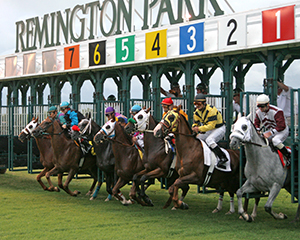
remington2It was refreshing to hear of Remington Park’s efforts to try to help solve the problem of horse slaughter. Trainers at Remington who are caught disposing of horses for slaughter will now lose their rights to stalls at the track, and therefore their ability to train there. Hats off to Remington Park for this. It is a step in the right direction.

But it doesn’t go far enough. If tracks can implement rules like this for trainers, then they should implement similar rules for owners who the tracks licence to own and race horses. 

Trainers are usually the people who make the arrangements for a horse that can no longer race, to leave the racetrack. Owners pay the bills when the horse is in training of course, but they have little to do with the day to day life of the horse and usually leave the task of finding a home, (or not…), when its racing days are over to the trainer. Many trainers do a great job finding a horse a new home, but some less scrupulous trainers will tell owners what they want to hear, for example, that they “gave the horse away to this guy who turns them into riding horses.”  Sadly that is often a lie and “the guy” who took the horse will actually be sending it to feedlot auctions, where it will be sold cheaply, he will pocket the money and then the horse will be transported to Mexico or Canada for slaughter.

Often the owner does not want to question the trainer and neither wants to go investigating or turning over rocks, because they know they might not like what they find underneath and would rather not know the truth. And right now, with things structured as they currently are, the owner can get away with burying their head in the sand in this manner and avoid taking any responsibility for their horse’s fate.

If tracks are prepared to ban trainers for sending horses to slaughter, they should commit to ban the owners of those horses too. The owner of the horse, after all, is ultimately the responsible party. 

Every track in the country needs to implement a policy like this. Horse racing in the USA will not thrive again until and unless the problem of horse slaughter, along with the drug issue, is solved. 

Australian Horse Racing Enforces Ban On Pre-Race Day Injections

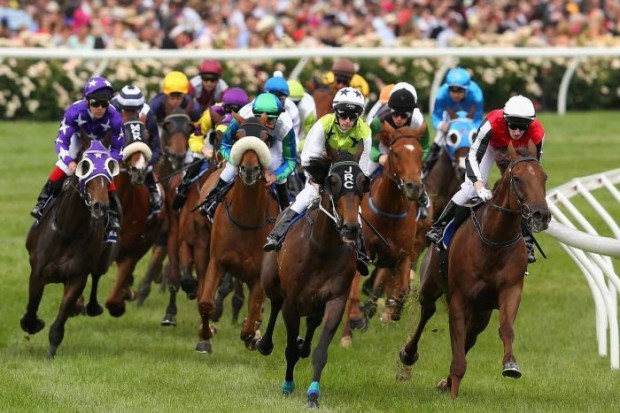
Melbourne-CupUS racing has a long way to go to become as clean a sport as it is in the rest of the modern world. Yet it now has even further. Australia recently implemented a complete ban on pre-race day injections of any kind. Here below is the statement from “Racing Australia”.


Racing Australia has tightened the ban on pre-race treatments by introducing rules that outlaw horses being injected within one clear day of racing or trials. The ban extends to blood tests, vitamin injections and all other injections of any kind.

The ban will be implemented from October 1.

Racing Australia believes there are compelling reasons for the introduction of a new rule to prohibit the use of hypodermic needles during the one clear day prior to racing or official trials.

Racing Australia issued the following statement outlining its reasons for the introduction of AR.178AB under the Australian Rules of Racing:-

• There is no scientific evidence to support a health and welfare imperative to treat horses by hypodermic injection within one clear day of racing whilst there are a number of very good integrity reasons to restrict the administration of any substances by hypodermic injection within that period.

• Although evidence of hypodermic injections may be detected by physical observation or inspections, it is important to have a prohibition close to race day to deter such practices.

• The standard explanation/defence to the detection of an apparently very recent hypodermic needle puncture to a major vein on race day is that the horse received an injection, often an intravenous drip via a large bore catheter, on the day prior to the race day.

• Banning injections within one clear day of racing makes it much easier for an official veterinarian to form an opinion that a hypodermic needle wound leaking blood, and/or with a fresh subcutaneous haematoma over a major vein, was the result of an injection within the restricted period.

Racing Australia believes that there is an unjustifiable reliance on intravenous injections close to race day. Integrity concerns demand a reform to long established practices that are not essential to the health and welfare of the horse.

There is certain to be a protest from trainers who rely on blood counts as a measure of a horse’s fitness and well-being.

However RA says this is highly contentious with any tangible evidence of a condition far from clear and argues that blood tests taken on a Thursday before racing on the Saturday should give the same, or close to the same, information.

It is important to note that AR.178AB allows a trainer to seek the permission of stewards for an exception to the ban if clinical issues in the horse are apparent.

The definition of a “Clear Day” is a 24 hour period from 12.01am to 12 midnight.

By way of example, if a horse is racing on a Saturday, the last time that the horse may be injected is midnight on the Thursday prior to the race.

The horse must not be injected on the Friday or at any time on the Saturday prior to the running of the race.

AR.178AB – Prohibition on use of injections during the One Clear Day prior to racing and official trials

(1) A person must not, without the permission of the stewards, inject a horse, cause a horse to be injected or attempt to inject a horse, which is engaged to run in any race or official trial:

(a) at any time on the day of the scheduled race or official trial, prior to the start of such event; and

(b) at any time during the One Clear Day prior to 12.01am on the day of the scheduled race or official trial.

(2) Where there has been a breach of AR.178AB(1), or the stewards reasonably suspect that there has been a breach of AR.178AB(1), the stewards may order the withdrawal of the horse from the relevant race or official trial.

(3) Where there has been a contravention of AR.178AB(1), the horse may be disqualified from the relevant race in which it competed.

(4) Any person who breaches, or is a party to a breach of, AR.178AB(1), commits an offence and may be penalised.

(5) For the purpose of this rule:

(a) injection includes, but is not limited to, the insertion of a hypodermic needle into a horse;

(b) it is not necessary to establish whether any substance was injected, or the nature of any substance injected.


Thoroughbred People’s Equine Legends Series: Flying Childers

FLYING-CHILDERS.3By Kimberly French

Established in 1967 as the Norfolk Stakes, the Flying Childers Stakes was renamed in 1973 when another race attained the aforestated moniker and it remained a British Group I until 1979, when it transitioned to Group II status. Contested over five furlongs at Doncaster on the third day of the St. Leger Festival, the event is restricted to 2-year-olds and pays homage to the horse that is widely considered the first tremendous Thoroughbred racehorse in the history of the sport, in Flying Childers.

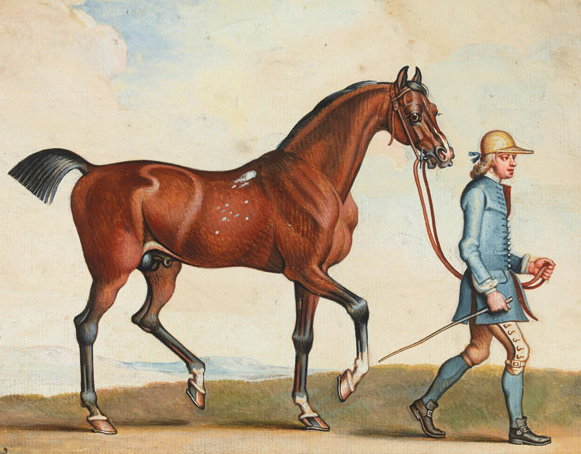
Foaled in 1714 at Colonel Leonard Childers’ establishment, Cantley Hall, Doncaster in Yorkshire, Flying Childers was out of the fine mare Betty Leedes and was sired by the historic Darley Arabian, one of the three founding studs of the Thoroughbred line. The flashy bay colt with a wide white blaze and four white socks sported an impeccable pedigree. His damsire was Careless, whose performances on the racetrack were quite prolific and that stallion’s sire, Spanker, was also renowned for his racing exploits during the era of Charles II.

Brought to England in 1704 from Aleppo, Syria, after his purchase by Richard Darley, the Darley Arabian was a bay horse with an outstanding conformation. Darley did not normally afford mares outside of his own the opportunity to mate with his prized stallion, but Betty Leedes was deemed classy enough for the trip to Aldby Park in Yorkshire where the Darley Arabian was in residence.

flyingchilders4Flying Childers inherited his blaze and the stature of his sire, as he also was measured at 15.2 hands, which at the time was quite robust, and eventually was purchased by the Duke of Devonshire, for whom he competed. As was customary at that time, Flying Childers was bestowed with the name of his breeder and during his time of competition was also referred to as Devonshire Childers after his new owner.

The horse was allowed plenty of time to grow and mature mentally as well as physically prior to his career debut as a 6-year-old. His first trip over a racetrack was on April 26, 1721 at Newmarket Racecourse where he finished first over Speedwell. He so thoroughly dominated that rival that his second race in October of that year over the same surface was a walkover. In his last start of the season he proved the respect for his talent was well-founded with a triumph over the older Almanzor, who was also the progeny of the Darley Arabian, and the top class mare Brown Betty in a match race between only this trio.

In 1722, Flying Childers only entered one event, which was another victory at Newmarket on October 22 over Chaunter. He did, however, compete in a trial race at York over a quarter mile and exhibited blazing speed by running his heralded colleague Fox into the ground.

Flying_ChildersAt age eight, Flying Childers once again showed his superiority simply because no one wanted to run their horses against him. He participated in a walkover in April at Newmarket and closed his career with another walkover in November at the same oval. His final contest was supposed to be a match race against Bobbsey, but that horse’s connections opted to pay a forfeit fee rather than allow their horse to compete.

It certainly is not shocking that the Duke of Devonshire entertained many a fine offer for the stallion. In fact, it is reported he was even offered the equivalent of the horse’s physical weight in gold crowns, which he readily dismissed. He placed Flying Childers for his second career at the famed Chatsworth in Derbyshire where like his sire before him, he was a private stallion. He perished at that location in 1741 at age 26.

Although Flying Childers was definitely not a dud in the breeding shed, he was not as illustrious as he was on the racetrack. His best offspring were Plaistow, Blacklegs, Second, Snip, Commoner, Blaze, Spanking Roger, Roundhead, Fleec’em, and Steady. Blaze and Blacklegs not only were outstanding performers but excellent sires. For example, Blaze’s male line still exists today, but not in Thoroughbreds. His descendant Messenger is a foundation sire of Standardbreds while another descendant Shales was Flying-Childers2essential in producing Hackney horses. Blaze also was a major contributor to the Thoroughbred gene pool as the damsire of the great stallion, Herod.

In addition, Snip’s son Snap was an outstanding broodmare sire and was the grandsire of Matchem through his daughter Conducter. Matchem, Herod and Eclipse are the three horses modern day Thoroughbreds can directly trace their lineage to. While Flying Childers was not directly responsible through his bloodline for the creation of Eclipse, that famed stallion is a direct descendant of Flying Childers’ full unraced brother, Bartlett’s Childers. Therefore, Flying Childers may not have a surviving male line in the breed, but his genetic material had a major impact on Thoroughbred racing.


The Interviews: Renowned California Race Caller Michael Wrona

MichaelWronaTBP: Where were you born and raised?

MW: Brisbane, Australia. I have family down there and some family in Sydney too. I’ve actually seen more of the US than I have of Australia, having been here since I was 24.

TBP: What are the big racetracks in Brisbane?

MW: There are two main metropolitan tracks, Eagle Farm and Doomben, which are across the street from each other, and there are a whole host of smaller tracks within the remaining area.

TBP: How did you become interested in race calling?

Radio broadcasting of racing is very big in Australia. I had a lot of exposure to listening to race calls, it interested me and I found myself mimicking the callers and wanting to emulate them.

My grandfather gave me a horse racing game called “The Melbourne Cup”, I still remember the ten plastic horses, rolling the dice and betting the false money, but I derived the most enjoyment from calling out the horses’ names as we pushed them around the board. I decided the dice were holding me back so the next thing I did was to make paper cutouts of the horses’ silks of that era, each one measuring about an inch to an inch and a half. I accumulated about a thousand of them, grouped them into categories for different types of races and distances and would push them across the floor shouting the call at the top of my lungs into a tape recorder. It probably drove the neighbors crazy. I was set on becoming a race caller.

eagle-farm-Race-TrackTBP: So how did you go about getting into the business?

MW: I wrote a couple of letters to established race callers in Brisbane and they invited me out to Eagle Farm and Doomben to meet them. They sometimes had a spare booth up in the grandstand and they would let me practice calling races into a tape recorder.

When I was 17 I got my first chance to call a public race live over the public address system at a track about an hour and a half outside of Brisbane on the provincial circuit, a place called Kilcoy. It was April of 1983. It must have gone reasonably well because I was asked to call the following race as well.

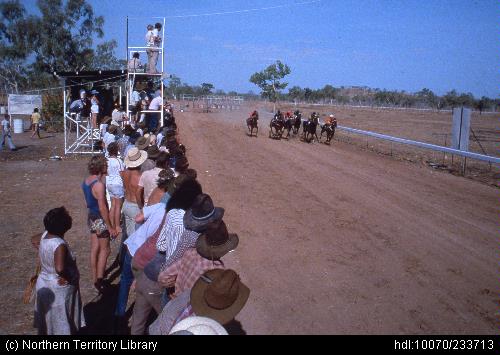
I had left high school and was working at a bank when the first opportunity to call a full card came a couple of months later. It was the most humble and basic of beginnings, it was way out in the middle of Australia in the outback at a track called Brunette Downs in the Northern Territory. People would converge from hundreds of miles around for this annual weekend of racing. The horses were a mix of thoroughbred and quarter horses. It was on a dirt track, which was unusual in Australia, it was bigger than US tracks though with no outside rail. The journey involved a flight in a normal commercial airliner, then the last leg was in a three seater plane for a couple of hours. The opportunity came my way because the original caller couldn’t do it and the next choice didn’t want it because they didn’t like flying in small planes. I didn’t even have a tent to sleep in when I got there, I slept at a cattle ranch under the stars.

brunettedownsI had to take a couple of sick days off my bank job to go up there and a few eyebrows were raised when I got back with my tan….  Over the next couple of years I got more part time opportunities at the tracks around Brisbane, and then an opportunity came up to go and work at the radio station that was dedicated to horse racing. It was mainly a behind the scenes job but it was a foot in the door, I started to get rostered on to call some greyhound and harness racing as well as the odd thoroughbred race, on Saturdays I’d be at the main racetrack assisting the team.

Then out of the blue came a life changing phone call from the race caller who I had most idolized growing up, the main race caller in Sydney, Johnny Tapp. He was offered the job at Hollywood Park in 1990 which he declined. He did bring his family over for a working vacation and called for three weeks, but by his own admission he felt he was a bit long in the tooth to make a move of that magnitude, so when they asked him if he could suggest anybody else he recommended me. I didn’t realize he was even aware of me! So arrangements were made and I came over to California in the Spring of 1990. I’ll never forget the first call I made at Hollywood Park, as I was calling them past the finish line Tappy was slapping me on the back.

One of my favorite memories of that first meet when I came over in 1990 was a classic renewal of the Hollywood Gold Cup with the great reigning horse of the year in Sunday Silence meeting Criminal Type, who would become the horse of that year. They were stride for stride in the last three eighths of a mile, Criminal Type won by a nose and I thought to myself that it was a long way from Brunette Downs and Kilcoy and the other places I used to knock around, so that was a very memorable race.

There was some pressure at the time to not call close finishes, but I stuck my neck out and fortunately got it right. I like to make the photo call if I have a strong feeling about it. If you know the angle and the horses are in stride you can be more confident about it, it’s when they are out of stride that it’s usually better to stay out of it.

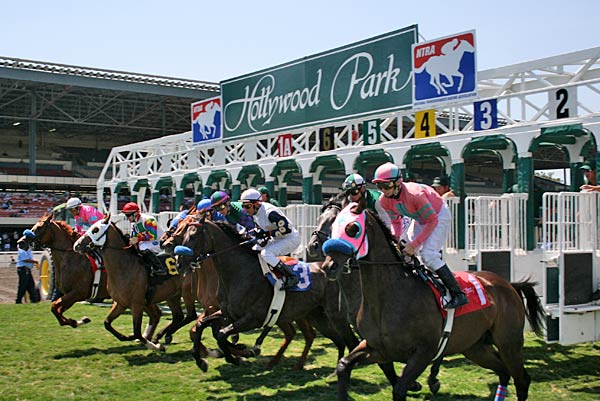
hollywoodparkTBP: How did that first experience work out?

MW: Within a year my Hollywood Park tenure was sadly over, I had the rug pulled from under my feet as there was a big upheaval and controversy over the ouster of Marge Everett, who was the lady who brought Johnny Tapp and myself over. It was a very bad, nasty, proxy fight. Fortunately I was contacted by Bay Meadows so I came up to Northern California. Then Golden Gate expressed an interest and for a while I had the Northern California circuit to myself.

Then in 1993 a similar thing happened at Bay Meadows to what had happened at Hollywood Park. I had never imagined that politics could reach the person in the booth on the roof and I found myself looking for another track, as Golden Gate by itself wasn’t really enough.

I went to Retama Park in San Antonio to call their inaugural season in ‘95 for a spell and then I was contacted by Arlington Park and I went there for two years, where I had the chance to call Cigar’s record breaking win for consecutive wins when he won the Arlington Citation Challenge. Arlington was a beautiful, opulent track and then the owner closed it down.

I went back to Hollywood Park and Turf Paradise was a part of that deal too. Then I went to Lone Star Park for five years, working concurrently at Fair Grounds in Louisiana.

TBP: How are race callers hired and paid?

MW: It’s normally a per diem contractor arrangement and is seasonal of course. I don’t get paid if I am not working unfortunately.

LosAlamitosTBP: How was your spell at Los Alamitos this past July?

MW: Los Alamitos was very enjoyable and very challenging because of the configuration of the track and the different angles compared to a track like Golden Gate. It has the longest home stretch in the country and they angled the backstretch differently to other tracks. There are some challenges with glare from the sun in the late afternoon too, but it keeps you on your toes and it’s nice to get yourself out of your comfort zone. It was also very nice to get reacquainted with Southern California.

TBP: What is your process as a caller to memorize colors and recognize horses?

MW: The focus is the jockey’s colors. It is helpful to have the colored saddle cloths too but you are taking a big risk if you rely on them alone because if you get a horse directly outside another in a bunched field you might just get a flash of the jockey’s cap and the saddlecloth can be totally obscured, so I always make myself learn the jockey’s colors. The equipment can also help, different color bridles and shadow rolls etc.. I repeat each horses name many times in the post parade as I watch them.

TBP: For me a great race caller calls the race in a very informative way as if it is for people who cannot see the race, which is your style in my opinion, as opposed to some callers whose style revolves around the idea that they are calling the race to people who are watching it with them.

MW: Well my style is really the old school Australian style because it was done mostly for radio, using that descriptive nature for an audience who cannot see the race, so that’s what I do.

michaelwrona2TBP: You are also known for the odd humorous quip, but in my experience when you do that it never comes at the expense of the call.

MW: Well thank you, I never want to be branded as a comedian and the accuracy of the call is paramount. Occasionally if a call can be embellished and give people a chuckle then why not, as long as you always keep the priorities straight.


TBP: How is racing different in Australia to here in the US?

MW: Horse racing is much more part of the general sporting culture in Australia, there is a vast network of betting shops, they are always around the malls and these days there are betting terminals in the pubs, bars and clubs. People have much easier access to horse racing. The equivalent of the Daily Racing Form is available at all newsagents and everywhere newspapers and magazines are sold.

TBP: In Australia you have bookmakers competing with each other at the tracks offering different odds on the runners.

MW: Yes, there is the tote system like we have here but there is also the option of betting with a bookmaker at the track and getting a fixed price. It adds a lot to the atmosphere, color and excitement of a day at the races. Apart from the fact that people can’t take a fixed price with our tote system, one of the big issues here is the way the odds change after the race starts. It is very disconcerting and you wonder how and why in this technology age, it happens. In Australia even back in the 1980s the odds on the tote system changed instantaneously and they never changed after the start of the race. The US is supposedly the leader in computer technology, so how is it that we are still seeing such fluctuating odds after the start of the race? The whole idea of betting is to know what odds you are getting and to determine value and choose to bet when the odds are in your favor.

TBP: Do fillies race against colts in Australia?

MW: Yes very often, it’s no big deal for a female to beat a male horse in a race.

TBP: I also understand that there is a much broader variety in race distances in Australia.

MW: Yes there is and I would love to see more distance races here in the US. I wish more tracks had a seven furlong chute and could accommodate those races. There are incremental distances below six furlongs and above a mile, yet it’s a quantum leap going from six furlongs to a mile. I would really like to see more long distance races, there are no races for stayers here and they are very popular in other parts of the world. You never know how much potential is left untapped in some racehorses here, with no long distance races being run.

TBP: What is the race day drug situation in Australia?

MW: There is no tolerance for it whatsoever. It is well policed and the penalties are severe. There is no Lasix, there is nothing allowed on race day. There is a controversy over cobalt at the moment, but that situation demonstrates how non tolerant the Australian authorities are of race day drugs.

Horses breaking down in Australia is a rarity. The horses run more regularly than they do here and that gives fans the opportunity to latch onto horses and follow them and become fans. It is turf racing of course, perhaps that is easier on them than the dirt. Horses appear more sporadically in the US and the premature retirement of the good ones is a blight on the popularity of the game, although that is an international problem with the money available in breeding these days. It doesn’t give fans a chance to follow their favorite horses, and that’s how a lot of racing fans are born.

There were a couple of champion geldings running back when I was a kid that absolutely were the catalysts for me becoming hooked on racing. It’s a pity that there aren’t more incentives for older horses in the prize money program and structure here in the US, but even then it would be hard to compete with the stud fee numbers.

DSC_0302TBP: Is calling races on the Tapeta surface at Golden Gate different to normal dirt?

MW: Well when it rains, yes it is, because a horse can come from dead last through the field to win with completely clean silks, so from a completely selfish perspective I like it – it’s nice to be able to see the colors clearly! Winners also seem to come from all different positions in a race, you don’t get the kind of one dimensional speed bias that you often get on a dirt track.

TBP: Is there anything else that would make life easier for you as a race caller?

MW: I am very fortunate that I am doing what I always really wanted to do. One thing that I would enjoy though would be if owners of horses with tricky, strangely spelt names would get in touch with me so I could get the pronunciation right. I am not hard to get a hold of and I hate to get it wrong, so that would be very much appreciated!

The Interviews: Southern California Trainer Simon Callaghan

SimonCallaghan2Up and coming trainer Simon Callaghan has made a huge impression on the Southern California racing scene since he arrived on these shores from England eight years ago. If it wasn’t for a horse called American Pharoah, he would have already won a Kentucky Derby with Firing Line. Simon talked to Thoroughbred People about his experiences since coming stateside.

TBP: How did you first become interested in racing?

SC: My father, Neville Callaghan, was a trainer in Newmarket, England so I was interested in the horses and the sport from very early on. I became an exercise rider and assistant trainer to my father. I also rode as an amateur jockey in the UK in around twenty races and had a few winners.

TBP: What was your first experience of racing in the US?

SC: I came to the USA on a temporary basis to work for Todd Pletcher at Palm Meadows in Florida and Belmont Park, New York. I was here for about 12 months. It was amazing to work with Todd’s team and so many top class horses. I picked up so much good information and learned a lot from the experience. When I returned to England I took over the training operation there from my father who retired.

TBP: What was the catalyst that resulted in your move to the US?

SC: I was really interested in training over here after my experience working for Todd. I had some good owners/clients in the UK who had some well bred turf horses and we were interested in bringing them over here on a permanent basis to run in turf stakes races in California with the intention of earning some good money and black type. We had some early success with horses like Dubawi Heights and Belle Royal winning Grade 1 stakes races. It was tough at first to get new clients based here because I was somewhat labeled initially as a turf trainer, it took two to three years for that to change, but now things have transitioned. I still have turf horses of course but there are plenty of dirt runners owned by my US clients in the barn now.

SimonCallaghan3TBP: How difficult was it to adapt to training here as opposed to the UK and what are the main differences?

SC: In England the horses are trained at training centers and private facilities in the countryside away from the racetracks, whereas here in the US most horses are trained at the racetrack. Horses work in company with/against each other in England rather than alone against the clock. Here in the US we train and run on the same racetrack for the most part so the timing and clocking is more relevant here than it would be in England, where horses don’t train over the tracks they run on. In the UK and Ireland the tracks are all very different shapes and sizes, uphill, downhill, left handed, right handed etc. and there are more different types of ground conditions. There are quite a lot of differences but you just learn to adapt.

TBP: Tell us about your current training operation, approximately how many horses do you have in training at the moment?

SC: We have 45 horses in training now. Every year we have been growing and getting new clients. I’d like to get to around 6o horses here in California and then maybe have a string on the East Coast as well.

TBP: Do you have a particular style of training, if so how would you describe it?

SC: I don’t like to train my horses too hard for their first runs, I like to leave something in the tank to work on and see my horses improve over time. My horses typically don’t win first time out, they generally progress and move up from there first runs. Horses like Fashion Plate and Firing Line are examples of that.

simoncallaghan4TBP: What parts of training do you enjoy the most?

SC: The two year olds are one of my favorite parts of training, I love working with the young horses whose potential is unknown and bringing them along, I really enjoy that part of it all.

TBP: What parts of the job can you perhaps do without?

SC: I think the hardest part is making the phone call to the owner about an injury to their horse. I am very informative and upfront with my clients but that’s definitely one of the most unpleasant parts of the job.

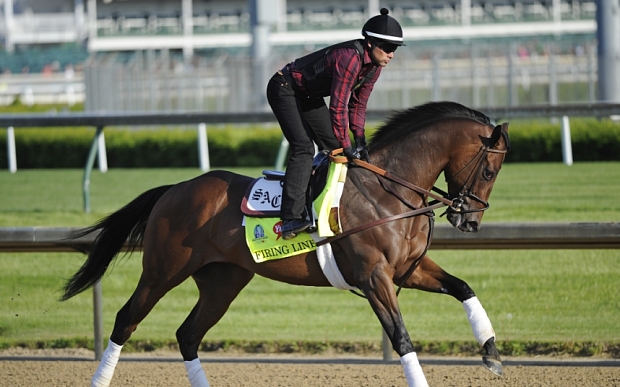
Apr 29, 2015; Louisville, KY, USA; Exercise rider Humberto Gomez works out Kentucky Derby hopeful Firing Line trained by Simon Callaghan at Churchill Downs. Mandatory Credit: Jamie Rhodes-USA TODAY Sports Apr 29, 2015; Louisville, KY, USA; Exercise rider Humberto Gomez works out Kentucky Derby hopeful Firing Line trained by Simon Callaghan at Churchill Downs. Mandatory Credit: Jamie Rhodes-USA TODAY Sports

TBP: What sort of character was your Kentucky Derby runner up Firing Line, and did you know that he was something special before he ran?

SC: He was a gentleman to be around, very classy with a good mind. We knew from day one that he was a really good horse. We bought him at the breeze up sales for $240,000 and when we got him back to the barn his first piece of work was just spectacular so yes, we knew he was potentially top class.

TBP: Slim Shadey was a good horse who you had some great wins with shortly after you started training here, what was he like to be around?

SC: He was great, a big good looking dark bay horse, we won two Grade 2 stakes with him and he ran second in a Grade 1. He was a bit of a quirky character, very strong and tough to gallop in the mornings, he enjoyed being on the lead and didn’t like it so much if he was taken on early. 

TBP: Of the other horses you have trained so far please tell us about some of your personal favorites and about their characters and personalities.

SC: Byrama was a great mare, she won a Grade 1 for us. She came a long way from breaking her maiden in England. Judy In Disguise was another great find by Aron Wellman of Eclipse partners. Fashion Plate was a very nice horse, mellow and sweet, it was very satisfying to find her at auction and see her do well as a racehorse. She won two Grade 1s, the Las Virgenes Stakes and the Santa Anita Oaks.

SlimShadeyTBP: Do you find it harder to keep horses sound here racing on dirt tracks than on the turf in England?

SC: Yes. Races here are run at a very fast pace from start to finish whereas in England they go slower early and finish faster. Over here you have to be tougher on them in training for them to be able to compete in faster early pace races, the turf and pace of racing in England is far kinder to them physically than the dirt tracks here. There is a much higher attrition rate here than in the UK.

TBP: You trained successfully in England completely without Lasix. Where do you stand on the Lasix debate?

SC: I would be perfectly ok with it if Lasix was banned on raceday. You are however definitely at a disadvantage right now if you run a horse that is not on Lasix against horses that are on Lasix. It needs to be a level playing field, but I could and would happily train and run horses without it if everyone else did.

TBP: When you were training in England what % of your horses running without Lasix would bleed in a race and how would you treat it?

SC: I’d say less than 5% would ever bleed. We would treat it by giving them some time off and turning them out for some R & R.

TBP: What is your opinion of what has happened with the synthetic track situation?

SC: The climate was the problem in California with the fluctuating temperatures from morning to afternoon. I was excited when they first went in as I felt it would be good for some horses, but the temperature was the problem for the rubber based surfaces they put in in Southern California. I think the Tapeta has performed a lot better than any of the other surfaces however. In an ideal world it would be nice to see a racetrack have all three – a turf, a dirt and a synthetic track.

Trainer Simon Callaghan walks Kentucky Derby runner-up Firing Line in the stakes barn at Pimlico Race Course in Baltimore, Wednesday, May 13, 2015. The Preakness Stakes horse race is Saturday, May 16.(AP Photo/Garry Jones) Trainer Simon Callaghan walks Kentucky Derby runner-up Firing Line in the stakes barn at Pimlico Race Course in Baltimore, Wednesday, May 13, 2015. The Preakness Stakes horse race is Saturday, May 16.(AP Photo/Garry Jones)

TBP: How do you feel about the state of racing and its customer appeal here in the US?

Here the really big events are as good as any major racing events in the world, but apart from that there are a lot of empty racetracks on the normal days. We need to be appealing to younger people and making it more of a social occasion. We could do with taking more breaks and time off as could the horses. I think it would help field sizes in the long run.

TBP: How many two year olds do you have in training this year and could you give Thoroughbred People the names of a couple you like?

SC: Yes we have around twenty two year olds this year. A couple of horses for people to look out for are a nice two year old by Friesan Fire called On Fire who should come on for their first run, and a Giant’s Causeway colt who Coolmore own, called Canada.

The Interviews: Jeff Seder of EQB: Bloodstock for the 21st Century

JeffSeder

Jeff Seder has been a pioneer in the field of equine biomechanics and the study of the physical attributes that makeup an exceptional racehorse. After developing a fascination with horses in his twenties, Jeff went on to create EQB and has since advised successful clients like Ken Ramsay, Bob Baffert and Ahmed Zayat on their purchases. He talks to Thoroughbred People.

TBP: How did you become interested in horses? 

 JS: When I was 26  I went on a date and took a ride on a rented horse. I had a great time, so I started getting serious about it and I decided I wanted to get involved with something that had to do with horses. I was too big to be a jockey and I didn’t have any connections at all. I said to myself, I have business knowledge, knowledge of the sciences – I was pre-med at Harvard and in the top 1% of my class. I thought I could bring statistics and science to horse racing.  

I was in law school and had to do a thesis. My thesis advisor was Archibald Cox, who you may remember from the midnight massacre and the Nixon Watergate scandal. I had to go to see him about a thesis topic. He asked me what I was interested in. I looked down at the floor and said “Horses”….  I thought he was going to kill me… Instead he turned around, grabbed a book from behind him and dropped it on the desk. Dust flew off it. He said, “This is the Statute of Massachusetts that governs horse racing. It’s a perfect combination of business and law. I don’t think anybody here has ever looked at it, why don’t you do that?”  So that’s what I did for my thesis and I learned a lot.

Then in 1976, the East Germans burst onto the scene in the Olympics. That little country won more medals than anyone else. It used to be just between Russia and the United States, now these guys come along. The US wanted to do something about it and have a response to it. There was a change in the tax code which meant you could claim tax deductions for doing research to help Olympic athletes in sports medicine. It didn’t last long, but I grabbed the opportunity while I could and got a foundation established.
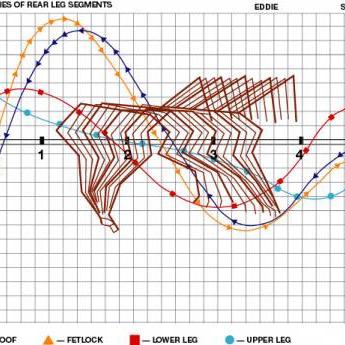
Jeffseder3I started working with the coaches of the USA figure skating team and the luge and bobsled teams. I rounded up biomechanics  experts and ended up doing half of the Olympics Committee’s biomechanics work on sports medicine. We took high speed cameras and analyzed what people who were winning were doing differently, and what we were not doing. I learned to benchmark the champions.  We worked for the luge team for one season. They had never previously been in medal contention. After we worked with them, suddenly they were in medal contention.

I decided I wanted to do the same kind of thing with horses, but if I had known then how long it would take and how much it would cost, I would not have started.

 TBP: Was anyone else doing any similar research at the time?

JS: No, data like this on racehorses just didn’t exist then. There are plenty of people out there doing similar things now, but they don’t have our databases and they don’t have our years of experience. There are a lot of cheap imitators.

TBP: So how did you go about embarking on the study of biomechanics in horses?

JS: I built the first portable ultrasound machine and the first heart rate monitor for horses that you could take into a stall that worked well. I had it custom shipped from Hitachi. This was before personal computers of course. I used defense department contractor parts for it and wrote in machine language right down to the actual pluses, minuses and zeros to get the thing to work.

I started building up data from looking at horses hearts and spleens. Some of the leading veterinarians in the world who told me what I should expect, were not even close. They would show me a jar with a horse’s heart in it and tell me it wouldn’t go as fast as a human’s heart, because of how big it was.  Then we discovered that racehorses’ hearts were going 200+ beats a minute or faster coming down the stretch. The horse’s heart can go faster than the human heart and it can change gears immediately. A horse’s heart can be going at 26 beats a minute at rest in a stall. If you go to the stall and snap your fingers, you won’t see that the horse has moved a hair, but the heart rate will have jumped to 120. It can change gears that fast and go that fast.

There were other big differences in what was different about horses from humans. The way they react to drugs is different. Morphine is a depressant in humans, but it’s a wild stimulant to horses. The spleen doesn’t do the same thing in a horse that it does in a human. In the horse, over evolution it became able to do the same thing as the blood doping that was outlawed in the Olympics, when Russian athletes were giving themselves transfusions of red blood cells. Horses do that naturally, evolution gave it to them, but we don’t do that ourselves as humans, so we weren’t aware that it was something that was going on in horses.
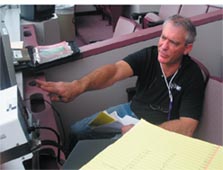
jeffseder2We also didn’t know that horses were cooling themselves by panting. They pant as well as sweat. When we were studying their lungs doing blood gas analysis we had to build a mask and put the horse in a pool, have computers analyze everything and have the device try to catch all the air they could. The device is called a spirometer, it looks like a huge water heater and it’s supposed to catch all of the air. It didn’t, it caught about one second’s worth of air. We started using multiple spirometers and that didn’t work. Then we used a weather balloon, and that didn’t work. We looked at each other and asked ourselves what is wrong with this picture, where is all the air from the lungs going, why are these horses moving so much air? The answer was they were cooling themselves with it.

In the beginning not only did we not have the equipment to get the data, we didn’t know what we were looking for. I had to film horses in slow motion and digitize everything. I hired professors from MIT in engineering and statistics from Rutgers, doctors from Harvard and veterinarians from the Lubow Center.  There were people giving me their theories, “Here is why Secretariat was a great horse.” They were good theories, but they were wrong. No one had any real data on what made great racehorses.  I spent years and years building that database.

TBP: Had any similar research been done on other animals?

JS: Any biomechanics literature and studies that was out there mostly came from the Fatigue Labs at Harvard. They put anything from iguanas to alligators, to gazelles to elephants, on treadmills and they developed equations to describe the four-legged animal’s ways of moving and their energy use. After that, they could then take a fossil footprint of a dinosaur and figure out stuff like how tall the dinosaur was, how much they weighed and how fast they could go. Some of this was then being used to consult and advise people on racehorses’ strides.

I gathered and digitalized data on thousands of racehorses. I followed every split of every race these horses ran through the end of their three year old year. I actually published it, but it was hard to get it published and accepted because I wasn’t a vet. They thought I was just a greedy guy trying to make money, but the only way I could legitimize what I was trying to do was to get my findings published. They were still sure I didn’t know what I was talking about, even though I had so many consultants who were luminaries in their field.  

We spent a long time, we spent a lot of money, we built mountains of data and we learned a lot. I discovered that while the biomechanics studies that had been done on wild animals were useful to distinguish between a gazelle and an elephant, they were worthless to be used for horses and to distinguish between a claiming horse of moderate ability and a top class stakes horse.  We learned that the really good racehorses are fundamentally, physically very different from the average racehorse, even when they are a yearling. 
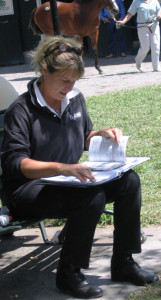
PattiMillerTBP: How did you start marketing this and making it a commercial venture?

JS: I am a terrible marketer and also I had no horse people working with me from inside racing who could help me out. Then I hired Patti Miller who had been one of the first women jockeys in the United States. She was very smart and just as crazy as I was and she was a traditional horse person. She was fascinated by what I was up to, but when we’d get together, she’d look at some aspects of what I was doing, say “that’s ridiculous” and tell me why. 

We started to marry the practical with the theory and the data and we found out stuff that no one else believed was true, not even the doctors and the vets. But it was true.

TBP: So how did you start and get to use your studies and tests in practice?

JS: I had a neighbor, George Strawbridge. I got to know him because Pattie Miller went foxhunting with him two or three times a week. He gave us the chance to find him a few new racehorses at a two year old sale, using our technology. The first year we did it for him we got him Forever Together who won an Eclipse award for champion sprinter. Then the next year we bought him Informed Decision as a two year old in training. Informed Decision breezed an 11.1, so she wasn’t an obvious horse in the sale to everybody, but my my tests she was pretty near perfect. She became a sprint champion and won five Grade 1s. So I had those notches on my belt.

Then around 2007 a guy called me up who was just getting a name in this industry, Ahmed Zayat. He said he would give me a chance to go to the yearling and two year old sales with him. That was a big turning point. We bought and developed five stallions and had two horses that ran second in the Derby. Then American Pharaoh came out of it, as we had bought American Pharoah’s dam, Princess Emma using my methods and testing.

Then there was Ken Ramsey. He doesn’t buy multi-million dollar horses, so people look at Ken, a top owner and breeder for ten years, and wonder how does he do it?

First of all, he works hard. Second, he is a genius in pedigree. Third, there’s us. He’s been buying mares that have had all of the physical attributes in the elite top 2% range that we had spotted previously, but who didn’t achieve their full potential on the racetrack through injury or what not, but who still had a huge heart and excellent mechanics and scored high in all of the stuff we measure. You have seen what Ken has done. He’s killing them with his home breds. 
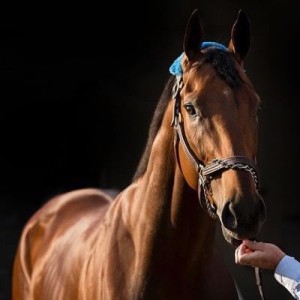
PharoahstillTBP: Tell us about American Pharoah

Well he wasn’t a horse that a traditional horseman would miss.  He was drop dead gorgeous, you didn’t have to be a genius to see he was a good looking horse, but in addition to that, what we knew about was all the hidden stuff that we test for that he scored off the chart in. He went to the sale at a time when Zayat was looking to sell some assets but he got a cut on his ankle, it had become infected and become a little swollen. We said you are not going to get your price on this horse because everyone is scared of that ankle and that swelling. Ahmed ended up buying him back at $300,000.


TBP: When do you get the chance to first analyze a horse?

JS: We analyze horses at the farms as they are growing up as babies and before they are broken. Then we go to the auctions before they sell to inspect them again. 

TBP: Tell us how the process works, beginning to end.

JS: First, we do all of the traditional stuff.  We have Pattie Miller go and look at the horse. Second, we start doing testing on the horse, looking at their internal organs, shapes and types and their cardiovascular system. Third, if we get there because the horse is looking good, we look at slow motion films of the horse training.

There are a lot of things a lot of horses do that make them much more prone to injury, which many really good horses just do not do. You cannot see these things with the naked eye because the action and movement is too fast. Regular video will not provide the details on the subtle things going on and on the pressure points in the legs etc., because it is 34 pictures a second and does not allow you to see as clearly as you need to. We can see these things because we film at 500 pictures a second in high definition. We look for things that predispose a horse to injury but we also look at the things that tell you how fast the horse is. We need to know how easy as well as how safe racing velocities are for the horse. These are two different areas and we have two completely different analyses types for them.  

For the organs we use the ultrasound. Originally, we had to order different transducers specifically for us so we could get the right depth and the right resolution. We ended up taking what was the traditionally accepted veterinary exam of a heart and throwing it out. We changed the equipment and the way it was done and we changed what people looked at and where they looked.

You also need enough horses and data to compare one horse to another horse within 30 days of it’s chronological age and close to it’s weight, height, and sex. You can’t compare an 800 pound 14 month old filly with a 1000 pound 17 month old colt, it doesn’t work.

JeffSederTBP: When you go to a sale do you have enough access to the horses to do successful ultrasound testing?

JS: We do now because we are spending millions of dollars at the sales. It’s not invasive. At the sales we spend the time and the money and research everything in depth. We look at every horse.

We don’t even look at the catalog until after we look at the horse. Pedigree is the science of probability that dictates what you will get before the horse is even born. Once the horse is born, you have what you have. Even if something is a low probability event, that doesn’t mean it won’t happen. Rare things happen. It’s our job to catch these things when they do.

 TBP: Do you score or grade horses using scales or percentages?

Yes. We run through a variety of many tests. If horse gets an A+ in five of them and a B in just one of them, we will take him off the list. We’re looking for the hole in a horse rather than what’s great. Very few horses pass all of our tests. Usually only about 2% of the horses in an auction will pass. My job is to find that 2%. If there are 300 horses, I would probably have a final list of six horses.

TBP: Who can access the results?

I keep all the results secret. Everyone contributes but the individual team members don’t know, only I know the results. They are only available to a few clients at each sale. They know who they are and they know who the other clients are and we come to an agreement over who gets what. I tell them that they are going to have preferences but if I have a list of six horses, it doesn’t matter which one they get because statistically they are going to have equal probabilities of being good horses. One or two are going to be really great and I don’t know which one or two they are, but the odds are the same for all of them so people shouldn’t care which they get, although they often do of course.

I think if people check EQB’s track record, and actually check not just every good horse but every horse that we’ve bought, they would see that our percentages are really unusual. Regarding the statistics, there is a lot of information but not all of it is reliable. Some statistics and factors are much more powerfully predictive than others. I think a big mistake that people make is that they grab any new thing that comes along, or they fall in love with one or two variables, which may be real but they might not be as statistically predictive as some of the other factors. I think that is the heart of the matter of how you pick a horse. 
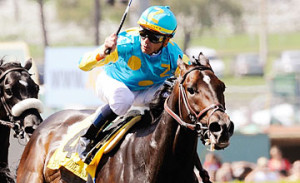
pioneerofthenileTBP: I assume American Pharoah would be top 2%?

Oh heck American Pharoah was top 0.5%. Everybody knew he was a good horse. He’s beautiful. What I had to add there, was the information about his heart, spleen, and lungs and some other biomechanical stuff. But yes, he’s as good as it gets. If you draw a bell-curve over all of the variables, he’s way off the edge of it. He’s a rare physical specimen.  

TBP: Why did Ahmed Zayat even put American Pharoah through the sales ring?

He made all his money in Egypt. Then the Arab Spring came and for a while there, I think they tied up a lot of his money. He’s alright now, but for a few years there it was touch and go as to whether they would take all his money or not. He had a couple of rough years. I think he thought he was going to get a million dollars for American Pharoah and he might have done that until the cut and the inflammation on the ankle, then the prospect of the million dollars went out the window. Everyone was telling him to take the horse home, including us.

TBP: What is your opinion of synthetic tracks?

35 years ago, a Doctor from MIT and I went out and tested racetracks. He developed a small computer that would tell you what the spring constant was of the track. We tested a lot of racetracks. What we found out was that racetracks were very inconsistent. They had potholes, ruts, hard and soft spots, they had places where the drainage was different, there were many bad inconsistencies.

So why would the solution be a different surface? What about making the base better? In my opinion it was the bases that were the problem. Then they went and changed the surfaces.  

In California at Santa Anita, it was my understanding that the drainage required was going to cost too much and they didn’t want to do it. So they didn’t do it correctly and of course it didn’t drain right. Then they punched holes in the asphalt under the cushion to try and fix it. Around those holes, the asphalt crumbled and then you had both draining issues and asphalt in the cushion. Some of the asphalt worked its way up into the synthetic track surface.
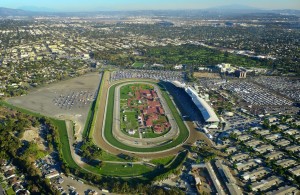
Santa Anita1They sent a guy out from the University of Maine with his ground penetrating radar and he found all of this. The report was supposed to be confidential but then it leaked out and people wouldn’t ride there. Then they threw out the track.

Now is that the synthetic track’s fault? Or a series of blunders in the execution of it? It wasn’t fair. Most of the synthetic tracks, as long as they had a good base, had better safety statistics, unless they screwed around with the maintenance or something.

TBP: You were looking at acquiring Laurel Park in Maryland a few years back. What happened?

I raised the money to go do it. I got to the day of the auction and the court canceled the auction on the day because they said that no one there had enough money. I was pretty sure we were going to get it. How they could decide that there was not going to be anyone there, when there were obviously enough qualified bidders, I don’t know. They didn’t know who I was, but they knew who the others were who were there.

I had spent almost a year and hundreds of thousands of dollars in due diligence. I had studied racetracks for years. I really thought we were ready. We just didn’t get the opportunity to do it. Since then there hasn’t been another track like that available. When there is one, we’ll go after it.

TBP: Do you feel that it is dangerous to have Casino’s linking to and supporting racetracks?

Absolutely. Fifty years ago, racetracks were the only place you could gamble. Now the gaming industry has become immense and racing is just a small piece of it. The racing is also the most expensive and complex piece of it. It is cheaper and easier to make money for an operator from a slot machine. So why would they want to continue with the racing then? The only reason they’re continuing racing is because they have to, to keep their license. So if that requirement disappeared, so might the racing.

Having said that, a niche business can be terrific. Racing could become the high-end, sophisticated niche within gaming. A racetrack can also make money by itself without a casino – if it’s done right. However it’s not going to do that as long as the people who are running it have no expertise in that niche and consider it to be an albatross. And that’s where we are at with that.  
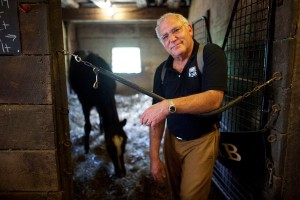
jeffseder5TBP: Another problem is that there is no incentive or advantage offered from a betting perspective to go to the track.

JS: No there isn’t, in fact it’s the other way around now. People placing bets off track are getting the rebates. So it actually ends up being cheaper for them to bet online away from the track. But look, people can still do that in other countries, they can bet online off track as well, but they go to the races because it’s fun. It’s not enough fun here. 

TBP: Where are you on Lasix and the drug debate?

JS: I wouldn’t want to go to zero in training because I do not think that is good for the horse. Some of the horses legitimately train better with a little aspirin or a little this or that. It can be safer and more comfortable for them. Testing has gotten pretty good. The problem isn’t with the testing or rules, it’s with the enforcement of them. It’s so haphazard. When trainers get banned, their assistant just takes the license over temporarily. Enforcement is the problem and it has always been a farce.

You will fail to curb drug use if you don’t do any police or enforcement work. You go to some of these minor racetracks and everyone knows who’s cheating. The trainer doesn’t get caught because between him and his vet he can get around the testing.  Even if he does get caught, it doesn’t matter because the enforcement is so bad.
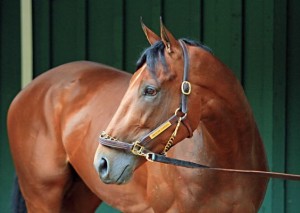
AmericanPharoahAt BarnTBP: Do you think we know less about horses now than we did a century ago?

Well one of the interesting things I think we have learned is that the horses this new technology horses is picking, look like the pictures of the great horses that we see in the books from 100, 150 years ago. It may well be that what has happened since then, when most people had horses and they were part of their everyday lives, is that a lot of the common knowledge base has just been lost. Some of what we are doing now is rediscovering it. I think we are bringing it back home. The technology is discovering the things that they knew back then.  I think people underestimate the body of knowledge that was out there when horses were everywhere and virtually everyone had them.

TBP: How good is American Pharoah?

I think he’s good as there has ever been, even though he lost the Travers.  Secretariat was beaten several times.  As you know, the race is not always to the swift nor the battle to the strong.


Learn more about Jeff’s company EQB at EQB.com


Thoroughbred People’s Equine Legends Series: Sir Archy

sirarchy1By Kimberly French
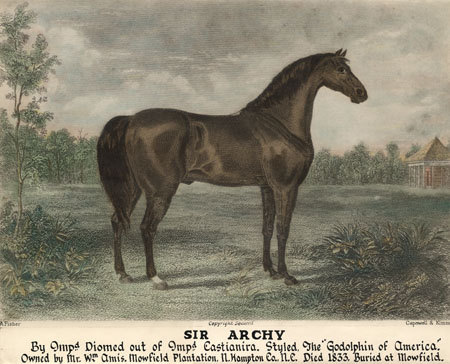
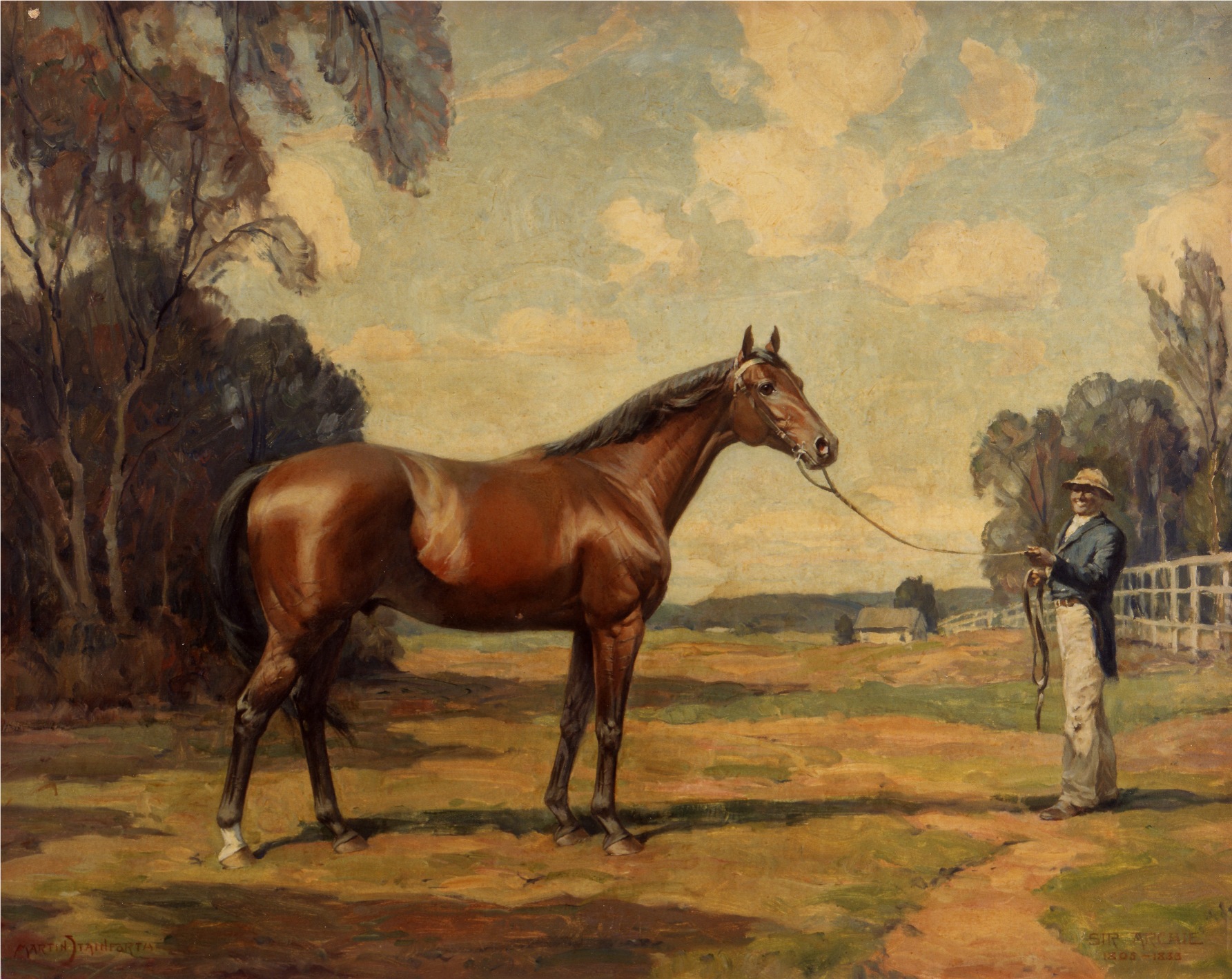
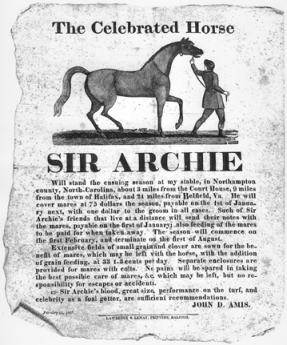
Also referred to as Archy, Sir Archie or Archie, the dark bay son of the first Epsom victor Diomed and the Rockingham mare Castianira, was born in the spring of 1805 at the Ben Lomond Plantation near the James River in Virginia. Little did Colonel John Tayloe III and Captain Archibald Randolph know the foal they had bred and initially named Robert Burns, would be hailed as the first great Thoroughbred sire to hit the ground in the United States and that his influence on the breed would extend to him being referred to as “The Godolphin Arabian of the American Turf.”


Diomed was most likely selected as a sire because not only was he was a superior racehorse, but as a stallion he was nearly unrivaled in producing top quality stock. Imported to America at the end of his stud career, Diomed passed in 1808 before one of his greatest sons ever commenced his career.


sirarchy2While he was still a youngster, Sir Archy’s name was altered by Tayloe to honor Randolph, but the two friends never raced him in either of their stable’s colors. As a 2-year-old, the colt, who only possessed a splash of white on his hind pastern, was purchased for $400 and an unnamed filly by Ralph Wormeley IV. His new owner, however, determined that racing was no longer for him shortly after acquiring Sir Archy and put the horse on the market. Wormeley had no offer for the colt, so he dropped him in the box for the Washington D.C. Sweepstakes in the fall of his 3-year-old year.


Unfortunately, the colt was not in his best form, as he was struggling to recover from a case of strangles and came home well in arrears of Bright Phoebus. Wormeley decided his horse should compete knowing he was not in peak condition because he did not want to pay the stipend for forfeiture. Although still ill, Sir Archy performed for the second time at the Fairfield Racecourse in Richmond. It appeared the outcome of this race would be a repeat of what had transpired in his first racing engagement, but Sir Archy did manage to come home third to True Blue in the third heat. This effort attracted the attention of none other than Colonel William R. Johnson. Known as the “Napoleon of the Turf,” Johnson did not tarry and bought Sir Archy for $1,500.


Sirarchie3It was under Johnson’s tutelage and that of his conditioner Arthur Taylor that Sir Archy served notice he was a force to be reckoned with. At age four, the bay stallion captured four of five races, which were all contested in four one mile heats. Despite not racing frequently, Sir Archy proved his dominance by defeating all the top class runners of his day such as Wrangler, Tom Tough, Palafox, Minerva, Ratray, Gallatin and Blank. In fact, in his victory against Blank, who was highly touted, the stallion ran the fastest time ever witnessed below the James River, which was 7:52.


Johnson, who obviously knew horseflesh, felt very few horses were capable of holding a candle to Sir Archy.


“I have only to say that, in my opinion, Sir Archy is the best horse I ever saw, and I well know that I never had any thing with one that at all his equal,” he wrote in letter that was originally published in the December 1829 edition of the American Turf Register and Sporting Magazine. “And this I will back; for, if any horse in the world will run against him at half way ground, four mile heats, according to the rules of racing, you may consider me $5000 with you on him. He was in good condition this fall, (1809) and has not run with any horse that could put him to half speed towards the end of the race.”


SirArchy5After his triumph over Blank, Johnson, ever the consummate wagering man, put up a $10,000 bet saying Sir Archy would beat any American horse. The public must have concurred for no one was willing to accept Johnson’s challenge. With no one to run against, Sir Archy was retired in 1809 with a record of 7-4-1-0. He changed hands yet again, as General William Richardson Davie, who was the governor of North Carolina, purchased him for $5,000. He commenced his stud career for Davie and then upon Davie’s passing for his son until 1818 in Virginia. He fee was initially $50 a cover, which after his first crops hit the ground was increased to $75 and later to $100, which was quite pricey for that day and age.


In 1818, Sir Archy acquired yet another new owner in William Amis. For the last seventeen years of his breeding career he held court at Amis’s North Carolina plantation Mowfield near the Roanoke River in Northhampton County. He was retired in 1831 at age 26 and died on June 7, 1933 at age 28. It was estimated he earned more than $76,000 in stud fees during his time at Mowfield.


Sir Archy was so stellar in the breeding shed that in 1827 the Washington DC Jockey Club and the Maryland Jockey Club placed restrictions on the number of horses that would be allowed to run in their races. Although there were other details involved, it served to eliminate all horses sired by Sir Archy. His sons and daughters were so prolific and inbreeding to his line and the Diomed line was so fashionable, only those horses produced from it were placed into competition.


sirarchie4His breeder Randolph referred to him as, “A horse of commanding size, with great power and substance. He is eminently superior in all those points indispensable to the turf horse and mainly contributory to strength and action. His shoulder, the most material part of the horse, is strikingly distinguished, being very deep, fairly mounting up to the top of the withers, and obliquely inclined to the hips. His girth is full and deep, back short and strong, thighs and arms long and muscular, his bone good. His front appearance is fine and commanding-his head and neck are well formed, the latter rising well out of his withers. Take Sir Archy upon the whole and he has more size, power and substance than we often see combined in the full bred horse.”


More than a decade after Sir Archy’s first runners began to dominate their competition his prowess in the breeding shed was being compared to his sire’s. That is when rumors started to float around the stallion was not the progeny of Diomed, but of another horse named Gabriel, who had fathered quality runners Postboy and Oscar.


Tayloe responded to these falsehoods by a letter that was published in American Farmer on August 11, 1826.


“To your inquiry relative to the sireship of Sir Archy, I have to observe in reply, that I sold one half of Castianira, the dam of Sir Archy, to Mr. Archibald Randolph before Sir Archy was foaled on the south side of James River in the spring of 1805 the joint property of Mr. Randolph and myself. I believe that Gabriel was alive in 1804, but I am very confident he never covered at the stand with Diomed. Gabriel and Sir Archy are something alike in form, but not in color, Gabriel being brown-can’t speak positively as to marks, but have no hesitation in saying there can be no doubt of Sir Archy’s being got by Diomed. Castianira was a dark brown, almost black mare.”


People could try to cast any doubts they wished on Sir Archy’s origin of birth and bloodline, but it could not be denied how tremendous he was as a sire and grandsire. As a sire he was responsible for 31 stakes victors and even influenced the development of the American Quarter Horse through his son Copperbottom. Some of this top horses include Timoloen (1814), Bertrand (1826), Sir Charles (1816), who was the leading sire in 1830, 1831, 1832, 1833 and 1836, Sumpter (1818), Stockholder (1819), Lady Lightfoot (1812) who gave birth to Black Maria, Reality (1819), Henry (1819), Sally Hope (1822) and Flirtilla (1818). He was also the grandsire of Bonnets O Blue, who was a great race mare, who in turn gave birth to Fashion and was the grandsire of Boston, America’s first outstanding racehorse, who fathered the renowned Lexington.


Sir Archy, who stood at 16 hands, was one of the first horses inducted into the National Museum of Racing and Hall of Fame in Saratoga Springs, New York, and is still honored today at two different gravesites. Over the passage of time, it is unknown where the horse is actually buried and what attempts would have been made to move him, but there is a marker at one location in Virginia where he was born. This signage states Sir Archy lies there with his groom and his dog and the burial area is marked by a stone wall that was erected in 1972.


The second location that claims to possess Sir Archy’s bones is where he spent the majority of his life: Mowfield Plantation. His exact whereabouts on the property are not certain, but the original plantation house has been refurbished and still remains.


Although his final resting place has not been determined, it is certainly a fact Sir Archy’s contributions to racing are of a magnitude and scope which not many other horses throughout the history of the turf can ever equal or surpass. Barbaro, Cigar, Affirmed, Seattle Slew, Secretariat, Seabiscuit and Man O’ War are all directly descended from Sir Archy and many more Thoroughbred champions carrying his DNA will continue to cross the finish line for years to come.


Thoroughbred People’s Equine Legends Series: American Eclipse

AmericanEclipseBy Kimberly French
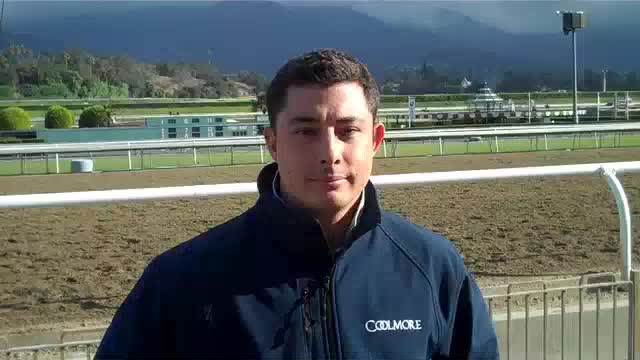
“I believe we lost by the absence on the occasion of one of Virginia’s best sons, who had a ‘rascally ague’ at the time,” the Honorable John Randolph of Roanoke said during a session of Congress after Sir Henry met defeat at the hooves of American Eclipse. From May 27, 1823, which was the date of “The Great Match Race,” Randolph “could never endure the sight of a lobster, because, as he stated, “it was a supper of lobsters, not Eclipse, that beat us. If Johnson had been there the day would have been ours. As it is-Eclipse will gain more fame for beating such a horse as Henry than for winning the race.”
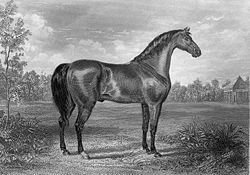
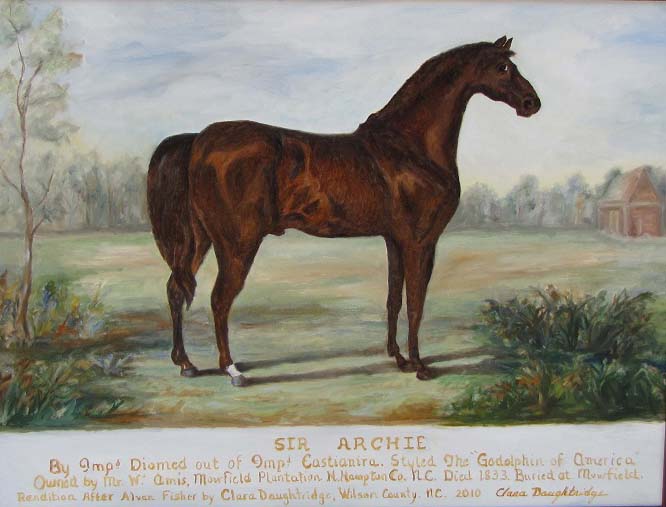
The contest Randolph is referring to with such rancor, captivated the country, was the first recorded instance of a sporting event and was a precursor of future bellicosity between the North and South. A crowd of more than 60,000 people packed the stands at the newly minted Union Racecourse in Jamaica, New York, which was a mere three miles from present day Aqueduct, President Andrew Jackson and former Vice President Aaron Burr were on hand to witness the duel and the Stock Exchange ceased operations in honor of the event.

Despite the fervor that swept the nation, many feared the solidification of sectional rivalry between the Northern champion Eclipse and the Southern star on the rise in Sir Henry. This affair, “may do no harm, if it do not recur oftener than once a century,” expressed The Statesman, “But an annual excitement of the same description is certainly to be deprecated, since its inevitable tendency would be to arraign the north against the south, and produce a deep-rooted hostility.”

So what transpired to culminate in a sporting event of this magnitude and significance? It commences with the birth of American Eclipse.

americaneclipse4On May 25, 1814, a chestnut colt with a white star and a white hind right ankle was born at General Nathaniel Coles’ farm in Queens County, Long Island. Coles’ newest arrival was the progeny of his pride and joy Miller’s Damsel, a daughter of the renowned Messenger, who was known as the “Queen of the Northern Turf” during her racing career. The colt’s sire was Duroc, who next to Sir Archy was the most successful sire to date in North America and was a son of the first Epsom Derby victor Diomed. Before this colt was ever weaned he impressed Coles enough to grant him with the moniker American Eclipse, in honor of the foundation English Thoroughbred, Eclipse.

As was the custom, the colt was not placed into conditioning until age three. After nine weeks of training, Eclipse showed tremendous promise in a trial race and was turned out to grow into himself prior to competing in earnest in his 4-year-old season.

The following year Eclipse performed only once at Newmarket Course in New York, which would be the site of the Union Racecourse five years later, but he left no doubt of his talent. Collecting $300 in purse money, he defeated Black Eyed Susan and Sea Gull in a contest of three-mile heats.

In 1819 when Eclipse was five, Coles sold the stallion to Cornelius Van Ranst for $3,000. He made two trips to the post for his new owner where he left Little John, Bond’s Eclipse and James Fitzsimmons in his wake in four-mile heats. He earned $1,000 for his efforts and was then sent to the breeding shed.

At that time New York racing and the Northern version of the sport in general, were nowhere near what the South had to offer. After Union Racecourse, the first dirt track in the country, was erected in 1821, John Cox Stevens, president of the racetrack, asked Van Ranst to return Eclipse to the sport to race against the pride of the South in Lady Lightfoot for a $500 purse with four-mile heats. The daughter of Sir Archy had already annexed 31 races in her career. The showdown with the undefeated stallion would occur on opening day, would also include Flag Truce and Heart of Oak and meant to promote the rise of prominence of New York racing.

True to form, Eclipse made short work of all three members of the field in two straight heats. After he trounced Flag Truce and Heart of Oak, they were withdrawn from the second heat. Lady Lightfoot was beaten in the first heat by more than two lengths with Eclipse stopping the clock in 8:04, while in the second heat he cruised home in 8:02 with the overmatched Lady Lightfoot finishing more than an eighth of mile in arrears.

TheGreatMatchRaceThe following year, at the age of eight, Eclipse again returned to the track to collect three more triumphs. In the spring he bested Sir Walter in four-mile heats for $700 in prize money and in the fall met Sir Walter, Duchess of Marlboro and Slow and Easy for $1,000 purse again over four-mile heats. The stallion so devastated Duchess of Marlboro and Slow and Easy in the first heat they withdrew from the second and after his sole rival, Sir Walter, displayed a fit of temper, cruised home the easiest of winners in the second heat.

His final performance of the season was in a match race against another one of Sir Archy’s vaunted Southern offspring in the outstanding racehorse Sir Charles. Scheduled for November in Washington, D.C., with a total purse of $10,000 ($5,000 from each side), the race had to be postponed after Sir Charles sustained injury to a tendon just days away from the race. It was placed back on the calendar for November 20, 1822, but sadly never lived to its billing as Sir Charles succumbed to his injury and was pulled up.

Hours after the race results were in the books, the gauntlet was thrown down by a contingent of Southern horsemen, led by Colonel William R. Johnson, or the “Napoleon of the Turf,” was issued to Van Ranst and Union Racecourse. Johnson established a match race between Eclipse and any Southern horse of their choosing to be held at Union Racecourse the following spring with $20,000 to be paid out by the losing connections. Billed as “Eclipse against the world,” the South did not have to name their entry until post time and the race would be four-mile heats.

This was not just a horse race but a regional showdown. Johnson and his colleagues labored all winter to condition a horse that would beat Eclipse. They began with five contestants: John Richards, his full sister Bestsey Richards, Sir Henry, Flying Childers and Washington. All of the horses were by Sir Archy, who Johnson had trained, while the remaining member of the group was his grandson.

Johnson and his trainer Arthur Taylor traveled their charges to Bristol, Pennsylvania, to train up until the race. Washington was taken out of training and John Richards, Johnson’s favorite, was injured. All three of the horses were taken to Union Racecourse several days before the contest, but when Sir Henry’s name was revealed as Eclipse’s opponent, it did not shock many in the know.

AmericanEclipse2The four-year-old chestnut son of Sir Archy out of a Diomed mare was bred in North Carolina and had bested Bestsey Richards in four mile heats just recently in Petersburg, Virginia, in 7:54 and 7:58, the swiftest times in course history. Also, Sir Henry received a weight allotment from Eclipse based on his age. He only carried 108 pounds to the gate, while Eclipse was saddled with 126.

Oddly enough both horses shared the same coat color, markings and height (15 hands) when they brought up to the judge’s box, “The doubts which had been entertained (and there were many) that the southern sportsmen would pay forfeit and there would be no race, vanished at once,” the Post reported. “and all was in anxiety to see the result of the contest.”

The thrill was so palpable and the rivalry so heated, many Southerners bet their plantations on their horse and Northerners bet their life savings on theirs. Through all the din and fanfare, however, the man ultimately responsible for the meeting of these two titans of the turf, was not present. So where was Colonel Johnson?

After the Northerners held a resplendent dinner honoring the match race the previous evening, Johnson, who imbibed heavily on the plentiful libations and seafood dishes became so ill he could not leave his bed.

“Thus the Southrons, deprived of their leader, whose skill and judgment, whether in the way of stable preparation, or generalship in the field, could be supplied by none other, had to face their opponents under circumstances thus far disadvantageous and discouraging,” stated Cadwallader Colden, also known as his alias “An Old Turfman.”

Although is it well established who the victor of this historically vibrant contest is, Sir Henry did not disgrace himself in defeat. In fact, he and his rider took advantage of a last minute jockey change on Eclipse who had always been ridden by Samuel Purdy. Van Ranst selected a young jockey by the name of William Crafts to guide Eclipse to victory.

In the first heat, Sir Henry became the first and only horse to finish before Eclipse, but the undefeated champion was the victim of a horrific ride from his new rider. Crafts whipped the horse so hard, he cut his testicles and sheath so badly blood was flowing from them. Sir Henry, however, demonstrated his class as he hit the wire a length in front in a record time of 7:37 1/5.

Realizing his error in judgment, Van Ranst pulled Purdy, who was dressed in his silks from the crowd, to regain his mount for the remainder the heats. In the second heat, Eclipse brushed to the lead on the inside and defeated Sir Henry by two lengths in 7:49. For the third heat, Sir Henry was the recipient of a jockey change as Arthur Taylor climbed aboard. A trainer by trade, Taylor, was rumored to possess even more exemplary talents as a rider. He was told to allow Eclipse to take the lead and then unleash Sir Henry in the final furlongs. Purdy knew of these tactics and would not allow Taylor to reserve his horse’s energy. He contested strides with his rival until taking the lead and Sir Henry, ever gallant made his run in the end, but could not sustain it. Eclipse had annexed the match race.

AmericanEclipseAccording to Cadwallader Colden, “While the North celebrated victory, Sir Henry’s supporters mourned their loss in no small way. Several Southerners, having lost their plantations, committed suicide on the spot and the financial impact of the loss was felt for some time. The challenge of a rematch was immediately made, but was turned down by John Stevens. It was nineteen years before the American Turf witnesses another such national contest.”

Johnson wrote of the race the following day in the Virginia Times, “I now embrace the earliest opportunity to inform you of the result of the Great Match. We Southerners all assembled here in fine spirits and joined the contest with strong resolution. We have lost the battle, but are not vanquished – could we have had an open course to run upon, and not the crowd, as was the case, we should have beat the race, as ours is the best horse. The first horse was taken by Henry, and he closely contested the 2d and 3d.”

Following his triumph, Eclipse was once again retired and sold through auction to Walter Livingstone for $8,050. He first stood in New York and then later in Virginia, for Johnson himself and Kentucky. He changed hands several times, but at the time of his death in 1847 at age 33 he was owned by Jilson Yates. He perished in Shelby County, Kentucky, and his offspring included Medoc, a quality racehorse and two-time leading sire, Mingo and outstanding filly Ariel. While never considered to be a leading sire, Eclipse certainly proved he was worthy and consistently passed his durability, speed and strong bone to his offspring. Fitting for one of the first great race horses bred in America and for a horse named after one of the legends of the sport.

Eclipse, however, represented so much more than an outstanding racehorse that elicited reverence. He demonstrated the rising regional tensions of a nation that were on a collision course for a bloody Civil War whose effects still remain today. He also was responsible for the star power of America’s first sporting event, the tumbling of the Dow Jones and the shuttering of Congress. There will never be another horse quite like him and his place not only within the annals of the American turf, but of the nation’s history are forever unrivaled.