Silver Buck: The Gold Cup Champion at the Heart of the Dickinson Era
Silver Buck won two King Georges and the 1982 Cheltenham Gold Cup, becoming one of the defining chasers of the great Dickinson era.
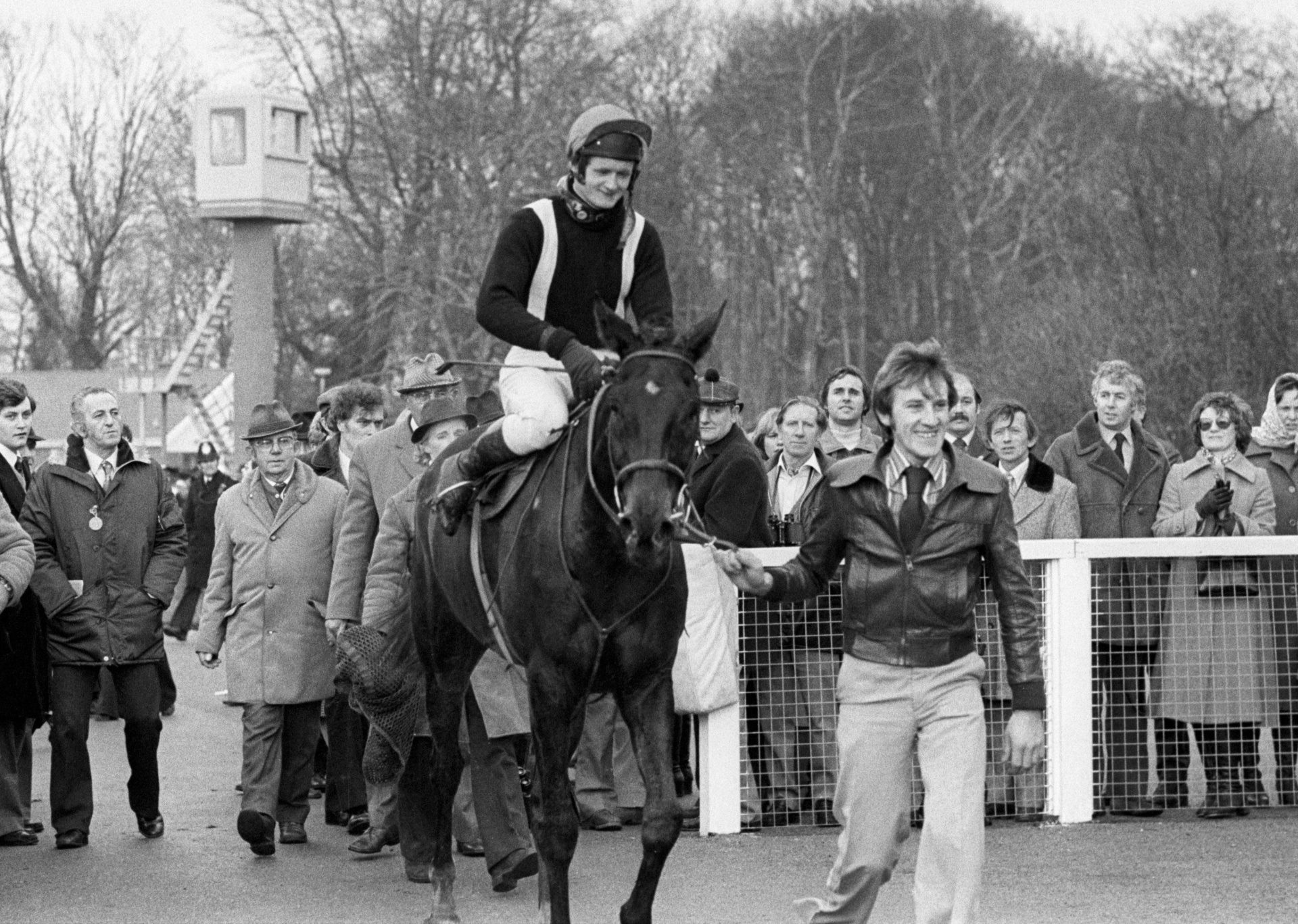
Silver Bucj and Tommy Carmody coming in after winning the King George. — PA Images - Alamy
Silver Buck was one of several great horses who helped establish the Dickinson stable as the dominant force in British jump racing at the beginning of the 1980s. Winner of two King George VI Chases and the 1982 Cheltenham Gold Cup, he remained a high-class chaser for six seasons and was still winning at the age of 12. His career also bridged the period between Tony Dickinson’s years as trainer and the remarkable rise of his son Michael, whose Harewood stable would soon assemble one of the strongest collections of chasers ever seen in Britain.
Foaled in Ireland in 1972, Silver Buck was by Silver Cloud out of the Aureole mare Choice Archlesse. He passed through Barney Curley’s hands in Ireland before being sold to Christine Feather, the mother of future Flat trainer William Haggas, and joining the Dickinsons in Yorkshire.
He began his racing career comparatively late and won four races over hurdles during the 1977-78 season, but his real ability became apparent after he was switched to fences. As a novice in 1978-79 he won five of his seven starts, including the Embassy Premier Chase Final at Haydock, where he defeated Night Nurse after a sustained contest. Night Nurse was already a dual Champion Hurdle winner and was developing into an outstanding chaser, so the performance immediately placed Silver Buck among the better young staying chasers in training. He ended the season by finishing third in the Sun Alliance Chase at Cheltenham.
His progress continued rapidly in 1979-80, when he went through the season unbeaten, winning six races as well as collecting a walkover. At Haydock he won the first of what would become four consecutive Edward Hanmer Memorial Chases.
At Kempton on Boxing Day he recorded his first major championship success in the King George VI Chase. Ridden by Tommy Carmody and still trained by Tony Dickinson, he beat Jack Of Trumps by a length and a half, with Border Incident well behind in third.
Kempton proved particularly well suited to Silver Buck. His fluent jumping and tactical speed were considerable assets around the flat three-mile course, although his effectiveness there also contributed to a developing view that Cheltenham might present a more difficult test.
He did not contest the 1980 Gold Cup, having not been entirely convincing in his preparation and with his connections ultimately deciding against running on the heavy ground.
Michael Dickinson took over the training licence from his father in 1980, and Silver Buck provided him with an early major success when retaining the King George that December. Night Nurse was still threatening when making a mistake three fences from home and later unseating at the last, but Silver Buck had again confirmed himself as one of the leading staying chasers in Britain.
His next attempt to establish himself at Cheltenham was less successful. Sent off favourite for the 1981 Gold Cup, he remained in contention until an untidy jump at the second-last and eventually finished third behind Little Owl and Night Nurse. The result strengthened the view that Silver Buck might be at his best over Kempton’s three miles and that the extra demands of the Gold Cup, particularly on testing ground, perhaps stretched his stamina.
That view was overturned twelve months later. Silver Buck’s preparation for the 1982 Gold Cup had been disrupted by a hind-foot injury during the winter, and at one stage his participation at Cheltenham was in doubt. He recovered in time to win a preparatory race at Market Rasen and went to the Festival at 8-1 in a field of 22, with Robert Earnshaw taking the ride.
Silver Buck and stablemate Bregawn emerged as the two principal contenders late in the race and drew clear of the remainder. Bregawn continued to challenge, but Silver Buck stayed on strongly to beat him by two lengths, with Sunset Cristo another 12 lengths away in third. At the age of ten, and under the conditions that had previously been thought least likely to suit him, Silver Buck had won the Cheltenham Gold Cup.
The performance established him as the leading chaser of the season. Timeform rated him 175, one pound ahead of Bregawn, and he was voted National Hunt Horse of the Year.
Silver Buck remained close to the top the following season. He won the Edward Hanmer Chase at Haydock for the fourth consecutive year, conceding weight to the emerging Burrough Hill Lad and beating the future Gold Cup winner by two and a half lengths. His attempt to win a third King George ended in defeat behind stablemate Wayward Lad and Fifty Dollars More. By the spring of 1983, however, the extraordinary depth of the Dickinson stable had become fully apparent.
Michael Dickinson sent five runners to the 1983 Cheltenham Gold Cup and produced the result with which his training career remains most closely associated. Bregawn won from Captain John and Wayward Lad, with the defending champion Silver Buck fourth and Ashley House fifth, giving Dickinson the first five home.
Silver Buck was no longer the best horse in the yard that afternoon, but his place in the result was significant. He had been one of the horses around whom the stable’s rise had been built and had already given Michael Dickinson his first Gold Cup and, shortly after taking over the licence, his first King George.
Silver Buck returned for one more season and remained remarkably effective. He ran eight times in 1983-84 and won five of them, including a handicap at Cheltenham under top weight. His final appearance came at Wetherby on Easter Monday in 1984. Now 12, he defeated three opponents in a handicap chase and ended his racing career with a victory.
His life ended later that year in a freak accident at home. Silver Buck was a nervous, highly strung horse away from the racecourse, despite the courage and consistency he had shown when racing. Graham Bradley was preparing to ride him to the gallops when waterproof clothing apparently frightened him. Silver Buck bolted across the yard and collided with a wall, suffering a severe pelvic injury from which he could not be saved.
The accident abruptly ended the life of a horse whose durability had been a distinguishing feature of his career. Silver Buck competed at a high level through an exceptionally strong period for British steeplechasing, first against horses such as Night Nurse and Little Owl and later alongside Wayward Lad, Bregawn and Badsworth Boy in the Dickinson stable.
His own record — two King Georges, four consecutive Edward Hanmer Chases and a Cheltenham Gold Cup — places him firmly among the outstanding staying chasers of his generation. His 1982 Gold Cup was particularly important because it answered the principal question that had followed him throughout his career, proving that a horse regarded by some as ideally suited to Kempton could also succeed over the more demanding championship test at Cheltenham.
By TP Editorial
Follow Thoroughbred People
Comments
Have your say. Please keep it civil and on the subject.
Loading comments…