
Ollie Smith
Cheltenham groundsman Ollie Smith talks about ten years working at the racecourse, the responsibilities and pressures of race day, memorable Festival moments, and the horses that have meant most to him.
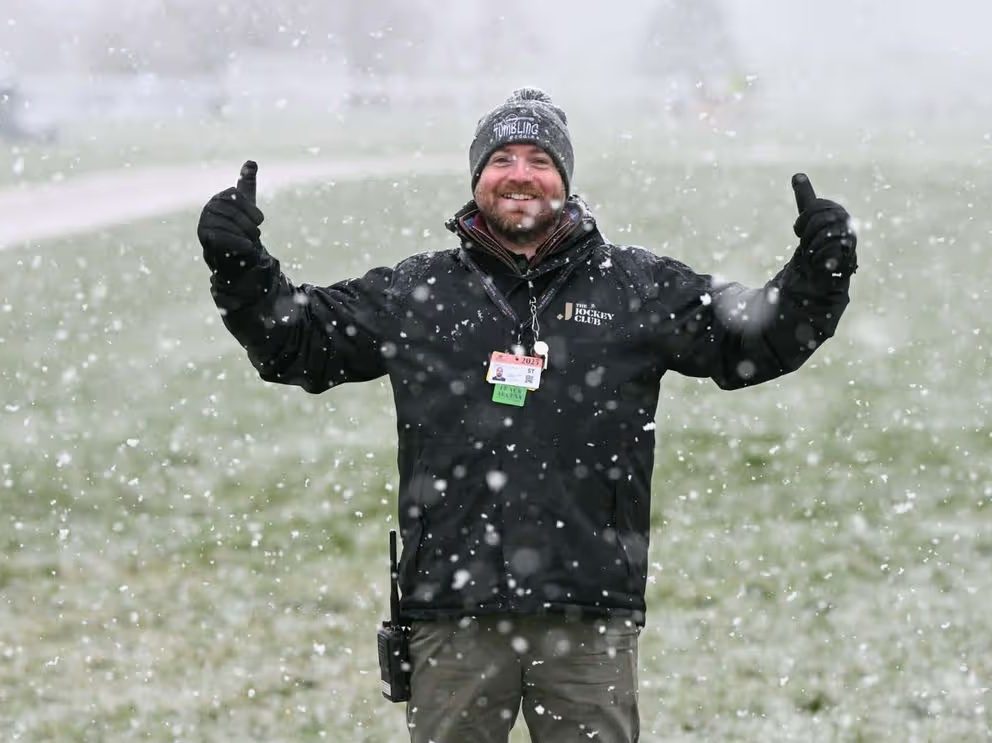
Ollie Smith at Cheltenham in the snow. — Francesca Altoft
What are your earliest memories of racing and horses, and how did you get involved professionally?
My earliest memory is a day out at Cheltenham with my dad when I was about six. I remember being up in the grandstands, meeting Jim McGrath, and having a great day out, and that's probably where I got the buzz. I also rode horses from about 4 to 14, but just as a hobby.
I left the Royal Air Force in 2016; in the summer, I saw a post on Twitter. It was an advertisement from Cheltenham Racecourse for race-day fence attendants. At the time, I knew the head groundsman and another lad on the ground staff team, so I made a few phone calls, and the rest is history, so to speak. I’m going into my 11th season now. It’s flown by, which is the scary thing, but it's been incredible to be a part of.
Tell me about starting work at Cheltenham
On my first day, I arrived early and was driven around the track. Then we went through fence bypass procedures, etc., all the important stuff. Lots of standard things have been in place for donkey’s years, but sometimes an incident at another racecourse would get highlighted at a team briefing. It’s always about being switched on and alert.
I was paired with a full-time member, Tommy, in my area. I worked alongside him for my first two seasons, then took over as lead and managed my area. My first day was learning on the job; things happened, and you had to react and decide what to do. I started on the Friday of the October meeting in 2016 and cracked on from there. I do all 16 race days every season.
It was either the October or November meeting that first season; I can’t quite remember, as it's 10 years ago now, but Ryan Hatch was riding for Nigel Twiston-Davies in a two-mile hurdle race. I was down at the first hurdle when he was unshipped from his horse; luckily, it wasn’t a bad fall. I was just amazed at how quickly it all happened. I had been racing all my life, and when you’re up in the stands or watching on TV, you don’t appreciate how quickly things happen. One minute they’re all jumping off; the next, a jockey is on the floor. It was a wake-up call of how quickly things happen.
Ollie with his Denman Tattoo — Mikal Ludlow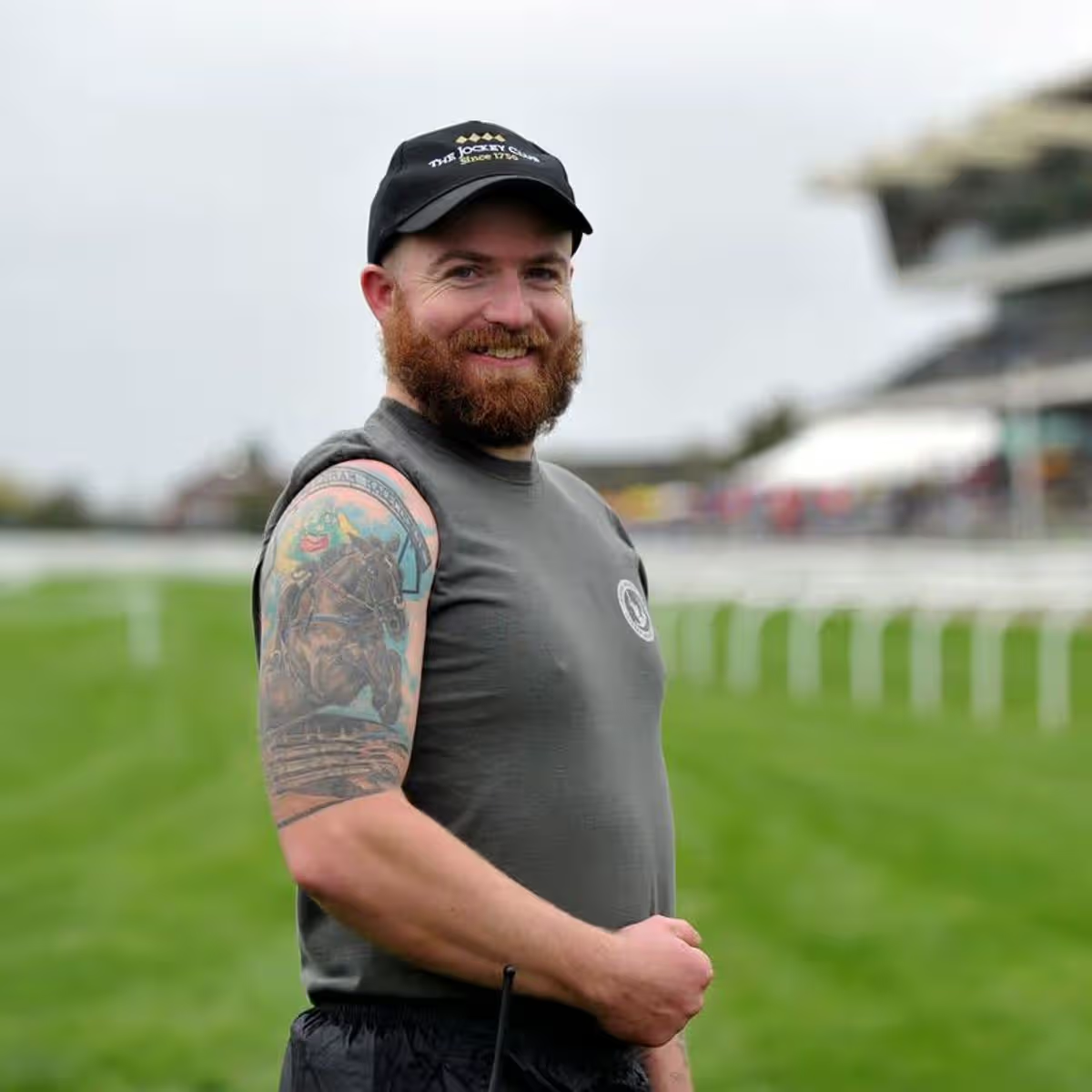
Has your role changed and developed over the years, and if so, how?
Currently I cover the two-mile start, what we call the shoot bend, so the 2m 4f and 2m 5f race starts. I have a buggy with a stretcher, screens, and everything I need. I cover a big area: on both the old and new course, I have two hurdles, three chase fences, and two cross-country fences. Most other fence attendants would just have one fence and one hurdle, so my level of responsibility has been high from day one. On race day, I’m on track early, check all my kit, and make sure I have all my flags and screens. Then I walk the ground in my area, especially between fences, so I know where to watch for patches, especially in a big 20-runner handicap, where one area might be more likely to get churned up. I like to cover every blade of grass so I know the ground condition, and I keep an eye on it throughout racing so I can flag anything as it comes up.
So I wouldn't say the role has changed too much because I've just been doing that one big area for 10 years. I get various people paired up with me throughout the season, but it's always on me to make sure everything is right. Obviously, we tweak and change as things crop up throughout the season, but the role itself hasn’t changed since I started.
Tell me about some high-pressure moments you have been involved with at Cheltenham Festival and how you dealt with them
I think it was a few festivals ago, but I remember Asterion Forlonge was in the Supreme, and he always jumped badly to his right. I was down at the first hurdle when the tapes went up, first race of the week, and once they have cleared the first, I have to make hay to get to the bottom of the hill at two out.
As they came down, Asterion wiped out Mark Walsh on Elixir D’Ainay, and that brought Rachel Blackmore down on Captain Guinness. I was left with one horse on the ground, Mark, who wasn’t completely conscious, and Rachel was also on the deck. So my first reaction was to pin the horse down because he was close to Mark, and the last thing I wanted was for him to jump up and trample all over Mark. I knelt on the horse's neck, and you learn how horses fall, and I knew he was likely to be winded, so as soon as his lungs filled back up, he’d be up, and then Mark’s in danger. At this point, the convoy arrives, and they’re putting the screens up, everything like that. I’m talking to Mark and Rachel; Rachel was ok but had the stuffing knocked out of her a bit, and I was reassuring Mark that the medical team was on their way. It all happens so quickly, and the vets and medical staff respond so efficiently; in a split second, they’re all there with me.
Those first reactions are all down to instinct and making sure I’m doing the right thing at the right time. Luckily, on that occasion, the horses and jockeys were all fine, and we pressed on with the rest of the day, but it goes to show how quickly things can happen, and how much pressure there is.
What gives you the biggest job satisfaction in your role at Cheltenham?
It’s tricky to pinpoint one thing, because ultimately we’re there for the welfare and safety of the horses and jockeys. I suppose when I have to react to a situation like the one mentioned earlier, and I know I made the right decision, and everyone is fine and can carry on with their day, that's the biggest relief.
I suppose being on the gallops before racing is one of the most satisfying parts of the job, being out there with all the superstars of the sport and legends of the game; to be honest, it's hard to call it a job.
But ultimately, if we leave the course after a day's racing, no matter what point in the season it is, if everyone's gone home in one piece, and we've had no major incidents, and all horses are fine, and all the jockeys are going back in their cars, then it's been a good day.
Which is your favourite day of the Cheltenham Festival?
Obviously Gold Cup day is special. When we’re in position, and they’re circling at the start just a few hundred meteres away from me, even talking about it now gives me tingles.
Regarding Tuesday, by the time that first day comes around, I’ve already been to a few preview nights; I’ve been out on the gallops Sunday, Monday and Tuesday morning. The gates open, the people start pouring in, and we all start getting edgy because everything has been building up to this first day of the festival. I’m so lucky to be down at the first hurdle when the tapes go up for the first race of the week. If the wind's blowing the right way, when you get that Cheltenham roar, it sweeps down the hill and comes straight through you, and it's absolutely incredible.
If you could change anything about the Cheltenham Festival, what would it be?
That’s a tricky one, because I’m on the course working, but if I step back from my role, I think there could be changes to benefit the average racegoer, fairer prices and things like that. The same debate comes up online every year, but the Festival is the pinnacle of our sport. Some people also think Cheltenham generates so much money from the Festival, but that money filters down to the smaller tracks throughout the season through The Jockey Club. I try to look at it from a neutral perspective, and I think Guy Lavender has made positive changes; he’s always been a good listener and receptive to feedback.
Tell me about some of your favourite horses you have met over the years
I’ve had some very special moments with a lot of horses, but a few stand out. Before I started working in racing, a horse I loved watching as a spectator was Champagne Fever. The first year I started to look at trends and really study racing form was leading into the 2013 festival, and I was calling it from Christmas that Champagne Fever was going to win the Supreme at the Festival, and I think I backed him at 16/1, and he ended up going off at about 5/1 on the day. He led from start to finish, and I was screaming the house down in the Best Mate enclosure. So when I got to meet him at his ROR parade and meet the grooms who looked after him, it was so special to have those intimate moments with the horse.
Ollie and Champagne Fever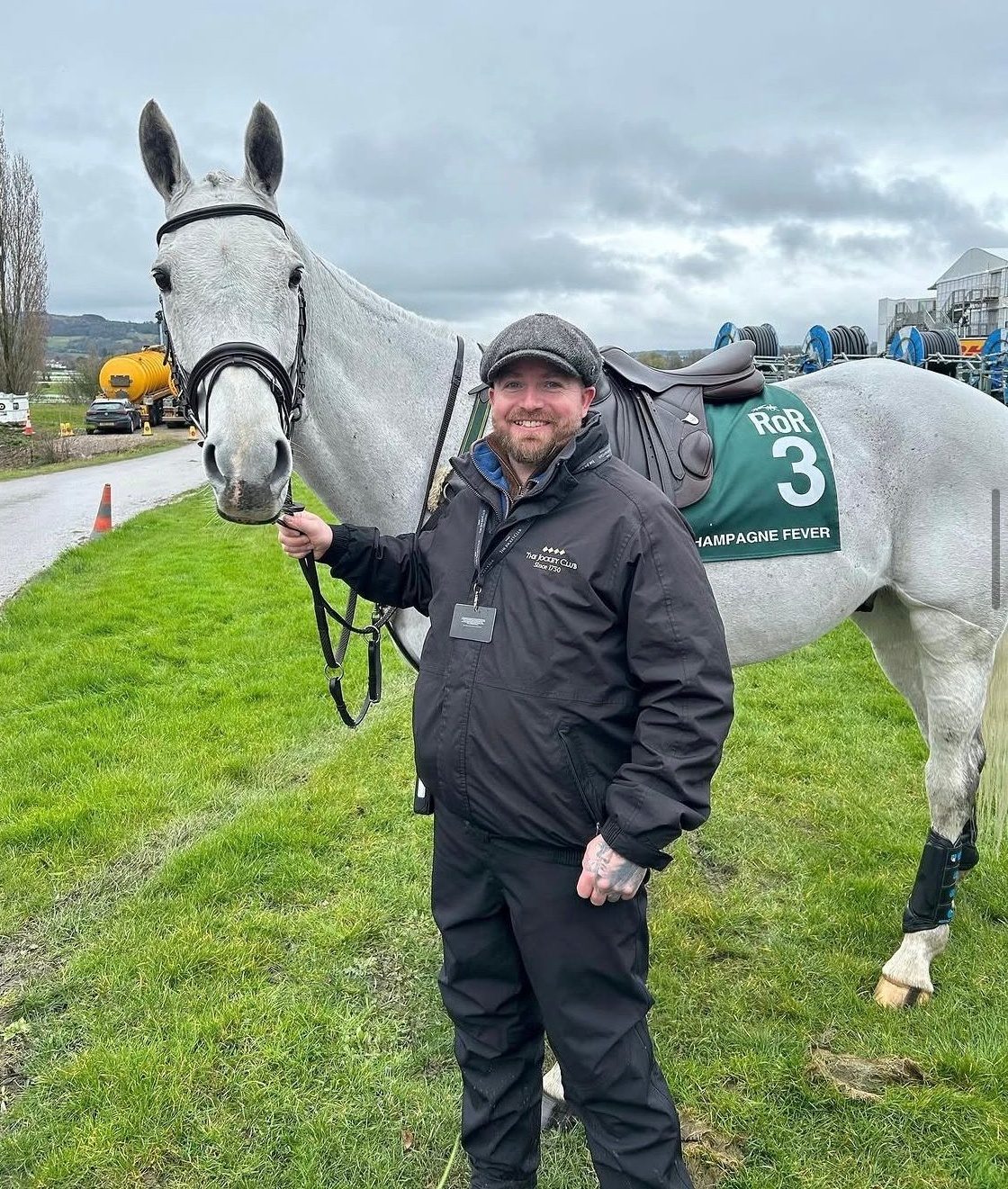
It’s hard to list them all because I’ve been lucky to meet so many legends, and for me, once racing actually starts, you’re in the zone, and you only have to blink, and those horses fly past you, so I try to take it all in on the gallops before racing starts. While I'm out on the gallops, that's my chance to get up close and personal with them and see them for the horses they are. You have to cherish those moments because horses are fragile, and you never know what might happen.
Everyone is so accommodating, letting me meet the horses and have those moments to stop for photos. I’m very grateful to the stable lads and lasses, as well as the photographers like my good friend Francesca Altoft.
Which horse are you most looking forward to seeing in March 2027?
It's hard to pick just one because they are all amazing, but I do love Gaelic Warrior. I watched him do that demolition job at Punchestown and thought, "This horse is improving all the time, so I know he’s the Gold Cup winner," so it’s an obvious choice, but it will be amazing to see if he can defend his title next year.
Lossimouth is another one; she’s stunning, and what she pulls out at Cheltenham is unbelievable.
A horse I’m excited to see next year because he didn’t perform this time round is Romeo Coolio. Jack Madden (Gordon Elliot’s travelling head lad) is a good mate of mine, and he adores Romeo. I’d love him to come back and do something good at Cheltenham. I know the Gordon Elliot camp are very sweet on him, and Jack’s an amazing lad who looks after the horse. He won an award at the Irish Thoroughbred Industry Awards, so I’d love to see Romeo Coolio fulfil his potential at the Festival next year.
Ollie Smith, Romeo Coolio & Jack Madden — Francesca Altoft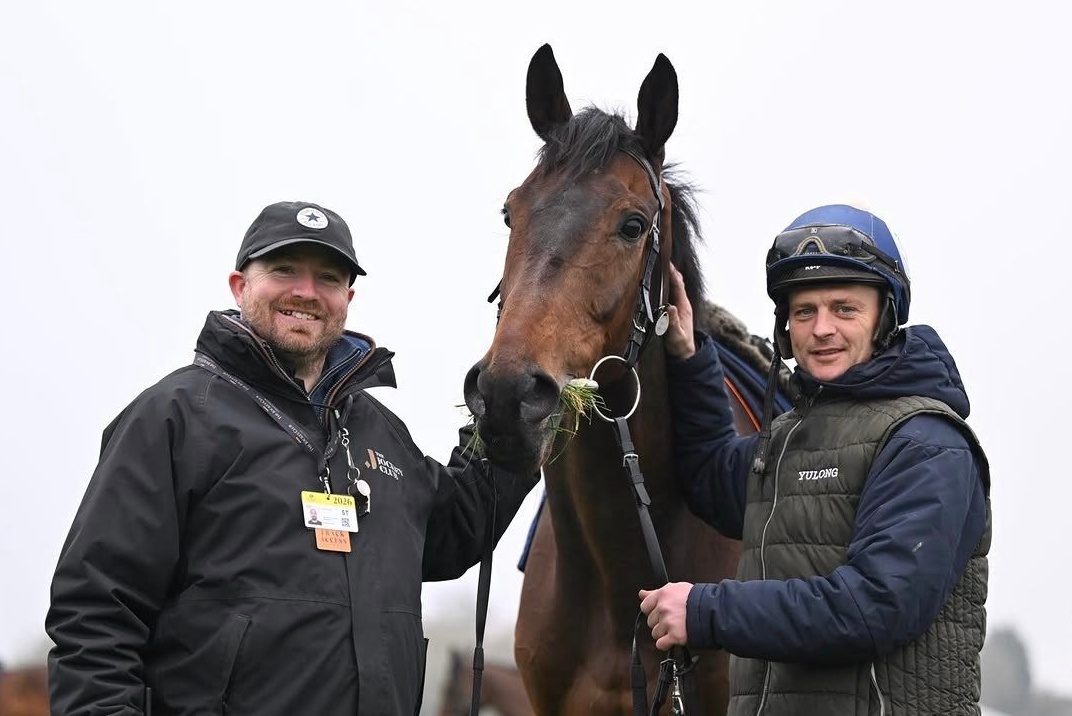
Yes. I saw Stratford was advertising for staff, so I contacted their Clerk at the time and then got put in touch with Sam Linley, who’s the head groundsman. A quick phone call and the rest was history.
I’m in my fourth season at Stratford; the ground staff team is small, so I go there early doors to help move side rails or finish watering, whatever needs doing. That way, I get a fuller day and more experience on the ground staff side. It’s a really good team, and I love working there. However, I did get knocked out by a horse once at the final fence; a horse crashed through the wings and wiped me out. I was a very lucky boy that day, but apart from that near-death experience, it's been an amazing four seasons so far!
Cheltenham is very pressurised; regardless of the meeting, all eyes are always on Cheltenham. Stratford feels different; generally speaking, it's a different calibre of horse in the summer, but I’m on the last fence and hurdle, right in front of the crowd, and that crowd is much closer, and it's a smaller track, so it has its own challenges.
You recently shared you have signed up to work at Aintree Racecourse; tell me about why you would love to work there
So we have a few guys that come down from Aintree to help at Cheltenham during Festival week, and then we have a few guys that go up to Aintree for the Grand National meeting too. I’ve always wanted to work at Aintree, but I’ve never got round to sorting it out, so I thought this was the year, and I made a few calls and made it happen. Aintree is a special place, and I’m excited for those big fences and a different challenge.
The Grand National meeting ties in with my birthday, so I’ve always felt connected to the course. I’m so excited to be part of it this time on the ground.
Favourite racing commentator and why
Richard Hoyles; he commented on the Cheltenham Gold Cup when Denman won. That commentary, along with the race itself, has stuck with me. I think he’s a lovely guy, and he really brings a connection to his commentary. You really feel his emotion, and he is so knowledgeable too.
Favourite racing presenter and why
I liked the Channel Four days. Tanya Stevenson and John McCririck was the era when I would religiously watch racing when I wasn’t able to go. I thought they were an amazing bunch, and Alistair Down was just class. I’m not as keen on the new ITV broadcasting, but I do love Ruby’s analysis; he gives real insight into what's happening, the tactics and everything. He has the most amazing racing brain.
I’d like to mention Josh Stacey; he’s very talented. I’m part of Christian Williams’ racing club, and Josh came down last year to the owners' day. He didn’t need any notes; he had deep knowledge of the horses. It all comes from his own mind, and you can see his passion.
Ash Symonds is another young talent. I got to know him well when out on the gallops, and he’s doing some great work these days. These boys are the next generation, and they have a great online presence, too, inspiring their fans to get into racing.
Favourite jockey that has hung up their boots and why
That’s a tough one; we have been blessed with so many. You have to give AP a lot of credit for what he did over the years. But if I really had to pick one, it would be Ruby Walsh. Those big days, Ruby Tuesdays at the Festival; he’s such a special jockey in those moments, and a tactical genius.
Favourite up-and-coming jockey to watch and why
I’ve got to know a lot of the jockeys over the years, and we have a good mutual respect. They’ve all been amazing to me over the years, but Harry Cobden is a top lad; he has that superstar status, but he’s really lovely in person. He’s given me some amazing racing memories.
Johnny Burke also deserves a special mention. Johnny has been there for me in the darkest of times, giving me amazing days out when it mattered most. I have a share in a horse called John Barbour, and both the horse and jockey have really kept me going.
I appreciate everything the jockeys do because they put their bodies on the line, not just when they're on the horse, but in day-to-day life; it's such dedication.
I spend a lot of time at Fergal O’Brien’s yard, and he’s got some amazing young jockeys coming through. Jack Hogan, Tom Broughton, Liam Harrison, Fern O’Brien they’re all worth keeping an eye on.
There’s plenty of good female jockeys coming through too; Isabel Ryder would be one of my favourites at the moment. It's great it's getting so competitive, and we need these jockeys to keep coming through.
Finally, what concerns you about the sport today and what can we do to improve the racing product and experience?
First, I think there’s a lot of great stuff going on right now; we’ve just had National Racehorse Week in the UK, where they open the doors to the public at many yards across the country. I think it's a great initiative because, before I started working at Cheltenham, it often looked a bit closed-door, but that's only from the outside; once you get a look in, it's not closed at all.
One thing I’ve seen at Fergal’s yard is an initiative started by his partner and assistant, Sally Randell, who recently opened a youth club to get kids involved in racing and learn about the horses. They do a few of these throughout the season, and it's been really well supported so far. I would love to see more of this in our sport.
Lots of yards are doing great things to get more people involved, show the inside of racing, and welcome people into the industry. It’s important that people are involved in racing year round, not just in March and April; they need to see firsthand the care that goes into the horses every day from all the staff on the ground. It’s also so important to tell these stories of the people caring for the horses and show what goes on behind the scenes on TV. I don’t care about people’s outfits or the latest TikToker; let’s talk about the horses. There are so many stories to tell, and that's how we inspire people to get involved and become fans.
The thing about jumps racing is a horse can come on the scene, and you get to follow them until they’re 12 or so, and the horse doesn’t have to be a world beater for you to still fall in love with following its story. People visiting yards can meet the horses, fall in love and then follow that horse for its whole career, its such a special part of it all.
There are obviously issues with the race program at the moment; it's very diluted, and at times it feels like there is too much racing. Two- and three-runner fields aren’t good for racing in my opinion.
Also, I would like to see British and Irish racing work together more; for example, this season we have Festival Trials Day and Dublin Racing Festival on the same weekend, which splits the horses, the jockeys, and the viewers. That doesn’t make much sense to me!
By Sophie DaviesThoroughbred People Contributor
Follow Thoroughbred People
Comments
Have your say. Please keep it civil and on the subject.
Loading comments…