Fifty Years of the Arc: From Alleged to Daryz
Daryz joins an elite group of dual Arc winners after becoming the first male horse since Alleged to win the Prix de l’Arc de Triomphe in successive years.
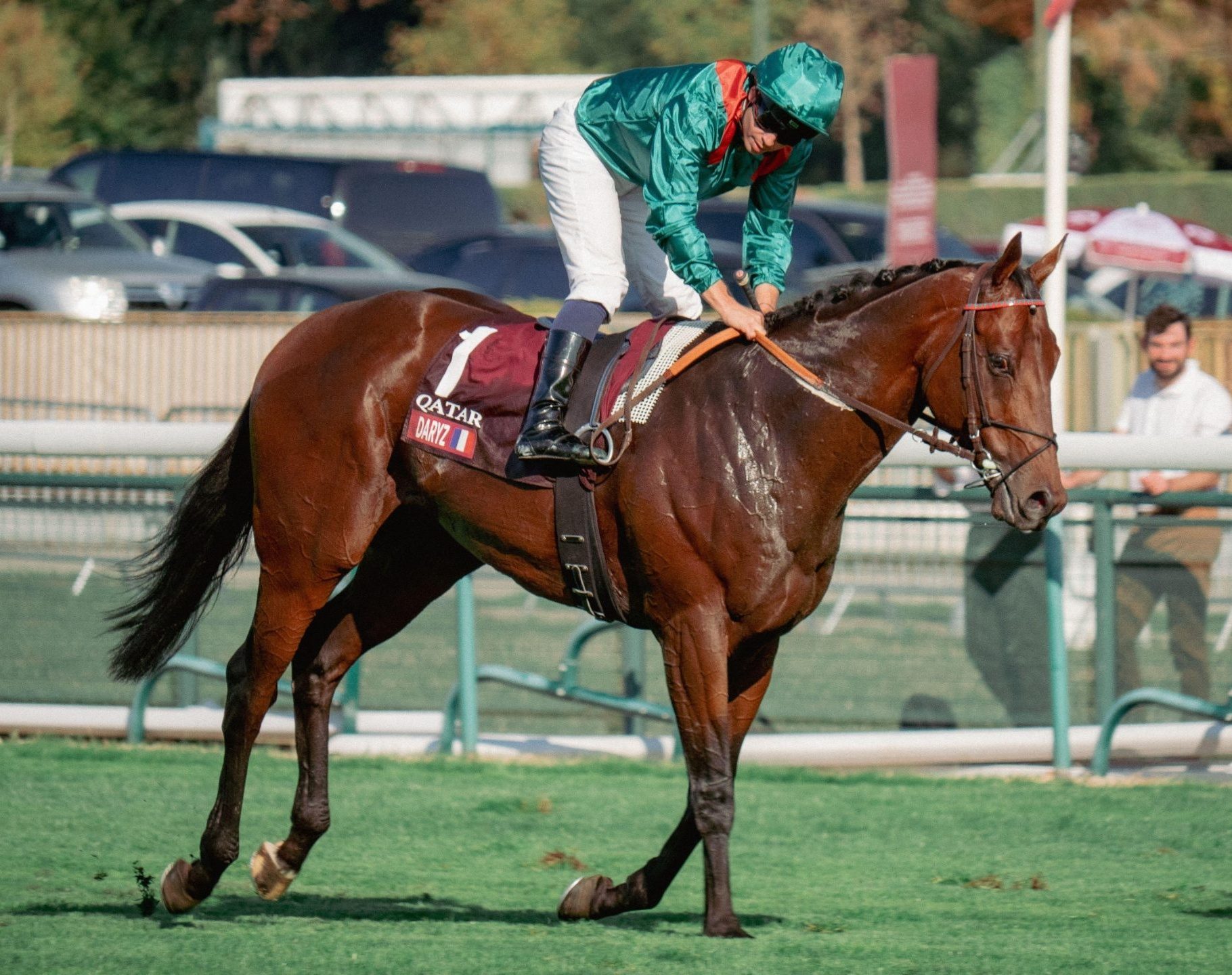
Martin Gleizes - Alamy
Daryz produced a performance worthy of the occasion at Longchamp on Sunday, becoming the first male horse for almost half a century to win the Prix de l’Arc de Triomphe in successive years.
Held up towards the rear by Mickaël Barzalona, the Francis-Henri Graffard-trained four-year-old still had plenty to do when Bay City Roller went clear in the straight. Once switched outside, however, Daryz accelerated past Diamond Necklace before running down Bay City Roller and going on to win by a length and a quarter.
It was a very different victory from last year, when Daryz defeated Minnie Hauk by only a head. This time he returned as the 13-8 favourite and, despite a race that did not develop ideally for him, won with considerably more authority.
The achievement places him in particularly rare company.
Only nine horses have now won the Arc twice in more than a century of the race. Over the past 50 years there have been just four: Alleged, Trêve, Enable and now Daryz. All four won their two Arcs in consecutive seasons.
Indeed, winning the race twice with a gap between victories is rarer still. Motrico, successful in 1930 and again in 1932, remains the only horse to have done it.
That statistic says much about the demands of the Arc. Many winners are retired immediately, particularly three-year-old colts with substantial stallion value. Those who return have often discovered that reproducing an Arc-winning performance 12 months later is considerably more difficult than it sounds.
Alleged and the last male horse to do it
Before Daryz, the last male horse to win successive Arcs was Alleged, trained by Vincent O’Brien and ridden by Lester Piggott in 1977 and 1978.
Alleged was lightly raced but exceptionally effective at a mile and a half. His two victories came during a period in which the Arc regularly attracted champions from across Europe, and his repeat success became increasingly exceptional as the commercial value of successful three-year-old colts encouraged earlier retirement.
A number of subsequent Arc winners returned in an attempt to defend their titles. Carnegie and Helissio both finished sixth, Montjeu fourth, while Bago, Hurricane Run and Torquator Tasso managed third. None could repeat their victory.
Daryz has now succeeded where all of them failed.
Dancing Brave and one of the great Arcs
Few editions of the past half-century are remembered more clearly than Dancing Brave’s victory in 1986.
Guy Harwood’s colt faced an exceptional field containing Derby winner Shahrastani, Prix du Jockey Club winner Bering, Acatenango, Triptych and Shardari. Pat Eddery held Dancing Brave up before bringing him widest of all in the straight.
The acceleration that followed has become one of the defining images of modern Flat racing. Dancing Brave swept past a field of accomplished Group 1 horses to beat Bering by a length and a half.
His Arc remains one of the benchmarks against which great middle-distance performances are judged.
There had already been another exceptional international achievement three years earlier.
All Along, winner in 1983, followed her Arc success by travelling to North America and winning the Rothmans International, Turf Classic and Washington, D.C. International. The four victories, beginning with the Arc, came within the space of just 41 days.
She subsequently became the first foreign-based horse to be voted American Horse of the Year.
Sagace and the Arc double that disappeared
Perhaps the nearest the race came to another male back-to-back winner before Daryz was Sagace.
He won the Arc in 1984 and passed the post first again the following year, only to lose the race in the stewards’ room.
Sagace had interfered with Rainbow Quest in the closing stages and was demoted to second, leaving Rainbow Quest as the official 1985 winner.
On the racecourse, therefore, Sagace came within an inquiry of joining the small group of dual winners.
Peintre Célèbre and the Fabre era
André Fabre’s influence on the Arc has been extraordinary. His eight victories remain the training record, beginning with Trempolino in 1987 and continuing through Subotica, Carnegie, Peintre Célèbre, Sagamix, Hurricane Run, Rail Link and Waldgeist.
Perhaps the most brilliant was Peintre Célèbre in 1997.
The three-year-old swept clear by five lengths and recorded 2min 24.6sec, then a race record. His combination of speed and authority made him one of the outstanding Arc winners of the modern era.
Two years later Montjeu won on very soft ground before returning the following season and finishing fourth. His influence ultimately extended far beyond his own Arc victory through a highly successful stallion career.
Sinndar and Sea The Stars
The beginning of the new century produced two Irish-trained winners whose three-year-old campaigns remain particularly distinguished.
Sinndar won in 2000 after taking both the Derby and Irish Derby, becoming the first horse to complete that treble.
Nine years later came Sea The Stars.
John Oxx’s colt arrived at Longchamp having already won the 2,000 Guineas, Derby, Eclipse, International and Irish Champion Stakes. He encountered traffic in the Arc but, once Mick Kinane found room, his acceleration settled the race quickly.
The Arc was his sixth consecutive Group 1 victory in an extraordinary three-year-old season.
There is now an additional connection between that performance and the latest chapter in the race’s history: Sea The Stars is the sire of Daryz.
Zarkava, Treve and Enable
Fillies and mares have played a particularly important role in the modern history of the Arc.
Zarkava arrived unbeaten in 2008 after winning the Poule d’Essai des Pouliches, Prix de Diane and Prix Vermeille. She maintained that record at Longchamp and retired unbeaten after seven starts.
Then came Treve.
Criquette Head’s filly won impressively as a three-year-old in 2013, beating Orfevre by five lengths. Her four-year-old season had been less straightforward, but she returned to Longchamp in 2014 and won again.
A year later she attempted something no horse has ever achieved: a third Arc victory. She finished fourth behind Golden Horn.
Enable came even closer.
She won at Chantilly in 2017 while Longchamp was being redeveloped, then successfully defended her title back at Longchamp in 2018, holding Sea Of Class by a short neck.
Her attempt at a third victory in 2019 produced one of the most anticipated Arcs of recent times. Enable took the lead in the straight but was caught late by Waldgeist and finished second.
She returned once more in 2020, when conditions were very different and she finished sixth behind Sottsass.
Trêve and Enable demonstrated just how difficult even a third attempt can be after two consecutive victories.
The modern Arc
The past decade has continued to produce a varied group of winners.
Golden Horn added the Arc to his Derby and Eclipse victories in 2015. Found led home an extraordinary Aidan O’Brien-trained one-two-three at Chantilly in 2016, ahead of Highland Reel and Order Of St George.
Waldgeist produced the performance of his career to deny Enable in 2019, while Germany supplied the 2021 winner Torquator Tasso, one of the biggest-priced winners in the history of the race.
Alpinista completed an outstanding sequence of Group 1 victories when winning in 2022. Ace Impact remained unbeaten when taking the 2023 Arc with a powerful late run, while Bluestocking gave Juddmonte another victory in 2024.
Then came Daryz.
His first Arc in 2025 was decided by a head against Minnie Hauk. His second was more emphatic, his turn of foot allowing him to overcome both a steady pace and a position well behind the leaders.
The victory also gave the Aga Khan family a ninth Arc, extending a remarkable record accumulated across several generations. Daryz himself was bred by the late Aga Khan, by Sea The Stars out of the Group 1-winning mare Daryakana.
Sunday may also prove to have been his final race. Princess Zahra Aga Khan indicated afterwards that, from a breeder’s perspective, she would prefer to see him retire safely to stud rather than return at five, although the final decision was still to be discussed.
If that proves to be the case, Daryz will leave racing having achieved something no male horse had managed since Alleged 48 years earlier.
Over the past half-century the Arc has been won by Derby winners, unbeaten champions, exceptional fillies and mares, future influential stallions and occasional outsiders. Yet even among that company, winning it twice remains exceptional.
Daryz now belongs to that very short list.
By TP Editorial
Follow Thoroughbred People
Comments
Have your say. Please keep it civil and on the subject.
Loading comments…